Blog Archives
Breaking the Rules, Writing in the Margins

UPDATE: We didn’t tell you that this is by the one and only Dave Chalker, Editor-in-chief of Critical Hits.
One of the things that stuck with me after attending a talk by game designer Monte Cook was his opinion on character sheets. He wasn’t talking about layout, or amount of stats or any of that: he was talking about the margins.
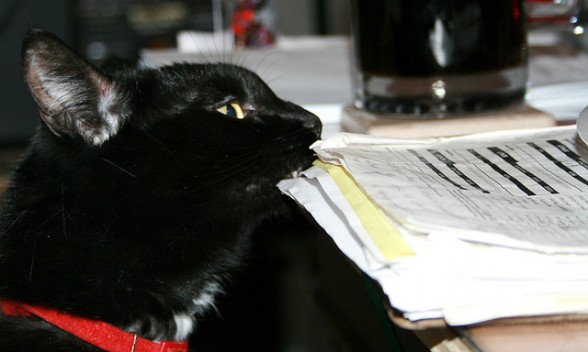
Totally stolen image from Dave's girlfriend, E.
More so in older editions of D&D, the margins of the character sheet were used to mark aspects of your character that didn’t conveniently fit into the rules. Cursed to never be able to find true happiness, cool scar running along the PC’s arm, pursued by a scorned lover, paralyzing fear of water.
There are so many great tools in modern RPGs that it can be easy to lose all the non-rules parts of characters, especially for DMs. When there are rules for every character flaw or lasting scar, it can be tough to break out of the mold. Here are three quick tips to try and bring some of that back.
Give PCs Unexplainable Powers
When your story fits with it, you can tell a PC that he has the power to do something- he just has to tell the DM. Don’t write out the rules. Instead, have that player jot down a note in the margin like “Can invoke the power of Unnamed God” or “Overcharge a spell.” You can make some notes on what that means to you, but don’t share the exact effects. When they do that, you can describe the additional effect based on the situation they’re using it.
By keeping the exact benefits changing, you can preserve the mystery for longer. Or, use it as a springboard to develop into a full-fledged power that the PC gets to keep.
Tie-in Strange Circumstances
When giving out rewards to the PCs, whether it be treasure or something more intangible, consider tying it to something strange. Maybe the sword that they discovered has an unusual smell. Maybe the new spell discovered has an added descriptor of “might cause madness.” Perhaps when spending the treasure, the character finds that it refuses to be spent on certain things by sending impulses to the character.
The trick here is to make it not entirely “your character has found something that he worked hard to get, and is now hosed.” These rewards should have some extra benefits to go along with the quirks, otherwise, the players probably won’t bother. Also it’s good to keep the effects from being strictly mechanical drawbacks.
Record History
When the heroes have become well-liked in a region, have them write it down somewhere on their sheet. When the party encounters a hag and it curses one of the PCs, have that PC write the curse down. When the character almost drowns in an encounter, have them write it down.
By putting it on the character sheet as a defining moment, it’s more likely to be remembered and referenced. Let the characters drive this- if they are trying to strike a bargain in another city, they can say “well, we’re well-liked in this city…” and you can have the character recognize them from this exploit: “Hey, my brother in law is from there!” Same with the more negative examples. If a player sighs and says (even jokingly) “oh, the hag’s curse is finally going into effect,” bring that into the game. Then later, that can be turned around if the player decides to deal with the curse, and emerges from the experience all the better.
By busting out of the rules that are provided, no matter the system, you can add extra flavor in a way that can only be done at your table, and not by a ruleset. Try it and see, and let me know if you’ve done anything similar.
Trash Bin FTW


We’re experimenting with a “trash bin” for your wiki pages (and soon, characters & items). This safety net will allow you to delete something, then bring it back later if you wish.
It’s not perfect, as certain aspects cannot be restored (like tags), so don’t go throwing things away without a little thought. However, you no longer need to fear that one of your players will spend an afternoon maliciously deleting your entire wiki.
The next logical step is to provide versioning history for your pages. That’s definitely on our TODO list, but I’m not sure when we’ll get to it.

API Update: mage-hand, a Ruby wrapper for the API, plus an offer for developers
 Progress on the API is moving so much faster than I originally anticipated. I’ve been working on it night and day, trying to get to a point where clients can actually do something useful with it. But, I’m not the only one who’s been busy!
mage-hand, Rubygem for the API
Ruby hacker shammond42 (@shammond42 on Twitter) has already created a Rubygem wrapper for the API, making it much simpler to interface with from your Ruby or Rails application. For any other Ruby hackers out there, take a look at mage-hand and make sure to follow it on github. Or, if you’re not a Ruby hacker but prefer PHP, .NET, or something else, you might like the next part:
Looking for API beta partners
Progress on the API has been much faster than I expected. After a week’s worth of work, we have a fully functioning OAuth provider and a few JSON response API methods ready to go. Before we go too far, though, I’d like to get some feedback on the basic OAuth workflow.
OAuth is a standard workflow for managing third-party applications that want to access resources on behalf of a user. Facebook, Twitter, LinkedIn, Netflix, and a whole slew of other websites have started using OAuth for exactly what we’re trying to do here on Obsidian Portal. Considering that there is a lot of library support (PHP, Ruby, Flash, .NET, etc) for OAuth, it seems like a good way to go.
Unfortunately, OAuth is significantly more complicated than other, simpler authentication methods. It requires a special procedure to authenticate the user, plus each API request must be signed with a special algorithm. What we’d like is some initial feedback on whether it’s accessible enough and works for the developer community.
If you’re interested in taking the totally unstable, soon-to-change alpha version of the API out for a spin, check out the overview page, then create an application. Giv the OAuth signup workflow a shot, and let me know what you think in the forum thread.
So what’s in it for you? Well, I’m giving priority to feature requests from people actively playing with the API. If there’s something you want to do, and data you need, then start playing around and tell me what’s missing. If I can add it easily, I will. Of course, everything is likely to change a bit in the coming weeks, but we have to start somewhere.
The Items tab – Keep an eye on it

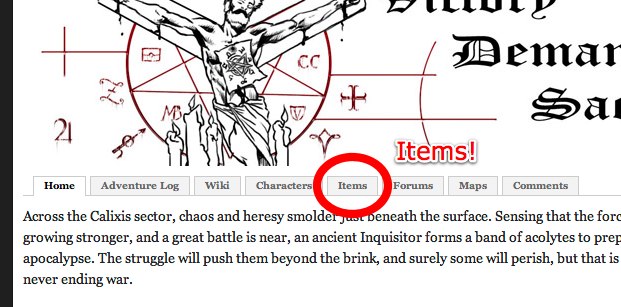 As many of you have no doubt noticed, we have introduced an Items tab on each campaign. This has been a long requested item, and I thought I’d explain why it’s taken so long, and where it’s going.
When I originally architected Obsidian Portal, I imagined that people would be storing and sharing characters, items, spells, locations, and all kinds of RPG-related data. I tried to create the ultimate generic data model that would hold all these things, and characters and items were the first implementations of that.
After using it for a while, I’ve come to realize that characters and items are fundamentally different in how they are used and even if they are used. For example, characters are a core component of every RPG. Items are a component of some, but not others. There are many systems that specifically try to avoid the “We loot the bodies” mentality that pervades D&D. Having played some of these games now, I can see why an Items list isn’t exactly necessary, like a characters tab is.
On the flip side, for games where looting is a central aspect, a raw list of items isn’t much help. Instead, you need something more like a spreadsheet, where you can easily track the items along with their quantity, perhaps the assessed value, plus a bag for currency. In many ways, it needs to resemble a computer RPG inventory screen much more than a raw list of items.
Unfortunately, we don’t have the time right now to give the Items tab the attention it needs, so we have to put it out as-is. We wanted to modify the top navigation to remove the Items and Characters links (which are pretty useless now that we have search), and that would have pretty much orphaned Items forever. So, that’s where we are today.
But! We’ve got plans for the Items tab to make it closer to what it needs to be. As I said, imagine an inventory screen or basic spreadsheet and you’ve got a pretty good idea. We’re not sure when we’ll get a chance to work on it, but it’s on our list.
Search Reloaded

Ryan made some awesome updates to search over the past couple weeks, and they finally went out last night. I thought I’d give a quick rundown, although the best thing to do is try it out for yourself.

More context
The formatting for the results is much nicer now, with more text for the wiki pages and adventure log posts. Before, a search hit just showed the name of the page and a link to it. As a bonus, the contextual text displayed is text where the search term was found.
Keyword highlighting
The search term you are looking for is automatically highlighted where found. This makes it much easier to quickly scan through the results.
Type filtering
By default, a search will return all kinds of results: characters, wiki pages, adventure log posts, and more. But, if you know exactly where you want to look, you can filter to restrict it to only the type of data you are looking for.
Go Ascendant for campaign-specific search
Remember, if you’re Ascendant, all your campaigns will have campaign-specific search enabled. This is much handier than using the sitewide search, since you can restrict the search to only your campaign’s content. It’s extremely handy, trust me! If you want to enable this awesome feature, tell your GM to Ascend Today!