


Contest Results for the Stats & Art Contest: The Giraffelich!
So we announced our 6 winners on our Newsletter. By the way, do you get the Obsidian Portal Monthly Newsletter? To get it, edit your Obsidian Portal Profile, check Receive e-mail updates, and click Update! Anyway, we announced the winners, now we’ll show you the winning entries!
Stats:
First Place: Matthew Rinehart’s giraffelich.
Second Place: Geoff Nunn’s giraffelich.
Third Place: Owen K.C. Stephens’ giraffelich.
Art:
First Place: Justin Swadlo

Second Place: Bryan Cohen
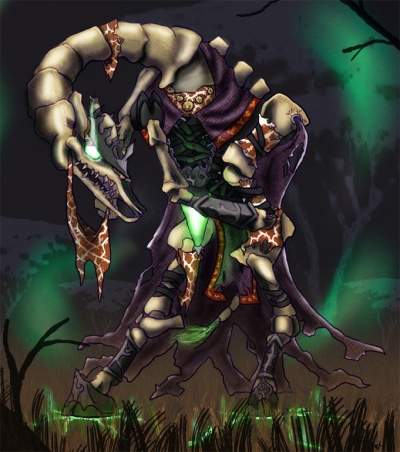
Third Place: Nicole Jekich
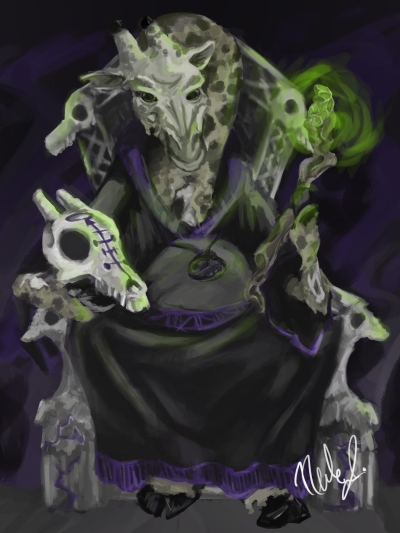
Congrats to all the winners! If you won, e-mail our Content Director (dan (at) obsidianportal (dot) com) to get your $25 Amazon Gift Certificate.
Free System Friday, 2/12/2010
It’s Free System Friday! Tired of your current RPG system? Try a new one for free! Today’s setting comes to us from designer Will Hopkins and it’s called City of Rain, City of Darkness.
Imagine a city where it never stops raining, airships rule the skies, and desperate citizens fight for survival. The wealthy build higher and higher into the sky, seeking to escape the damp while they leave to the darkness the laborers on which industry thrives. Technology and industry march on through the shadows and the downpour, and every citizen must make a living somehow. Welcome to City of Rain, City of Darkness…
Grab some friends, grab the setting notes, grab some rules, and make a new campaign today!
Guest Blogger Article, 2/10/2010
Cartography 101: Tips for making your game maps accurate and attractive.
by Johnn Four
This week’s article is all about maps! And it comes to us once again from that master of RPG advice, Johnn Four. In this first part in a three part installment, Johnn talks about Lines.
Maps Have Three Parts – Part 1: Lines
When mapping, I tend to just focus on the corridors, rooms, streets, caverns, and buildings. However, every map has more than just these areas; each has three zones in your design control. Next map you build, think of these zones and how you can change things up to be fun and interesting for your gaming.
Zone 1: The Lines
Most of the time, the lines represent walls and boundaries, and these things have shapes and textures. Lines are often hastily sketched on battlemaps and player maps, and then overlooked during descriptions. GMs draft their lines without much thought for mapping in-game.
Beef Up Description
When drawling map lines in dungeons and civilized areas, take a moment to think about what the lines represent, what the PCs would see and touch. Make notes about this directly on maps, with arrows, for easy reference. Use these notes to feed your descriptions of these areas.
Players groove off extra details like these to become immersed, and the little bit of time taken for this counteracts some of the hyper-efficiency of some game systems where it seems like you just get whisked from one battle to the next without much breathing room – without much living.
Use Evocative Materials
Notice how it gets boring telling the players the same descriptions over and over? “You are in a 10’x10′ inn room. It has the usual furnishings.”
Don’t give up. Instead, get creative. Fantasy offers so many options, thanks to strange materials, magic, slavery, potentially infinite project lives, divinity, and esoteric knowledge. Get yourself out of modern, scarcity-based thinking. Think big. Think wild.
* Gems
* Precious metals
* Magically hardened wood
* Strangely transparent – wood, stone, metal
* Alive
* Evil, demonic, or cursed
* Liquid
* Gaseous
Check out this rock and mineral directory [http://www.enchantedlearning.com/geology/rocks/glossary/] for more ideas. Bend anything from this web page to your imagination.
Faster Mapping
Cavern maps in modules are a pet peeve of mine. So is sloppy battle-mapping. Both involve such sins as partial squares, lines you can’t possibly recreate on player maps, and useless spaces.
Avoid Partial Spaces
If your game system has rules for partial battlemap squares, then this is not an issue. For my game of choice, though, you are screwed. What is the movement cost of half a square? Third? Eighth? Can a PC fit into such spaces? Can a large creature use those spaces?
If your game system rules only support full squares, then just map with full squares. Otherwise, it’s confusing and problematic.
Some designs might require partial squares. Ok. I support this. If you want to create rooms with interesting shapes, or decide builders would have used the shortest, straightest paths for connector spaces, ok.
Be prepared for interaction in these spaces though. Whip up some house rules, perhaps, or talk over general guidelines with players. One player thinking those spaces are just for show, while another uses them for advantage, creates group friction.
Take your average cavern map, for example. A tiny creature can fit into almost all the folds and creases, as can various rewards and other game elements. Just not the PCs. Unless they reach in. Are they allowed? I’ve played and GM’d games where it’s assumed those spaces were of no consequence.
Make Mapping Easier
Draw lines that are quick and easy to reproduce during sessions for players or by players, for battlemaps or progress maps.
For example, cavern maps are killers to reproduce. So, what ends up happening is the player map or the battlemap just gets rounded off. Fancy, curly walls and passages become straight or jagged lines. Who has the time and patience to turn an 8.5″ x 11″ map into a huge map for minis by hand during a session?
If the players aren’t going to see the benefit of complex lines and maps, then do yourself a favour and make your lines simple to recreate during sessions.
Same goes with weird shapes and complex areas on maps. Anything you can do to make in-game mapping faster and easier on you, the better. Keep maps simple, make descriptions and encounters rich.
What Goes On The Lines?
The lines themselves aren’t empty. They have strange inhabitants often overlooked during design. These inhabitants get quickly added on or neglected.
Entrances and Exits
Entrances and exits sometimes have strategic value. They restrict movement or enhance it. Do you want a villain to escape easily? It would be a shame that an ill-placed portal traps an important NPC. Remember: Dead ends eliminate choices and stop progress. Plan exits with pacing and exploration in mind.
Notice how the area around a door needs to be kept clear? This can carve up your game space in undesirable ways. For example, placing a door in a narrow, end part of a room makes that area unsuitable for furnishings and interactive bits. Or, placing a door in the middle of a line might split a space into two, limiting other design and encounter decisions.
Strategic exit and entrance placement helps guide trap and hazard placement. For example, a defile determines movement, and traps can be more precise with better triggering success. Traps in high traffic areas are hazards to the locals, though, so consider hidden entrances for them to use, or use traps that have better precision. A pit in front of the kitchen door means all the orcs go hungry.
Doorknobs
Be prepared for the doorknob question. This trips me up often. Can the entrance be locked? If so, how? From what direction? Check out this sequence of DMing mishap:
DM: You come before a door. It has glowing runes on it.
Group: What is the door made out of?
DM: Wood with bands of metal for reinforcement.
Group: How does the door open? Can it be locked?
DM: The door has hinges, and there is no keyhole. It’s probably barred. [Looks at map. Realizes it has to be barred from the players’ side to make sense.]
DM: There is a length of wood nearby, resting against the wall.
Group: Great! We bar the door and camp out here for the night.
DM: Damn you dirty apes!
Yeah. That’s happened to me. Many times, in many configurations. Logic traps for everything from door location to door material to locking mechanism. One giant DM hazard if you’re not careful.
Light Fixtures
Light fixtures are another interesting element. Their regular placement might create a pattern that you can interrupt as a clue, perhaps to point out a secret door or important furnishing.
How are the lanterns, torches, or other light source fixed to the wall? If you are planning to use darkness for effect, be wary of placing portable light sources without thought. If you have cunning space-based challenges, such as chasms or traps, be wary of fixtures that grant advantage, such as rope tie-off spots (better yet, place these with intention as potential solutions to such puzzles).
The Lines Are A Lie
Lines narrow vision and creativity. They trick you into thinking there is less in a location than there actually is. During games, I become too focused on the path, direction, and distance. The lines are a lie. There’s more to any space than just its boundaries. Read the next part of this series: Maps Have Three Parts – Part 2: Adventuring Spaces.
Free System Friday, 2/05/2010
It’s Free System Friday! Are you tired of your current table-top RPG system? Try a new one for free! Today’s system is Crimes People Play by Joe Williams. Joe is the co-author of other fun RPG games like Lost Souls and Legendary Lives.
In Crimes People Play, you and your friends play a colorful group of detectives out to solve baffling mysteries. It features an open ended storytelling system that gives power to the players!
This is a great game of shared narrative and light rules. Grab some friends, grab the rules, and make a new campaign today!
New System Thursday, 2/04/2010
It’s New System Thursday! That magical day of the week where we broaden our horizons. A day where we take on new challenges. A day where we seek out new life and new civilizations so that we may exploit them for treasure! I’m getting a bit ahead of myself.
Anywho, today is New System Thursday, and on New System Thursday we add a new system to our list of over 100 supported table-top RPG systems and settings. Today we did things a little differently. Today we asked our Facebook fanpage to pick the systems and settings we would add today. Yes, systems. Yes, settings. We asked them to come up with 10 new and exciting systems and settings and boy, did they deliver! Here they are in no particular order!
IronClaw
From the Anthropomorphic Cat People at Sanguine Productions comes their flagship product, Ironclaw.
Ironclaw is a role-playing game set at the cusp of a change in a fantasy world’s history. Dozens of different sentient races, cultures, and societies are converging upon the strategic island of Calabria. As a player, you will start with humble beginnings, only to become involved in machinations as each noble house vies for control. Which side will you take? Will you throw your dice with the Bisclavret, becoming a mercenary hoping for riches and glory? Can you stand against the Avoirdupois warriors, in their staggering numbers and unyielding formations? And what of the mysterious Doloreaux, with the rumors that they may have unlocked the secrets of the wizard-kings of yore? Or can you really hope to remain neutral as the fates of nations are decided?
Will you succumb to the animal within and rule with an iron claw, or will help save a wild world from itself? Make an IronClaw campaign now!
A.G.E System
From Green Ronin Publishing comes a brutal game of dark fantasy, Dragon Age RPG.
It has been hundreds of years since the last Blight ravaged the world of Thedas. Many believe that it can never happen again, that the Dragon Age will pass without the rise of such evil. They are wrong. Beneath the earth the darkspawn stir. A new archdemon has risen and with it a Blight that will scourge the lands and darken the skies. The nations of Thedas need a new generation of heroes, but who will answer the call?
Defeate the Blight, cleanse the land, make a Dragon Age RPG campaign now!
Iron Kingdoms
Privateer Press has an awesome RPG setting in the same fictional world as the Warmachine minis war game. That awesome setting is Iron Kingdoms.
The Iron Kingdoms possess a rich history—and a dark future—full of unique monsters, deities, heroes, and villains. Immerse yourself in the detailed world of grit and sorcery with the Iron Kingdoms RPG. Unleash the power of mechanika, the fusion of magic and machine; take on the persona of unique character classes, like the Gun Mage who combines powerful magic with a deadly acumen for firearms; and travel through a fantastic world that blends classic fantasy settings with a high-octane rush of contemporary culture.
I once made my own Trollkin high holy day in this game. Called it Tromadan. True story. Make an Iron Kingdoms campaign now!
Qin: The Warring States
From Cubicle 7 Entertainment comes a system that would make John Woo proud, Qin: The Warring States.
China. 240 BC. The state of Qin is the most authoritarian and brutal of all the Warring States. Its vast and disciplined army stands ready to embark on its great project : the union of all things under Heaven into a single Empire, or Tian Xia. But you can still change the course of history. Become a legend ! Enter the epic world of Warring States China, a world of colorful myths and timeless legends, bold wu xia and beautiful courtesans, wise scholars and scheming eunuchs, exorcists and monsters…. All await the daring exploits and noble deeds of a new generation of heroes.
Apparently, everybody is kung-fu fighting. Are you? Make a Qin: The Warring States campaign now!
The Shadow of Yesterday
From that one guy at CRN Games comes The Shadow of Yesterday.
The Shadow of Yesterday is pulpy romantic sword-and-sorcery at the end of one world and the beginning of the next. This game melds the best of standard fantasy role-playing and a hard-charging narrative engine. The revised version of this game, out now, focuses even more on mechanics that make your story zing off the table and into your imagination.
Set in a post-apocalyptic fantasy world where the creation of a moon has ravaged cultures and thrown the fate of the earth into question, TSOY is like a Weird Tales contribution written by Emily Bronte.
We’re halfway through! Make a The Shadow of Yesterday campaign now!
Prose Descriptive Qualities
Atomic Sock Monkey Press teaches us that sentence structure is FUNdamental with PDQ! Quoth the Wikipedia:
Most ASMP games share in common the PDQ (Prose Descriptive Qualities) system, a rules-light game engine that has three different levels of task resolution for any situation, in order to let players resolve encounters in as much or as little detail as desired.
The mechanism is to generate a random number or roll, add a freeform stat or set of stats, and compare to a difficulty number — either a fixed difficulty number or the opponent’s roll. In conflicts, the amount which you beat another character’s roll by is the amount of damage or failure ranks (see below). Stats are rated in five named ranks: Poor [-2], Average [+0], Good [+2], Expert [+4], and Master [+6].Conflicts result in the accumulation of either “failure ranks” (which recover at the end of the contest) or “damage ranks” (which may take longer to heal). Each point of either type means that the loser must choose a stat to downgrade by one rank. So if you lose a conflict roll by 3, you must lower three stats each by one rank, or one stat by three ranks (with a minimum of Poor: -2). You can choose any stat to take your damage in — i.e. you can downgrade your “Accounting” quality based on a hit in a fight. When you can’t lower your stats any lower (i.e. a hit when all stats are at Poor [-2]), then you have lost the contest.
I’m almost as excited to play this system as I am to finish this blog post. Make a PDQ campaign now!
Master Craft
Crafty Games made a table-top RPG system too, you guys! It’s totally Master Craft!
It’s super fun!
-Dan
Make a Master Craft campaign now!
Fantasy Craft
Did you know that Crafty Games makes settings for their Master Craft system? They sure do, check out Fantasy Craft.
This is the time of high adventure – your adventure! Take charge of your gaming experience with simple yet powerful rules that let you craft any character, any monster, or any world you can imagine. Whether you like your fantasy bright or bleak, gritty or gonzo it’s all here, supported with one of the most versatile RPG systems ever devised.
Will you embark on a new legendary quest? Will you make a Fantasy Craft campaign now?
Mechwarrior
You’ve clamored for it, you’ve threatened personal harm, so here it is, Mechwarrior! Make a MechWarrior campaign now!
Colonial Gothic
From those filthy backstabbers at Rogue Gamers, comes the hair-raising, What If setting, that is Colonial Gothic.
You know the history. All have read about the founding of America. This history shows what led to the American Revolution and the cry for independence. The history is clear, and there is no real dispute over these events. Or is there?
There is a secret history, and this history deals with events that took place in the shadows. These events played a role in the history of the American colonies and the Revolution that few know about. The truth is hidden, and plots are afoot. Events are moving behind the scenes, and lurking in the shadows are agents with their own agenda.
Shoot some red coats, and watch out for those elder gods, and make a Colonial Gothic campaign now!
Guest Blogger Article for Feb 3rd, 2010
Writing for five: How to avoid developing a campaign that only appeals to you
by Chgowiz
This week’s Guest Blogger Article comes to us once again from old school enthusiast, freelance game writer, and all around nice guy, Chgowiz!
You’re a new player in a campaign. You have your character all rolled up, you’ve dotted your I’s and crossed your T’s and you’re all set to have fun. You sit down and the Game Master begins. It might be the same session, or it might be a few sessions later, but you get the feeling that the GM’s amazing story has become more important than the actual game that everyone is playing!
GMs who run great campaigns really love the worlds they build. They spend a lot of time and thought into writing them; it’s similar to the creativity that goes into writing a novel. At some point, the GM can fall in love with their creation so much that it can lead to player frustration. They begin to feel like all they are is a scripted actor in a story instead of being a full participant in the GM’s world with the ability to shape it.
If a GM keeps the following 5 tips in mind, they can make sure that the game remains relevant and fun for everyone to participate in, GM and player alike.
1. Just in time Game Mastering – have big brush strokes to keep the campaign “on track” but allow for a lot of freedom and discovery.
I call this my “coloring book” approach. I like to create the broad concepts that will define my campaign going forward and then invest the time to develop things as they’re needed. This does two things for me: 1) I don’t get overwhelmed with the amount of prep-work needed. I don’t have to think about things until they’re needed and I don’t get derailed on some hare-brained idea that only I’m going to like. 2) It gives me the freedom to adapt to how the game develops, rather than forcing everyone down a specific track. I may think that exploring the issue of halfling racism seems like a good idea, but nobody else might. Painting broad brush strokes means that I have the room to flex on what story unfolds, as the players adapt and grow.
2. The campaign exists in the players’ heads as much as the GMs – leave lots of holes for everyone to fill it up.
Players who invest their imagination into a campaign become more engaged. A Game Master who allows the players to color in the campaign “coloring book” prevents him/herself from becoming too enamored with the details. This means I may like the idea of elves being jungle primitives, but if I leave the reasons “why” and the details open for the players, they get to develop the race in ways that I might not have imagined. This has the added benefit of making the game as much of a discovery for me as it is for the players. I can keep them roughly within the lines, but they add in the details.
3. NPCs are meant to be killled. Kill them often. Make more. The players deserve to be awesomed up.
This is one of the more common GM complaints that I hear about – the GM falls in love with a particular NPC (called a “Mary Sue”) and makes them the center of the campaign. The NPC can never be killed, always has the answer or the means to defeat or escape the players. Ugh! Players hate this.
There’s only one answer to this… allow the players to win! NPCs are like M&Ms, meant to be eaten fast, crunched down hard and then you go to the bag for the next one. Players want to be awesome and your NPCs are the XP path to their awesomeness. That doesn’t mean a GM shouldn’t make them challenging! I think GMs should play the NPCs as hard as one can – but when the PC rolls a crit right in the middle of the villian’s exposition – WHAM! Down he goes and the players cheer. Now it’s time to roll up that new villain…
Of course, if a GM’s NPCs die, what happens to that campaign plot or storyline that depended on the NPC? A GM has a couple of options. One, let the players win. Tada! They headed off the evil guy at the pass and saved the kingdom – about 6 sessions earlier than planned! Now it’s time for the GM to take those threads and weave them into a new story. Alternatively, there are other NPCs, right? Nature abhors a vacuum and the monsters hate a power vacuum even worse. Now’s time for a new bad guy to take the reins… and wreak his revenge on the players!
The bottom line… don’t make the NPC a bottleneck, make them opportunities for more awesome things.
4. If there is a plot, make sure it’s a player driven plot.
The most important thing to a GM’s story and campaign… is the players! It’s not the finely-tuned plot that they’ve created which nobody really cares about. Pulling players into the world also means allowing them the freedom to explore the world and find the things that they want to care about.
It’s a fine line between creating a dynamic world that will continue to move forward despite what the players do, and proving enough ways for the players to affect the world IF THEY CHOOSE TO. Some players want to have Dragonlance-like stories, where they can be involved in a sweeping plot. Other players just want to loot tombs and get filthy rich. By allowing the players to move their own plots forward independently, a GM can create a reactive, rich world where he or she gets to see how the twists and turns develop by the players’ devices.
That’s not to say the world can’t be dynamic – I can have the big bad villain working on the Death Ray Machine while the players are fiddling around with mustard farming, but at some point the hammer will fall. That’s OK too, because the players drove their own story to now deal with the outcome.
5. Know when to say “Yes” and “No”. Do more “Yes” than “No”.
Players will always want the cool stuff. They will always want to get that +1 or +2 advantage. They will always want to push for the cooler options, the add-ons and the magic items that will awesome them up more. The trick for the GM is to not fall in love so much with their world that they can’t allow the players to get those advantages; rather it is to make obtaining those options a part of the game so that it becomes something of real value.
Here’s an example. I have a player who has an 18/73% strength. He’s amazingly strong and his damage bonus just splits creatures in half. So now he wants to take advantage of an optional rule that would allow for a bow that can reflect his strength bonus. Rather than say “No” or just “Yes”, I’ve said “Yes, that’s possible. There are legends of bows such as these – and you might be able to find them in the lost city that’s probably full of undead and horrific creatures.”
So now I’ve created a quest in his head, a possible hook for both of us to flesh out but I’ve set up the boundaries of my campaign – yes, you can have these neat things, but they are the extremely rare exceptions, not the rule and you’re going to have to risk much. I’m not so much in love with my campaign that I can’t let the players rock, but I’m going to make it a challenge for them to get there.
So…
What do you think? How do you keep yourself in tune so that you don’t end up with Mary Sues and plots and worlds that only a GM could love?