


Four new site updates, 3/1/2010
Hail Adventurers!
We’ve been busy behind the portal making changes so you don’t have to! As you know, we’re dedicated to providing the best campaign management platform in the world, and that means that the changes are always fast and furious around here. Here’s what’s changed in our most recent round of updates.
1) Co-GM Functionality –Ascendant Members Only!

You’ve dreamt about it. You shouted about it. And we’re finally giving it to you! Just log into your account, open one of your campaigns, click on Manage Members, and the screenshot above says the rest! This feature is available to our Ascendant Members only. Why not become one today?
2) Improved Notification System –Ascendant Members Only!
Want your players to know about an important update to a page in your campaign? Or perhaps you’d like to share a particularly sensitive update with a single player? Now you can send automatic email notifications for any of your campaign pages!
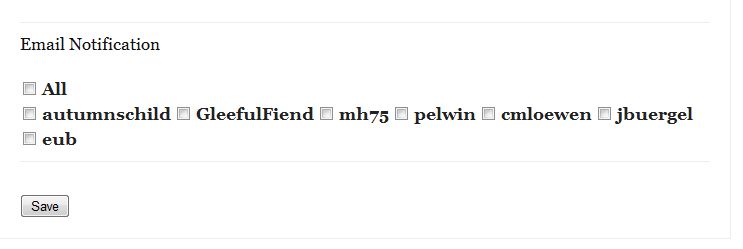
Additionally, we’ve tweaked forum notifications so that each poster can control who gets notified for each post. It’s super nice! Just like the last feature, this one is only available to our Ascendant Members. Why not give it a go?
3) Changing your Username
This feature is available to all users! Did you enter in the wrong Username when you signed up? Does it haunt you throughout your day with a dark whisper in your mind saying “You did it wroooooong. I’m a scary voice in your heaaaaaaad!” Well fear not my deranged friend, because now you can change your Username!
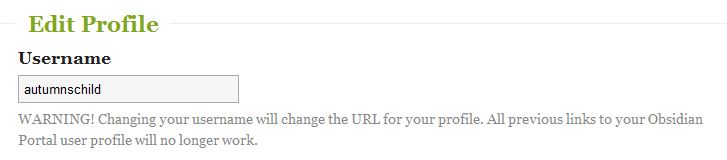
If you’d like to change your Username, log into Obsidian Portal, click on “My Profile” and then “Edit My Account”. Your Username is the first thing on the page. Changing your username will change the URL for your profile and all the previous links to your Obsidian Portal user profile will no longer work! So be careful when you make the change, or the hauntings will continue forever.
4) 15 day free trial for new Ascendant Memberships!

All new Ascendant Memberships are eligible for a 15 day free trial! Simply choose the length of subscription you’d like and checkout with Amazon. If you don’t like your Ascendant Membership, cancel any time before the trial runs out and you won’t be charged a cent! Sign up today!
Forgotten Realms: The Savage North

It’s March! That means a number of exciting things, but first and foremost for you, dear Adventure, it means that there’s a new Featured Campaign! As you know, we feature a new Obsidian Portal campaign every month. We do this so you can see some of the best table-top campaigns the internet has to offer. And this month, we have something very special for you this month.
This month’s Featured Campaign is DMed by Rodney Thompson, RPG Developer at Wizards of the Coast. Rodney was the Lead Designer for the Star Wars: Saga Edition RPG and he’s currently the Lead Developer of the upcoming Dark Sun 4th Edition setting. And his Obsidian Portal campaign, Forgotten Realms: The Savage North, is awesome. Rodney was kind enough to let us interview him about his work at Wizards of the Coast, and his campaign.
Obsidian Portal: So we hear that you work at Wizards of the Coast. Can you tell us more about what it is you do there?
-What are your responsibilities?
-What cool stuff are you working on now?
-If you could change any aspect of the current edition of D&D, what would it be?
Rodney: My job title at Wizards is technically RPG Developer, but I’m a man of many hats. While my primary responsibility is to be a Developer on D&D, I’ve also spent the last few years as the lead designer and developer on the Star Wars RPG.
As for recent projects, my biggest projects coming out in 2010 are the Dark Sun Campaign Setting, which I was the lead developer for, and the D&D Essentials line, which I co-designed. I was also the lead designer on the Monster Vault.
It’s tough to say what I’d change right off the top of my head, because any change has a lot of repercussions once made. I’ll say that we’ve got some exciting new stuff coming up in the Essentials that really are going to surprise (and, I hope, delight) people. I think if I was going to make one change to my 4E campaign, it would probably be to change the way magic items interact with character math. Basically, I like my magic items to be a little more special icing on the cake, and a little less of a required part of the character needed to succeed. That said, we’ve made some headway down that path with DMG2 and we go even further in Dark Sun, so that’s one change that’s coming about.
Obsidian Portal: Where do you get your inspiration for your games?
Rodney: I tend to be a very classic fantasy/classic D&D style of gamer. That said, my current campaign is heavily inspired by Western films—not necessarily in their environment or visual aesthetics, but definitely in terms of the story. My campaign plays on a lot of classic Western themes—lawlessness vs. civilization, dangerous men on a dangerous frontier, authority figures who are little to no help at all, etc.
Obsidian Portal: How much time per week do you spend getting ready for a game session?
Rodney: I tend to prep one adventure at a time, and each adventure I design covers about 1 level’s worth of play. I usually do a few hours of up-front prep before I start the adventure, and then over the course of the three or four weeks it takes to run I usually do about an hour of prep every Sunday night before I run on Mondays. On top of that, I’d say I put about an hour a week into things like maintaining the Obsidian Portal wiki for the campaign, sketching out custom magic items and other rewards, and generally brainstorming the direction that the campaign is headed in.
Obsidian Portal: So your campaign is called Forgotten Realms: The Savage North. Can you tell us about its world, its inhabitants, the PCs, and the overall story?
Rodney: I’m running the campaign in the Forgotten Realms of 4th Edition, but in the North, mostly in Icewind Dale and the lands north of the Spine of the World mountains. Since the 4E Campaign Setting didn’t really touch on that area much, I’m pretty much filling in the gaps using my 2nd Edition FR materials. When I was in college I ran a pretty expansive 2E campaign in the North, and I’m using all of my old materials as a basis, but updating things to the new timeline.
The great thing about the North is that it’s very much the frontier, and there’s a lot of fertile ground for thrusting the heroes into a position of influence right away. There’s less intervention from higher powers there, and plus I’ve always liked the sort of frigid, snow-covered lands as a backdrop for D&D.
The main antagonists of the campaign’s heroic tier were a group of bandits called the Blackhands, known for their distinctive black gloves. More than just outlaws, the Blackhands were pretty much controlling the entire North through fear and intimidation, and were found in most of the Ten Towns “protecting” the inhabitants from harm. When the heroes arrived, they started liberating Icewind Dale from the clutches of the Blackhands, and at the conclusion of the heroic tier they finally discovered the secret citadel used by the Blackhand leaders, laid siege to it, defeated the white dragon Aurelion that had been aiding the Blackhands, and discovered that the Blackhand’s leader had secretly been dead for years. As we enter the paragon tier, the players have discovered that some githyanki had been manipulating the Blackhands all along, and were clearly involved in some kind of plot that seems to encompass not only the North but also the Nine Hells, Baldur’s Gate, the prison-city of Wheloon, Zakhara (yeah, that’s right, I’m including Al-Qadim material in the campaign), and Myth Drannor.
Towards the end of the heroic tier, the heroes started to realize that they were not just brought together randomly, but that they all have some connection to the greater scheme of things. Zereb-Khan (a genasi swordmage, played by Logan Bonner) discovered that an old apprentice of his former master was once a Blackhand lieutenant who served time in Wheloon with Sardon (a genasi warlord, played by Chris Tulach). This apprentice and Sardon were members of the Seven of Wheloon, a group of criminals who escaped from the prison-city after being broken out by drow of the Shadowstep clan. Malkyr (a drow rogue, played by Mike Mearls) is a member of this clan, but wasn’t involved in the breakout. Theren (a half-elf warlock, played by Derek Guder) discovered that his father was murdered by this old apprentice; Theren’s father was also once an instructor at Blackstaff Tower, who set Harold Glimmerswick (a human wizard, played by Greg Bilsland) on a hunt for a mysterious substance known as godsblood. They all recently discovered that the aforementioned apprentice was turned into a seeker of godsblood by the Order of Blue Fire, who apparently have plans to do the same to Sardon. As you can tell, there are a lot of connections between the heroes’ backstories that have come to light over the course of the campaign.
Obsidian Portal: How closely do you stick to the Forgotten Realms canon?
Rodney: I like to use the FR setting as a backdrop, but not as a metaplot. The story I’m telling is definitely my own. As I mentioned before, I’m using a lot of 2E reference materials for my game, so it’s kind of a hodgepodge of the 2E Realms with 4E Realms overlays. In general, I’ve used the 4E Campaign Guide as a jumping off point, and occasionally circle back around to pick up things from time to time, but it’s very much my own story.
Obsidian Portal: We hear that many of your players are also game designers. Do you have to grapple with them for control of your game world, or do they typically let you DM as you see fit?
Rodney: I’m usually pretty flexible about letting my players define the campaign world anyways, so there’s no grappling. If anything, I try and encourage them to take ownership of the setting. For example, Chris Tulach completely made up the whole concept of a group of escapees called the Seven from Wheloon, and I took that and ran with it, tying it into the character histories of other characters. I find that letting my players be creative like that keeps them engaged, and whether or not they are game designers.
Obsidian Portal: How much of the campaign world is original content developed by you and your players?
Rodney: Almost all of it. While I use canon FR locations for most things, every single NPC and storyline is completely of my own making. The only exception is that I inserted the Scepter Tower of Spellgarde adventure into the game at one point, but customized it heavily.
Obsidian Portal: Where do you get your inspiration for your story?
Rodney: The heroic tier, at least, is heaviliy influenced by Westerns. The Blackhands are sort of a cross between the Zhentarim and the Cowboys from Tombstone or Calveras’ men from The Magnificent Seven. Going into the paragon tier, I’m easing back on the Western themes, and leaning more toward classic D&D adventuring. It’s tougher to do the Western-inspired stories at paragon tier, so for that I’m drawing a lot upon the design work I did for the upcoming Plane Above sourcebook, as well as the Al-Qadim campaign setting. I feel like the campaign may head to Zakhara at some point, but up until then the players will be spending a lot of time in Baldur’s Gate, if I had my guess. We’ll have some urban adventures, and then go from there to Zakhara, or possibly to the Underdark or to the Astral Sea, depending on how the campaign develops.
Obsidian Portal: Where does your game group typically play?
Rodney: We have played in numerous places thus far, but we currently play in conference rooms at Wizards of the Coast. The office has some really nice rooms with big white boards, large tables, and comfortable seating that I like to take advantage of. Some rooms even have speaker systems, so I can connect my iPod to it and play background music during the game.
Obsidian Portal: How well do you know your players?
Rodney: I’d say we’re all pretty good friends. I currently work or have worked with four of the players, and the others are either close friends or have come in from other campaigns. We hang out outside of the game, and of course I see several of my players around the office on a daily basis.
Obsidian Portal: What kinds of challenges are you faced with in your campaign?
Rodney: It’s definitely had its ups and downs. I originally started the campaign as a more casual, beer-and-pretzels kind of game. While we were having fun, we weren’t making much progress, and I was itching to run a game that was more fast-paced and plot-heavy. So, late last year I started implementing a series of changes to make sure we played more regularly and got more gaming in. Since then, the game has really picked up momentum. In fact, I started a series of blog articles on the Wizards Community site called Campaign Repairman to chronicle the process of me turning my game around. I figure a lot of DMs probably have some of the same problems that I have faced, and could benefit from some advice on how to make changes and salvage a lackluster campaign.
We’ve also lost a couple of players due to real-life obligations, and so we’ve had some challenges in introducing new players, but so far the core group has remained engaged.
Obsidian Portal: What aspects of your campaign are you really proud of?
Rodney: I’m really excited about how well the game has turned around after slowing down from time to time. I was worried that the campaign was going to fall apart at a certain point, but things look to have turned around. I’m also very proud of the capstone adventure I ran to get the players from 10th level to 11th level. It was an all-day adventure that played out over the course of about 8 hours. It was a blast, and I hope I can top it in the future. Maybe for the 20th level adventure…
Rodney has dedicated his career to his love of gaming. His Obsidian Portal campaign is a living testament to his cause. For the dedication exhibited by Rodney and his players to keeping table-top RPGs alive and well, we welcome them with open arms into the immortals halls of the Obsidian Portal.
New System Thursday, 2/25/2010
It’s New System Thursday! We take some time each Thursday to add a new system to our list of over 130 supported table-top RPG systems and settings. Today’s system is 3:16 Carnage Amongst The Stars by UK RPG demigod, Gregor Hutton.
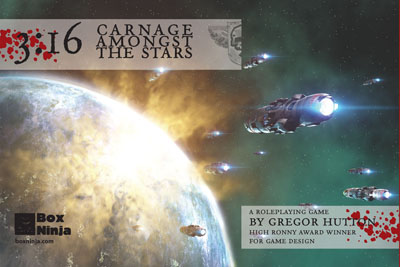
In space, you murder a lot of aliens.
Is 3:16 a perfect game? Well, no, as it’s not got….. ummmm…… then there’s…… errrrrr…….. OK, I’ll admit it; I can’t think of a damned thing to add or take away from 3:16 that would make it a better game. So I guess it must be perfect after all.
3:16 is a stupidly simple beer-and-pretzels game and a deeply complex moralistic one, all at the same time. The players’ characters are members of the elite 3:16th Expeditionary Force who’s task it is to rid the universe of alien scum to keep the Utopian Earth a safe and wholesome place to be. It’s Starship Troopers, Those Guys from Alien II and every dumb Space Marine movie all rolled into one. Add in rules which perfectly fit the tone and setting, the utterly brilliant Flashbacks concept, the promise of Starkiller missiles and the lightest touch of moral decay and you’ve got a system that everyone should be legally mandated to play at least once in their life.
If you haven’t it yet you can buy a PDF of the rule book here. Then, Make a 3:16 Carnage Amongst The Stars campaign now!
Finding a Gaming Group
by Zachary Houghton
This week’s article comes to us from Zachary Houghton, who is a freelance RPG writer and proprietor of the gaming blog RPG Blog 2. He lives just outside Indianapolis, Indiana with his lovely family, where he waits all year for Gen Con to come back around. You can visit him at www.rpgblog2.com, or email him at mail.rpgblog(at)gmail.com.
So you’ve just had another gaming group end in failure. Perhaps you had too many no call/no shows, perhaps players drifted away, or perhaps the same old incompatibility issues sunk your campaign for the umpteenth time. There’s nothing more frustrating as a Game Master than to see poor group cohesion tank a campaign in which you had invested a massive amount of time.
Let’s face it: as our hobby gets older and our outside obligations and responsibilities increase, it becomes important to maximize our gaming time. All too often, we ignore one of the biggest reasons for a failed campaign: our group isn’t up to the challenge, or isn’t what we need for what we’re trying to do.
Of course, forming a solid gaming group is easier said than done, isn’t it? Often times, especially in small-town life, we have to work with what we have. We don’t have a large gaming network to pull from, or at least that’s what we think. That’s because we often ignore all the resources we have in finding and forming a new group.
I found myself in a similar predicament not too long ago. My buddies and I had just seen a campaign crash and burn very early on. There were chemistry issues, and we felt that new blood was needed—it wasn’t that we didn’t like the rest of our group, just that we all had different expectations and wants from our gaming.
We could have gone back to the same well we’d been going to for several campaigns. But frankly, it wasn’t working. We’d been in the same small gaming circle for so long, we’d stagnated. A small remnant of us decided we needed a new core. Over coffee one night, we discussed how to find more gamers. We knew they were out there, but how to reach them?
We decided on a “blitz” strategy. We didn’t know which approach would be successful, so we tried them all. We printed up fliers and hung them up at the library. We registered on online sites such as Meetup.com and Nearby Gamers. (Editor’s Note:We also have a resource here at Obsidian Portal you might like to try.) We slid fliers into RPG books on the shelves at Borders and Barnes & Noble. We put out the word on various social networking sites. We ended up receiving at least one inquiry from each method tried! If you were trying to get word out about a new product, you wouldn’t just use one medium, would you? Why should recruiting for a RPG campaign (a definite exercise in salesmanship) be any different?
From this, we received a number of interested parties. But how do we figure out if we’d all play well together? Well, email was our first way of communicating, which was good for getting an idea of their likes and dislikes. But I’m a firm believer that a face-to-face meeting can be important. So we didn’t waste their time or our time in a gaming relationship that may not work, we scheduled an informal meeting over coffee and bagels one night. We all showed up in a stress-free environment, and were all to talk about gaming, our hobbies, our schedules, our expectations—all things that may not have otherwise happened. More importantly, it was an excellent icebreaker and allowed us get into a comfort zone with one another earlier on in the subsequent campaign.
Admittedly, the group still could have had issues—that didn’t happen, but it’s important to remember that recruiting and meeting before your game isn’t a magic wand; it’s risk management. Treat it as such, and you should be fine.
Once you have the group, it is up to the Game Master and players to provide the continued momentum and dedication to make your campaign successful. But you need to start off on the right platform.
Interview with Evil Hat’s Fred Hicks
As some of you may know, Evil Hat is working on making a Dresden Files RPG. Everyone involved is busting their humps to get it ready for ORIGINS. Evil Hat publisher Fred Hicks took some time last week to answer some questions about the system and why you should be interested in picking it up. Lets read, shall we?
OBSDIAN PORTAL: Can you briefly tell us about the setting that The Dresden Files RPG and the books at large takes place in?
FRED HICKS: Two different answers, there. I’ll take the books first: they occur in a modern-day Chicago, where Harry Dresden is the only practicing wizard / private eye who advertises in the Yellow Pages. It has a blend of noir and adventure-fiction sensibility to it, and a big helping of urban fantasy gone gritty.
The Dresden Files RPG *could* take place there… but it doesn’t have to, necessarily. We have an entire chapter that talks about getting everyone together around the table, picking a city that interests them, and then turning it into its Dresden Files magic-lives-behind-the-scenes setting for the game.
OBSDIAN PORTAL: Where did Jim get the inspiration for this modern-day-fantasy-noir world?
FRED HICKS: Jim’s the first to admit he stole ideas from all over. The Anita Blake series by Laurell K. Hamilton was an early influence. The name Harry Dresden came from a combination of World War II research and the HBO movie “Cast A Deadly Spell”. Bob the Skull, who’s pretty much exactly what he sounds like, was a joke Jim had with his writing teacher. But it’s hard to really pin down one place and say “from there”, because Jim is a voracious reader. Where’d he get the idea? From all of genre fiction.
OBSDIAN PORTAL: What role does Jim Butcher have in its ongoing creation?
FRED HICKS: “Its” meaning the RPG? His direct involvement is light, honestly, though he and his agent have looked at the game to give it final approval. Jim’s just too busy to really actively get into the mix. Luckily, we have a very effective proxy for him in the form of the novels and short stories. Our lead setting developer, Chad Underkoffler, documented all of the material exhaustively in preparation for writing those portions of the game, and it really paid off.
OBSDIAN PORTAL: Ok, enough about Jim for a second, who else is on TDF RPG team?
FRED HICKS: There’s Chad, who I already mentioned, and me — I’m the publisher, the layout guy, and one of the developer/authors. Rob Donoghue laid some groundwork quite some time ago (and is working on the index for the game presently), and Genevieve Cogman helped us find our feet with the setting, writing an early draft of the introductory chapters for each of the two RPG books. The big guns, though, are Lenny Balsera as lead system developer, Ryan Macklin as lead project developer, Amanda Valentine as our managing editor, and Clark Valentine as our man providing covering fire for the system and setting sides of the effort. Adam Dray also helped out with editing for a while. Then there are all the Alpha playtesters — too many to mention here — who helped us build confidence that we had the system on the right track after a few failed attempts.
OBSDIAN PORTAL: The Dresden Files RPG is powered by an updated Fate 3.0 system. Can you tell us what kinds of updates were made? Does it still play like the Fate system we all know and love?
FRED HICKS: It plays like the Fate you’d know from SOTC, but with the dials firmly twisted in different directions — all done in service of producing a play experience that feels like the novels. Combat is FAR more dangerous than ever before. People are fragile and sometimes it’s better to lose a fight or walk away from one than to try to gut it out through to the end. The relationship between power and free will (you trade off the latter for more of the former) is baked right into the elements of the Fate Point economy. And we’ve taken all of the lessons of the last four years with Spirit of the Century and applied them to produce game system advice that is clearer and more on-target than before. This gives us a few mild terminology shifts as well, but getting into that kind of specific is better handled by a book than an interview.
OBSDIAN PORTAL: Where should we point our friends when they ask; “What’s the Dresden Files RPG?”
FRED HICKS: Start with the game’s website –http://www.dresdenfilesrpg.com — and one of the earlier novels. Honestly, any one of the first four, up through Summer Knight, would do. I hear Summer Knight is one of the better ones for reeling them in. On the website we’re “leaking” out bunches of information about the setting and character types and magic and all that. Some browsing around there will tell them a lot.
OBSDIAN PORTAL: Does TDF RPG have classes or races or factions?
FRED HICKS: Not *exactly*. We offer up a bunch of playable templates — recipes for creating characters and the powers that are appropriate for them — but they’re not as restrictive as any of the things you’re talking about usually are. A cross section would be: wizards, werewolves, minor talents, emissaries of power, champions of God, changelings, and certain kinds of maybe-not-so-evil vampires. But there’s more than just those.
OBSDIAN PORTAL: What character options are open to players interested in exploring their more monstrous sides?
FRED HICKS: Two kinds of playable werewolf and changelings are probably going to be front and center for that, but the field’s pretty wide, there — the trick is to come up with something monstrous that’s not SO monstrous that it represents a creature driven by its nature rather than with the option of free will. Only the latter have the chance of being player characters.
OBSDIAN PORTAL: What character options exist for those who like to shoot first and role-play later/never?
FRED HICKS: I believe those options are called “dead”.
OBSDIAN PORTAL: What character options exist for the white knight in all of us that seeks to banish evil from the world?
FRED HICKS: You could always pick up one of the currently ownerless Swords of the Cross to become a Knight. So white knights are almost literally possible. There are some options that land short of that. But really we expect a lot of good-guy thinking, when it comes down to it — the people who stand against the darkness could be regular-Jane cops, they could be empowered by their faith in their religion, or they could be rough and tumble wizards just trying to make a little bit of difference in their corner of the world.
OBSDIAN PORTAL: What types of Magic are there in this world?
FRED HICKS: The two main varieties of magic — beyond innate powers specific to certain kinds of creatures — are evocation and thaumaturgy. Evocation is the flash-bang-boom stuff, quickly cast and usable in a combat setting. It tends to be all about straight lines, pushing power from point A to point B, conceptually simple stuff. Thaumaturgy is the slower, ritualized stuff that requires preparation and research, but can produce potent, long-ranging, and more widely varied effects. A spin-off of those is what we call Sponsored Magic, which combines those two methods, but draws some of its power from a deal made with some kind of supernatural entity rather than from your own potential.
OBSDIAN PORTAL: How is the production schedule coming along?
FRED HICKS: Good! The first pass on layout is done, but there’s another couple months of effort to go before we can really think about starting up preorders. Closer than ever, though, and with an end in sight. I think — hope — we’re on track for our intended Origins 2010 release.
OBSDIAN PORTAL: Will there be a physical product release, or is TDF RPG all about the digital distribution?
FRED HICKS: It’ll be two _big_ books — the first volume, “Your Story”, is about 400 pages long, and the second, “Our World” is over 250. You can find out more about the particulars over on the game’s website.
OBSDIAN PORTAL: What’s your favorite aspect of the system?
FRED HICKS: How closely it lands to the feel of the books just in terms of how the system operates in play. We don’t tell people “you must do X to make it feel like the Dresden Files”… it just _feels like the Dresden Files_ when you play it. Hot stuff.
OBSDIAN PORTAL: What are you most proud of in TDF RPG?
FRED HICKS: How close it is to being done. It’s been a ludicrously long road.
OBSDIAN PORTAL: What kind of price point are we looking at here?
FRED HICKS: Well, full color hardcovers with page counts like what I mentioned above — you can look at similar products in the market and draw some educated and reasonably accurate conclusions. But we haven’t settled on the final price points yet.
OBSDIAN PORTAL: Can we expect any future content in the form of supplements or accessories for TDF RPG?
FRED HICKS: We’re not explicitly planning for that, but it doesn’t mean it can’t happen. For now we’re looking at delivering a complete game in those two volumes and then letting the novels themselves act as supplements. We’re definitely planning on hosting some public “let’s stat this story!” exercises via the blog over on The Dresden Files RPG website.
OBSDIAN PORTAL: When can we start playing?!
FRED HICKS: Soon! The book releases in June, and we’re hoping to start a preorder by then, if not 1-2 months before then, which will include folks getting to download the PDF immediately when they place their preorders through us or through Indie Press Revolution.
Free System Friday, 2/19/2010
It’s Free System Friday! Tired of your current RPG system? Try a new one for free! Last week, we gave you a great setting idea from the mind of designer Will Hopkins. This week: ICAR.
Icar is set in the far future, presently 92030. The human race has been through many wars but none as far reaching as the war that begun one thousand years ago. Now, the galaxy is split between a race of intelligent robots, called the Droids and the human race. The droids rarely impinge the territory of the human race, fighting amonst themselves they are little threat.
Watching over the human race is the Imperium, which is a benevolent organisation which desires the progress and survival of the race. The Imperium understands the gravity of its task. Without them, the human race would soon break apart. Of the three areas of space (called clusters) that humans control, one is rich and life is easy, one is industrially based and the third is still being colonised.
99% of the human race live and die without any knowledge of what is going under the surface of society. Gaia, a means of communicating in a virtual reality, has allowed subversive syndicates to operate within human space. The syndicates work either to make money illegally or to simply explore avenues of human existence that are denied to them by the Imperium.
The player characters begin as pawns in a huge space opera where millions of people’s lives are often at risk, by fighting for what they believe, they improve and grow in power until they are the ones holding the strings.
Grab some friends, grab the ICAR core rule elements, and make a new campaign today!