Greetings Adventurers, come gather ’round for a tale unlike any other we’ve shared before! Set in a modern landscape, our tale follows a series of individuals who serve as agents who walk the line between the known and the supernatural. Join us in talking with GM Dungeon Master Loki as he walks us through this fantastic world of intrigue and action in Department 7: Crescent City.
First off, feel free to tell us about the person behind the GM screen. Where are you from? What do you do aside from gaming? Alter Egos? Life partners? Family? Where can we interact with you on the internet?
I’m an 8th generation New Orleanian of French Creole background, so I was raised in a storytelling culture. I started playing D&D in the White Box era while undergoing leg surgeries at Children’s Hospital, beginning a lifelong love of RPGs. After years of working in music clubs and restaurants I changed gears and began working in online communications (web content, community management and social media) for clients including the Open Society Institute, The National Association of Broadcasters, and The VCU Brand Center.
In 2003 I took on the position of co manager of Planewalker.com, the Official Planescape fan site, where I stayed for over a decade. That and my involvement with Spelljammer.org gave me a taste for sharing my game oriented fevered rantings with others. Since 2014 I have worked as a Table-Top Role Playing Game designer. A two time Silver ENnie award winner, some of my design and writing credits since include the ENnie nominated DarkRoads and Golden Hells, the upcoming Gloomhaven RPG, XCrawl: Louisiana Rising, Bloodlines and Black Magic: The Crescent City, The City of 7 Seraphs, The Pop Culture Catalog series for Starfinder, and many others.
In 2021 Hurricane Ida drove me out of my native New Orleans and I ended up in Cincinnati. Now I teach Introduction to Game Design at the University of Cincinnati and try to freelance enough to keep the bills paid. My family is pretty much all back home in New Orleans so I don’t get to see them very much. Up here in Cincy my family includes my girlfriend, who plays the party cleric / spelljammer pilot, a few close friends, and my two preposterous felines, Puck and Gremlin.
As to where I lurk online, I”ve cut down a lot on that due to spam, AI, and turbulent politics. My website (sorely in need of updating), my Obsidian Portal profile, and my profile on Start Playing Games are really the best ways to contact me these days.
Tell us about “Department 7: Crescent City” in a nutshell. How did you design the world? What was your inspiration?
When I decided to run a modern game using my home city was an obvious way to make it easy on myself. I’ve already written books about using the Crescent City as a site for modern occult and cyberpunk games so I even had a good bit of material already developed for it.
Since several of the players have lived in New Orleans and played at my table ever since, I knew they had familiarity with the city’s culture and terrain. The others would play new transfers to the city from other branches of the Hoffman Institute. Additionally, it’s New Orleans. Our city is full of atmosphere, especially when you consider the folk tales and ghost stories to be true.
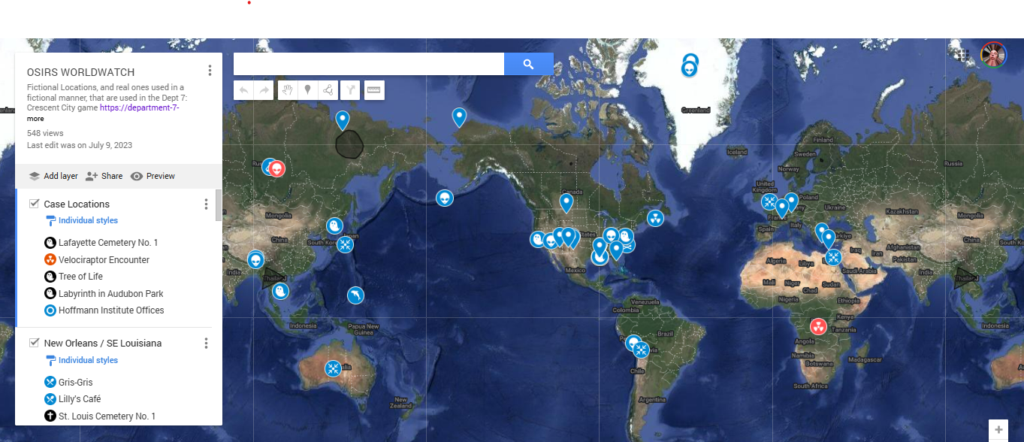
Scouring the internet for fringe stories about dinosaur sightings, alien abductions, and ghost stories made it easy to rapidly build a robust and crazy urban fantasy world with some roots in reality. The ones I thought would add to the world or provide good plot hooks would then get added to the game’s Google map. In addition there was an extensive array of such incidents / locations in the original Dark Matter game that I added.
How regularly do you play, and where do you play? Tell us about your current group of players.
We play on an irregular basis since the same players run different characters in some of the other campaigns in the series. Usually about once every month or two these days. We play online using my private server on Discord for Voice/Video/Text and Owlbear Rodeo for our VTT.
As to the players, they are a delightfully motley krewe.
Gary (Jacquemeaux DuBois) has played through several campaigns with me and is one of my old New Orleans crowd, now here in Cincy. Always good for extremely bad jokes and excellent food bribes for the GM (he’s a former chef).
Drew (Leif Luftson) is another who started at my table in the 90s when we worked in restaurants together. Now in Colorado he has returned to the table via Discord. Survivor of three Planejammer campaigns so far.
Desiree (Eulalie Anastasie “Stazzie” Dugas) another one of the New Orleans gamers at the table, despite now living in California. My former roommate (proving she is tolerant) and favorite Cajun who I got to return to the gaming table for the first time in decades.
Jaime (Michi “Michelle” Aoki) my girlfriend, and one of the team’s combat specialists. She’s been rolling dice with us since 2008 when I lived in Cincy once before. As a matter of fact one of her characters is an easter egg in City of 7 Seraphs.
Zan (Cole Morrin) A fellow pro game writer that I got to know while working with them on the City of 7 Seraphs. After playing Munchausen together at Gen Con 50 I knew they would be a perfect fit for the table. Zan rounds out the West Coast contingent at the virtual table. So far they have survived almost five years at my table without having to roll a new character.
Emily (Victoria Union) our campaign artist and mad journaler. Em is another Cincy gamer that came to the table in 2008 when I lived in Cincy a decade ago. Over those years she has become integral to the look and feel of the game. For example, the upcoming Planejammer Tarot deck coming soon from Evil Robot Games.
What made you choose Pathfinder for your system? How does that system complement your campaign?
The campaign series started back in first edition Dungeons and Dragons days, and has evolved embracing each edition until Pathfinder forked from DND 3.5. Since then Pathfinder 1e has been the baseline. My players like the granularity of control over their character the system gives them. Since it is a system I have written more products for than any other it’s also a matter of rules familiarity and comfort zone I suppose. One more point in its favor is that translating rules from one d20 based system to another is comparatively easy, opening up even more options for my players.
Your campaign integrates the real world with fantasy. Can you tell us a little bit about the immersion of the two? How do you decide which parts of fantasy are too much for the real world, and what is acceptable?
One reason I decided to run a modern sci fi / occult game was an idea I had for leveraging Google Maps as a game tool. Using a custom Google Map (OSIRS Worldwatch Global Anomaly Tracking) I was able to create entries for a lot of the high weirdness from Dark Matter, and other weirdness from Louisiana folklore, to create “known sites” around the world. Being able to fire up the map and see everything from reconstituted dinosaurs to secret alien colonies really helped my players with immersion.
It also allows for a lot of improv based on current events. The news and weather reports of the day set the tone If we are playing during Essence Fest or Jazz Fest, for example, they will have to deal with crowds, traffic and hordes of drunken tourists as well as chance celebrity encounters and the occasional musical interlude..Since it is a present day game I often use Google Street View to show them where their characters are and use screencaps from an aerial view to create any battlemaps I need. I’ve found that from the GM side of the screen it makes it a lot of fun and adds a lot of verisimilitude without a lot of extra effort.
As far as what is off the table? Not much. It’s a low to mid level game at present, but I do like big and flashy games almost as much as I love convoluted conspiracies.
Can you explain the structure and setting of your campaign? Your adventures are “cases” that your characters solve as agents in their agency?
In Dark Matter the players are agents in an X-Files style setting, so they work as paranormal agents for the Hoffman Institute. Much like the Men in Black movies reality is not far from what you see in the craziest tabloids.
This means that most of their adventures are assignments, while a few here and there are during their character’s personal time. This simplifies a few aspects of game play. Equipment other than personal items is requisitioned on a mission by mission basis easing the gear tracking part of the game. It also provides clear direction on what the mission goal is each time. For instance their most recent mission was testing out the Tangent Tunnel, an experimental device for travelling to alternate realities. While trying to rescue a lost exploratory team they ended up stranded in the Land of the Lost for three sessions. The upcoming session takes place after more testing of the Tangent Tunnel with them arriving on an asteroid city in the Tears of Selune in the Forgotten Realms.
That ties us in to the big picture. This campaign is part of a linked series of games that started in 1979. Events in one game can directly influence the others as they are all in a shared Omniverse. Currently one of the NPCs in the game is the cohort of Emily’s PC in The Spelljoined who got bounced into an alternate reality during a massive battle with the illithids (mind flayers).
How much time is usually spent preparing your game sessions? Describe a typical session.
It varies. Some of the episodes require several hours of prep time, but with the amount of info I’ve developed for the series over the decades, session prep is usually a short and sweet two to three hours if I’ve kept up with my notes (always a challenge). Since it is more of an event based sandbox game with an overarching metaplot, the players control a lot of the direction things take.
Sessions are usually about ⅔ investigation / role playing and ⅓ combat. Usually it takes about three sessions to resolve a case so far. Each case starts with a mission briefing and familiarizing the players with the mission and the current gear assigned. From fighting escaped, genetically engineered velociraptors through the streets of the Bywater to communing with nature spirits under Audubon Park’s Tree of Life the missions can encompass many story styles and objectives.
What can you tell us about the art presented in your campaign? Who is the artist? What made you choose this art style?
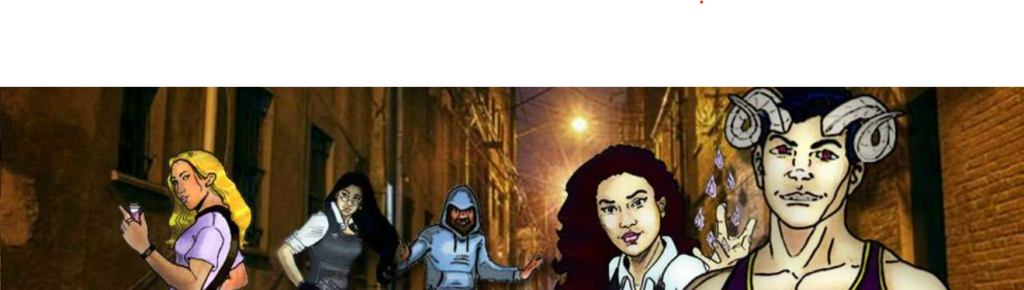
Things like the Hoffman Institute logo are taken directly from the Dark Matter game. The character art and most of the other incidental art is created by a freelance artist in our group: Emily “Syreene” Vittori. She’s been playing at my table since 2008 and has been the primary artist for the campaign series. She is also responsible for hundreds of pages of journal entries and campaign notes.The style is entirely her own choice and there are a variety of styles in her art for our games including classic game art, art nouveau, and even a few chibi images.
In addition there is art created by various players over the decades and a few professional pieces by Jacob Blackmon, done for the Starfinder game in the series, Catch My Drift.
How long have you been using Obsidian Portal? What brought you to the site and what keeps bringing you back?
Roughly 15 years nos. I stumbled across it ages ago and upgraded from the simple wiki I was using prior to that. When it comes to the things that keep me here the wiki is a big one, especially the ability to have sections that are for private notes between the players and myself. I also find that player participation away from the table, i.e. journal writing and such, increased when the adventure log became an option. It has a great set of features and solid organizational structure. All in all, other than some improvements to the backup downloads it is pretty much perfect for my needs.
If you had to pick just one thing, what would you say Obsidian Portal helps you with the most?
Creating an atmospheric portal for my players that organizes the ridiculous amount of house rules into a (hopefully) useful and appealing format. Even without knowing any CSS it is pretty easy to make it sing and it has much greater “out of the box” functionality than setting up a fully customized website. In addition the community is pretty great across the board.
What would you say is the biggest highlight of your game so far (please also provide images and links if possible)?
During one of the adventures that led them to Greyhawk I had the honor of having a special guest. Mike Nystul played with Gary Gygax in the days before D&D was published and the game has included spells named for his wizard, Nystul, ever since. Nystul’s Magic Aura being the most well known. Having him join us and play an updated version of his original character from Gygax’s table was an honor and a pleasure.
Okay, as a last question, we always ask for the GM’s “pearls of wisdom”. What GM insights can you offer the community this month?
It’s all about a combination of organization and improv. In the hopes it will be helpful to someone here is my approach.
If you have trouble making stuff up spur of the moment make a few lists as part of your prep. Each one can be as few as five items.
- A list of names appropriate to your setting
- A list of species/class combos that are common in your setting.
- A list of quirks or behaviors, i.e. constant toe tapping, a lisp, or a tendency toward puns.
With these three lists you have instant NPCs, just roll or choose one item from each list when you need it and the three combine to give you the basics.
For organization I use a triple monitor rig set up as follows:
Left Monitor – Combat Data Browser Tabs:
- Initiative Tracker Opponent Initiatives already pre-rolled and added. I advise adding the Dice Roller plug in.
- One Tab for each creature, trap, or hazard in the encounter
Middle Monitor – Interaction Browser Tab:
- Discord Video and text chat
Right Monitor – Maps and Rules Browser Tabs:
- Owlbear Rodeo Virtual Tabletop
- Obsidian Portal – Planejammer Hub for Core House Rules
- Obsidian Portal – Dept 7 Crescent City or current campaign
- Archives of Nethys Pathfinder 1e rules
- d20pfsrd.com Pathfinder Psionics rules
I keep a pad and pencils on my desk for notes. If I create an NPC on the fly their name / class / and defining mannerisms get noted as does any loot acquired, or major events / accomplishments of the session. (Add these to your wiki on OP immediately after the game because if you’re like me they can easily get misplaced before your group meets up again). It’s also worth noting that if you have trouble taking notes during games you can try recording audio or video of the sessions and go back to them to write your notes and recap. Just make sure to let your players know if you are recording!
That’s about it! May your 20s be both frequent and natural!
Thank you to the community for making this campaign of the month possible! That’s all for now, join us on our next adventure May 1st, and don’t forget to nominate your favorite campaigns for our next Campaign of the Month!