Read on to discover how a group of roleplayers from “Down Under” become the officers on the last voyage of the USS Excalibur on her final mission into the “Shackleton Expanse”, encountering new life and civilizations, including Romulans and Bluegill, in the seemingly endless quest into outer space. Let GM IanHoulihan and his crew guide you to boldly go where the Federation has never gone before in STAR TREK: Excalibur…
First off, feel free to tell us about the person behind the GM screen. Where are you from? What do you do aside from gaming? Alter Egos? Life partners? Family? Where can we interact with you on the internet?
Firstly, it’s an absolute honour just to be considered for this award. I’ve been part of the Obsidian Portal community for many years and being recognised alongside so many talented GMs is genuinely humbling.
Away from the GM screen, I’m a proud dad to five boys (all now 16 or older), partner to the incredibly patient Kerry, and human servant to two Cavoodle fur babies. We call Brisbane, Australia home, and life is usually a balancing act between family, work, gaming, and finding the occasional moment to breathe!
My tabletop journey began back in 1984 when someone introduced me to Top Secret. That one game opened the floodgates. Before long I was exploring Basic D&D, Rolemaster, and eventually the Star Wars Roleplaying Game by West End Games—a game that sparked a lifelong love affair with RPGs. Since then, I’ve played more systems than I can count, including Star Trek Adventures, and was fortunate enough to contribute professionally by writing for Legend of the Five Rings and Genesys under both Fantasy Flight Games and Edge Studio.
Gaming has also taken me beyond the table. I had the privilege of serving as Event Manager for the very first PAX Australia and later running Gen Con Australia in 2008 and 2009—experiences that gave me an even greater appreciation for the incredible gaming community.
When I’m not rolling dice or writing adventures, you’ll probably find me spending time with my family or out on the water paddling Waka Ama—traditional Polynesian outrigger canoeing—which is a fantastic way to clear the mind after plotting the latest campaign twist.
If you’d like to chat RPGs, worldbuilding, or just say hello, you can find me on most social media as @gmhooly. I also hosted The Forge: A Genesys RPG Podcast. While the show is currently on permanent hiatus, I’m always happy to talk shop with fellow gamers online.
The whole design aspect of your campaign is immediately obvious from the introduction to it on the landing page, so let’s start with that. What inspired the design aesthetic, and how did you go about setting it up. What tools did you use, etc.
The design was inspired almost entirely by Star Trek: The Next Generation. Since my Star Trek Adventures campaign is set during that era, I wanted visitors to feel like they’d just stepped onto the bridge of a Galaxy-class starship. The LCARS interface is instantly recognisable to Star Trek fans, so it felt like the perfect way to present information. Rather than simply decorate the page, I wanted the interface itself to become part of the experience, making players feel like they were accessing a Starfleet computer.
To build everything, I use the Adobe Creative Cloud suite almost exclusively. Every panel, button, icon, and graphic element is custom-designed to fit the campaign. Once the artwork is finished, it’s a matter of figuring out how to make it all work inside Obsidian Portal.
The funny thing is that I’m far from being a web developer. My HTML and CSS knowledge is almost entirely self-taught, learned through countless hours of experimentation, breaking things, fixing them, and occasionally celebrating when something finally worked! Whenever I hit a wall, the amazing Obsidian Portal community on the forums and Discord has always been there with advice, ideas, and encouragement.
In many ways, the page has evolved just like the campaign itself. Every new feature taught me a new trick, and every challenge pushed me to learn something new. It’s been a wonderful creative journey that’s still evolving every time I update the site.
Tell us a bit about your players. How long have you been playing together. Describe your typical gaming session. Online or In Person?
One of the things I love most about this campaign is the people around the table. While I have a bit of a rotating roster, there are six core players who have been with me since the beginning. They range in age from 19 all the way up to… me, at 55! It’s a fantastic mix of personalities and gaming experience, from complete newcomers to seasoned veterans, and we have a great balance of genders at the table as well.
We first came together just over a year ago through the Northside Adventure Gamers Association here in Brisbane—a club I helped establish to bring tabletop gamers together. While our regular games happen at the club, we also run additional sessions outside of club nights. Partly that’s because I’m a shift worker and can’t always make Thursdays, but mostly it’s because my players keep asking when the next mission is!
Our regular sessions are played in person every Thursday evening from 6:00 pm until around 10:00 pm. I deliberately structure the campaign like a modern Star Trek television series rather than a collection of standalone adventures. Each “season” consists of around eight to ten interconnected missions, with individual adventures usually unfolding over one to three sessions. That approach lets us tell bigger stories, develop the characters over time, and sprinkle in mysteries and plot threads that might not pay off until much later.
The best compliment I can give my players is that they’re completely invested. They laugh, debate impossible moral dilemmas, celebrate every victory, and occasionally surprise me by solving problems in ways I never expected. As a Game Master, that’s exactly the kind of table you hope to have.
Your BIO page on Obsidian Portal indicates that you are involved in both STAR TREK and PATHFINDER games. Do you have any thoughts on the differences between role playing in Fantasy and SciFi scenarios? Are there any differences in designing your page/campaign? Do you notice any differences in the way people play these two types of game?
I think the first difference people notice is the visual style. I like every Obsidian Portal campaign to have its own identity, so I design each page to reflect the genre and tone of the game. A Pathfinder campaign should feel like opening an ancient tome or a weathered map, while my Star Trek campaign is built around the clean, futuristic LCARS interface from The Next Generation. The campaign page is really an extension of the world the players are stepping into.
From a Game Master’s perspective, though, the biggest difference is scale. Fantasy campaigns tend to be geographically focused. Even if the world is enormous, the adventure usually unfolds within a kingdom, a continent, or a well-defined region. Science fiction opens the door to an almost limitless playground. Every star system can have its own culture, politics, technology, and environment, so worldbuilding becomes galaxy-building. Instead of detailed regional maps, I spend more time creating planetary overviews, sector maps, and notes that help each world feel unique.
I also think the two genres encourage different kinds of roleplaying. Fantasy is familiar—castles, dragons, taverns, and magic are concepts most players can picture immediately. Science fiction often asks players to buy into a specific vision of the future. Even franchises within the genre can feel worlds apart. Star Wars embraces mythic fantasy wrapped in science-fiction aesthetics, while Star Trek leans into exploration, diplomacy, and at least the appearance of scientific plausibility. As a result, Star Trek players often find themselves solving problems through teamwork, ethics, and creative applications of technology rather than simply drawing their weapons.
One of my favourite moments at the table is when the players start throwing around technobabble. They don’t need to be real engineers—they just need enough confidence to say something like, “If we reverse the ocular focus of the tachyon emitter…” and suddenly everyone buys into the moment. Those are the scenes that make Star Trek feel like Star Trek.
System-wise, I enjoy both Pathfinder and Star Trek Adventures immensely, but I’ve found my tastes have evolved over the years. These days I’m drawn to games with lighter mechanics that get out of the way of the story. I still love tactical depth, but I value systems that give players the freedom to be creative and give me the flexibility to say “yes” more often than “check the rulebook.”
Please outline the basic mission of your game aboard the U.S.S Excalibur. Where are you taking your players? What are they experiencing? Are you just travelling and discovering, or is there a firm goal/destination in mind?
At its heart, the campaign is about exploration. The players are the senior officers aboard the USS Excalibur, an aging Constitution-class starship embarking on one final mission before retirement. That premise gives us everything that makes Star Trek special: exploring strange new worlds, making first contact with new civilizations, solving scientific mysteries, and occasionally saving the Federation from threats nobody saw coming.
The campaign is set at the beginning of Star Trek: The Next Generation Season 4, using the Shackleton Expanse as our playground. It’s a fantastic setting because it’s largely unexplored, giving me the freedom to blend established Star Trek canon with original worlds, species, and mysteries while still feeling true to the universe.
Although every mission tells a complete story, there’s always a larger narrative unfolding beneath the surface. Our first season centered on the return of the neural parasites from the infamous Season 1 episode, “Conspiracy.” It began as a series of seemingly unrelated adventures while everyone learned the system, but the clues gradually revealed a conspiracy that had spread throughout the Romulan Star Empire. The season culminated in a classic Star Trek moral dilemma: should the crew forge an uneasy alliance that would leave the Romulan Empire enslaved, or commit genocide against the last surviving members of the Bluegill species to end the threat forever? Watching the players wrestle with that decision was one of the most rewarding moments I’ve ever had as a Game Master.
Now we’re in our second season, and the stakes have become even greater. The crew has uncovered evidence of an ancient race of world-builders whose descendants believe they are the rightful inheritors of the galaxy. Their ambition is nothing less than to rebuild their lost empire and subjugate every civilization across the Alpha and Beta Quadrants. It has become a story of exploration, archaeology, diplomacy, political intrigue, and the occasional starship battle, while still leaving room for those wonderfully strange Star Trek episodes where the crew encounters something no one could possibly have predicted.
That’s really the philosophy behind the campaign. The destination is never just the next planet—it’s the next mystery. Every mission should leave the players asking the same question that has driven Star Trek for nearly sixty years: What’s waiting beyond the next star?
How do you deal with combat situations? You would obviously have ship to ship contact, but I presume you have person to person contact on planet surfaces, etc. Does the STAR TREK game offer different combat systems for each type of contact? Do you use any homegrown systems?
One of the things I really enjoy about Star Trek Adventures is that combat isn’t the centrepiece of the game—it’s simply another tool for telling the story. The system supports both personal combat and starship combat, but both use the same underlying mechanics, making it easy for players to move between away missions, diplomatic encounters, and ship-to-ship engagements without feeling like they’re learning a new game each time.
Compared to many tactical RPGs, combat is intentionally more abstract. Characters move through narrative “Zones” rather than counting squares on a grid, which keeps the action flowing and encourages cinematic thinking over precise positioning. That feels very true to Star Trek. The best moments aren’t usually about eliminating every opponent—they’re about buying enough time to rescue civilians, disabling an enemy ship without destroying it, or finding a creative solution that avoids a firefight altogether.
I haven’t found much need to introduce homebrew combat rules because the system already does a great job of supporting the kinds of stories I want to tell. Instead, I focus on bringing the scenes to life. I design and 3D-print many of our miniatures after creating the characters in Hero Forge, and I’ll often create maps when the scene benefits from a physical representation. While I’m perfectly happy running theatre of the mind, I know some players engage more deeply when they can see the environment and where everyone is standing.
Ultimately, like everything else in the campaign, combat serves the story. If the players can talk their way out of a battle, outwit their opponent with science, or negotiate a peaceful solution, that’s often a far more satisfying outcome than simply winning a firefight. After all, that’s the Star Trek way.
All of your characters seem to have a distinct type of image? Where do you get these from? Are the pictures original artworks? Tell us more.
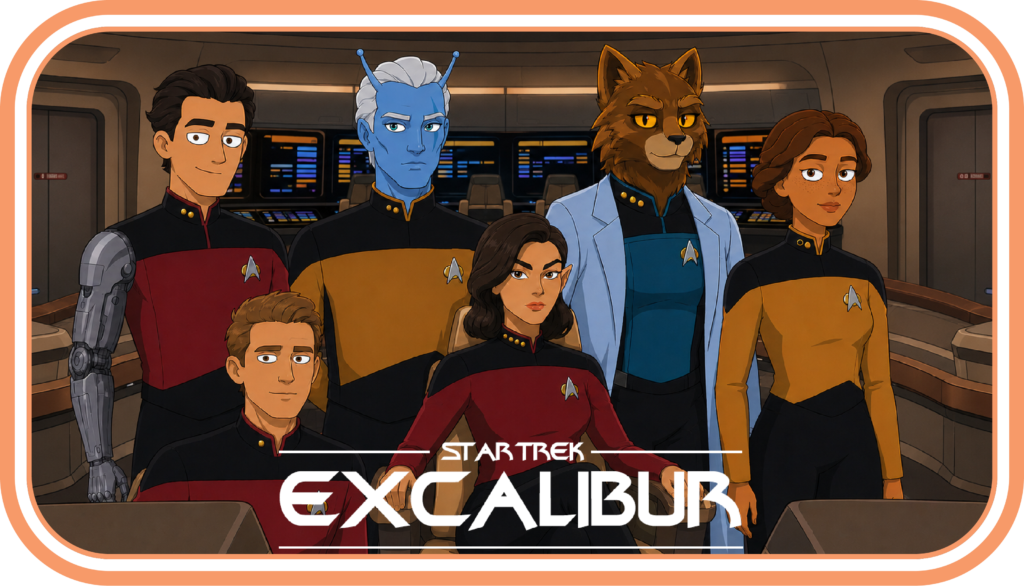
The artwork has evolved alongside the campaign. In the early days, I used Hero Forge to create sample characters and used those renders as their portraits. They did the job well and helped give every NPC a distinct identity. More recently, however, I’ve switched to AI-generated artwork to create portraits inspired by the style of Star Trek: Lower Decks. (I can almost hear your readers collectively groan at the mention of AI!) For me, though, it’s been an incredibly useful tool. With a campaign featuring hundreds of characters across multiple species, it simply wouldn’t be practical—or affordable—to commission original artwork for every single one.
The important thing is that the portraits aren’t there to replace artists; they’re there to help my players instantly recognise a character and make the world feel more alive. Having a consistent visual style across the entire campaign makes a huge difference to immersion, and AI has made that achievable in a way that wasn’t possible for me before.
That said, if this were a commercial project, I’d absolutely want to work with an artist. There’s no substitute for collaborating with someone who can take your ideas and bring them to life in a truly unique way. But for a private home campaign, AI has allowed me to create a cohesive visual identity that enhances the experience for my players without putting an impossible strain on my wallet.
At the end of the day, whether it’s a Hero Forge miniature, an AI portrait, or a commissioned illustration, the image is there to serve the same purpose: to help the players remember the characters they’ve met and make the universe feel like a living, breathing place.
The campaign seems to have been running for over a year. Have the players/characters remained basically the same throughout or have things changed a lot? How do you feel they (and you) have developed along with the Campaign?
Like many club games, the first few months were a little fluid. The Northside Adventure Gamers Association offers a wide variety of games, so it’s only natural that players occasionally try something different when another campaign catches their eye. By the end of our second mission, though, we’d found our core crew, and they’ve been together ever since.
Looking back, the biggest change hasn’t been the roster—it’s been everyone’s confidence. We were all learning Star Trek Adventures at the beginning, and like any new system there were plenty of moments spent checking rules or looking things up. Now the mechanics have become second nature, which means they rarely interrupt the story. The rules have faded into the background, exactly where I think they belong.
As the Game Master, I’ve evolved as well. Along the way I’ve created player aids, reference cards, and quick-action guides to make the game flow more smoothly. Those little quality-of-life improvements have helped keep the focus on the narrative rather than the rulebook, and I think they’ve made everyone more comfortable trying creative solutions.
The characters themselves have also grown in ways I hadn’t anticipated. Star Trek Adventures encourages players to reflect on their experiences through personal character logs, and those stories become part of their ongoing development. Rather than simply gaining new abilities, the characters evolve because of the choices they’ve made, the people they’ve saved, and the impossible decisions they’ve faced. Their Values change, their priorities shift, and they become more rounded officers because of what they’ve experienced.
For me, that’s been the most rewarding part of the campaign. We started as a group of people learning a new game. Over the past year the players have become the senior staff of the Excalibur, and I think everyone around the table feels that difference.
Who updates your Adventure Logs? Do you all engage in this activity?
I handle the main Adventure Logs, but they’re only half the story.
Before each mission, I’ll write the official mission log in the style of a Starfleet Captain’s Log or senior officer’s report, complete with custom graphics and a portrait of whichever character is narrating that entry. It’s my way of presenting the episode as though it had just aired.
The players then add their own Character Logs as comments beneath the main entry. I absolutely love reading these because they’re written from each character’s perspective. One officer might focus on the ethical dilemma they faced, another on the scientific discovery, while someone else is still annoyed that there wasn’t a Romulan conspiracy facing the crew this episode! Seeing the same events through different eyes adds another layer to the story and often reminds me of moments I’d forgotten had such an impact.
The best part is that Star Trek Adventures actively encourages this style of play. Character Logs aren’t just flavour text—they tie directly into character growth. Players can reflect on how events have changed their characters, revisit or challenge their Values, and connect those moments to their ongoing development. The Adventure Log becomes more than just a session recap; it becomes part of the characters’ personal histories.
It’s one of my favourite features of the campaign because it keeps the story alive between sessions. By the time we sit down for the next game, everyone has already had a chance to step back into character, reflect on what happened, and think about where their officer is headed next.
Have there been any particularly memorable sessions? What happened? Why was it memorable? In what way? Feel free to include comments from your fellow players in this description.
When I asked my players this question, the overwhelming response was simply, “All of it.” As flattering as that was, however, I insisted they give me something a little more specific!
One moment that came up repeatedly was a confrontation deep in the Engineering Section of a derelict Federation Starship with a Romulan officer who had fallen under the control of one of the neural parasites—the Bluegills, for those who remember the Next Generation episode “Conspiracy.” The encounter became a frantic balancing act, with half the crew desperately trying to shut down the warp core while the rest fought the possessed Romulan in brutal hand-to-hand combat. It perfectly captured Star Trek at its best: solving a scientific crisis while trying to survive an impossible situation.
Another favourite was the climax of our first season. The crew discovered a hidden Bluegill stronghold built around an ancient Arconian Gate—a canon piece of Star Trek lore that’s essentially a Stargate. It was there they confronted the Mother, leader of the Bluegills, in a spectacular final showdown. One of the players jokingly suggested that the insect swarms should suddenly have wings. Rather than saying no, I spent some Threat—the Game Master’s narrative currency—to make exactly that happen. The laughter quickly turned into panic, and it’s become one of those legendary “You remember when…” stories that still gets brought up around the table.
Several players also mentioned their first meeting with Morgana, an enigmatic being with powers reminiscent of Q. She has become one of those villains that players love to hate: always manipulating events from the shadows, always seeming to know more than she’s willing to reveal. She’s woven deeply into the mythology of the campaign, and every appearance leaves the crew with more questions than answers.
For me, though, the most memorable session happened only recently. The crew discovered an ancient alien data archive connected to the same civilisation as Morgana and unknowingly activated it aboard a Federation starbase. As the station’s computer systems were slowly taken over, a fragment of the archive infiltrated the Excalibur itself. Suddenly the party was split between two simultaneous crises—half trying to save the starbase while the other half fought to regain control of their own ship.
As a Game Master, those sessions can be terrifying. You’re constantly cutting back and forth between two groups, trying to make sure everyone stays engaged and gets their moment to shine. But that night, everything clicked. Every player had a chance to be the hero, nobody dominated the spotlight, everyone built on each other’s ideas, and the whole table felt completely invested from beginning to end.
Those are the sessions I remember most—not necessarily because of the explosions or the villains, but because everyone around the table was telling the story together. When your players are still talking about those moments several months later, you know you’ve created something special.
Okay, as a last question, we always ask for the GM’s “pearls of wisdom”. What GM insights can you offer the community this month?
If I could leave GMs with just two pieces of advice, they’d be these.
The first is simple: be your player characters’ biggest fan.
That doesn’t mean making things easy. It doesn’t mean pulling punches or handing out victories. It means genuinely wanting the heroes to succeed because their success creates the most memorable stories. I think too many Game Masters still fall into the trap of treating the game as “GM versus the players.” I’ve never found that particularly satisfying.
Instead, I try to say “yes” as often as possible. Sometimes it’s “Yes, and…” Sometimes it’s “Yes, but…” The important part is that I’m looking for ways to reward creativity rather than shut it down. My job isn’t to beat the players—it’s to create situations where they get to do something extraordinary. I want my players to walk away feeling like they just watched the best episode of their favourite TV show, and they happened to be the stars.
The second piece of advice is about preparation.People often ask how I can improvise so much or adapt when the players head off in a completely unexpected direction. The truth is, I rarely prepare locations—I prepare scenes.
A scene doesn’t care whether it happens in a starship corridor, an old Scottish tavern, or an abandoned mining colony. It’s simply an interesting situation with interesting people, a conflict, and a purpose. Once the players decide where they’re going, I look at my toolbox of scenes and ask, “Which one belongs here?”
That approach has two huge advantages. First, the players feel like they’re driving the story because they genuinely are choosing where to go. Second, I get to be surprised as well. Instead of forcing my ideas into a predetermined sequence, I get to discover the story alongside my players. After more than forty years behind the screen, that’s still one of my favourite parts of being a Game Master.
At the end of the day, that’s what tabletop roleplaying is all about. The players don’t remember perfectly balanced encounters or beautifully organised notes. They remember the moments when everyone at the table looked at each other and said, “Did that really just happen?” If you can create those moments, you’re doing it right.
Thank you to the community for making this campaign of the month possible! That’s all for now, join us on our next adventure September 1st, and don’t forget to nominate your favorite campaigns for our next Campaign of the Month!