Author Archives: vadercomplex
Obsidian Portal Campaign of the Month November 2024: Dark Conflagration

“In a system on the Terra side of the Great Rift this group in service to an Inquisitor must prove their worth through grit and valor to hold back the closing despair. Join them as you pour through this restricted Inquisitorial system and read along with their adventures in their own words.” Please join us in this month’s interview for COTM Dark Conflagration with our GM Medacia and Kenkewl00!

Tell us a little about the people behind the logs. What’s your group like, how did you all start playing together, and what drew you to Warhammer?
We have a group of 3 full time players, one part time player, and the GM. All of the players are lifelong TTRPG players from various professional backgrounds like healthcare, finance, baking, and theater. The GM tailored a short list of concepts for each player and let them choose their favorite. You can see the flavor of the character and the style of the author in each entry into the Inquisitorial Journal System.
The group has been going with varying members for over 8 years, starting with a long-running Vampire the Masquerade game. A few of us got into (or back into) WH40k about a few years ago when they came out with the box sets for pre-built armies, and enjoy the more miniature-focused gameplay.
Warhammer 40K’s atmosphere of hopelessness populated with great acts of heroism is what drew the GM to the system. The grind of ten millennia of slow collapse and bureaucracy combined with the terror of the events surrounding the Great Rift create a need for sacrifice and courage to fight back the encroaching darkness.
How often do you play, and how do you generally do so (online, in-person, hybrid)?
In-Person, once every 2 weeks is the schedule. Occasionally we’ll miss a scheduled session due to real-world obligations or add a session in-between when we can.
For folks that are perhaps less familiar with the world of 40k, where does your game fit into the grim dark?
It’s set after the universe got split by the Great Rift as Cadia fell, in a GM-created star system on the Terra-side of the divide. It’s inspired from various events going on throughout the 40K universe in the early part of M42. The players are part of a small group in the service of an Inquisitor in the Consus System, near the Pariah Nexus.
I love the various art on your site, from Characters to Items, Adventure Logs to Wiki Pages. How do you create/source the artwork, and do you have a secret for keeping the feel so consistent across your whole site?
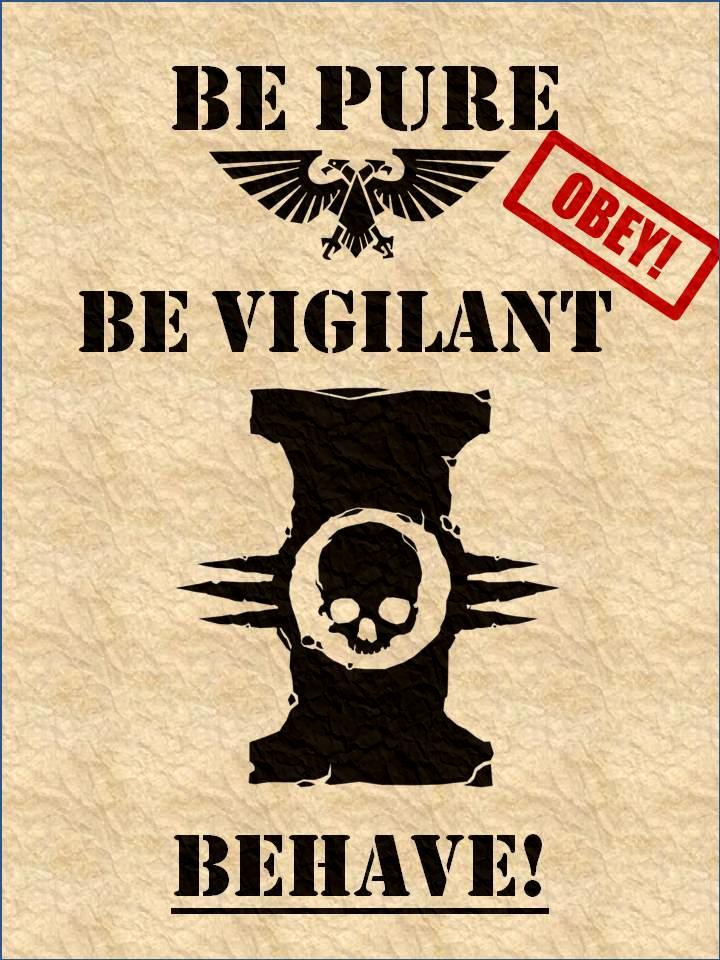
I chose a stylized realism for the overall theme. I sifted through many AI art sites and styles before settling on one that captured my look. I’ve used a lot of iterations of a single concept before settling on any image that makes its way to the site. As I learned more about how the AI responded to particular prompts I’ve been able to achieve my desired outcomes more efficiently. I’ve also tracked down specific pieces (like the propaganda posters) from existing art and included my favorites in entries or slideshows where appropriate. I’ve created or modified images and run it through a program that creates short videos for the cover page to create a more dynamic feel, hoping to give the viewer a more engaging experience like they’re breaking in to the Inquisitorial Journal System.
As you’ve been on Obsidian Portal for quite some time, what is your favorite campaign wrangling feature?
I have mostly used OP as a way to stay consistent as a GM – once its online, it’s easy to reference and I don’t have to deal with lost papers. I should probably use more of the functions truth be told. I like the session reminders, and the forum to post little things in-between sessions to keep players and fans engaged.
Swapping to your intense site for a moment, where did you come up with the style design you have?
I want to give the OP a more exciting feel than the standard campaign designs that I see. I want it to be an experience, and I want the players to sign in and make updates feeling like their characters journaling their horrifying experiences fighting the Chaos cultists. I also want fans to get excited to see the next update, to present a taste of how things would look in the collapsing world of 40K. I want them to feel like they’ve snuck into this secret archive and they’re watching the story evolve from afar. To inspire them to create their own star system, their own Inquisitorial warband and fight off the wickedness of a violent, indifferent universe.
I love your adventure logs, I see that one of your players is involved with them as well. How do you split that load?
Mendacia handles most of the details of the Logs – the game notes, the notable events/locations/people, that sort of thing. kenkewl00 gets involved by occasionally putting a placeholder Log in there for Mendacia to edit later, since one way to encourage player involvement we are utilizing is to give out in-game goodies (extra wrath tokens, given our system) for players to put notes from their characters perspective. kenkewl00, as a normally-GM type, tend to put more detailed notes than others, but the Ogryn puts a lot of time in to write the log in a low-int style since they are “in character journals”.
Back to your game, can you share an example of a particularly memorable moment from your campaign?
Lots of epic moments for a campaign that’s only six months old, plenty of acts of heroism and bloody conflict that I could reference here. However, I think the bright spots in this violent, grim saga are the personal exchanges between the Inquisition Pact members. The intro session for Roland (The Navis Imperialis Pilot) and Smasha (Militarum Ogryn) cemented their dynamic and it led to some great roleplaying. In the Calamitous Intent session this plays out with the Ogryn’s massive bulk and clumsiness enraging an entire bar full of patrons, effectively chasing him with torch and pitchfork. A few blocks of pursuit later the noble-born Pilot puts himself between the Ogryn and the crowd and has to use every trick up his sleeve (charm, bribery, his Navis uniform) to calm them. There’s a sense of obligation between Roland and Smasha, just the prior session Smasha had put himself between Roland and the blades and lasers of cultists.
Let’s round this out with one of our favorite questions for our featured GMs! If you had a secret sauce for running a great game, what would be the most important ingredients?
1. Don’t over-prepare. Set up the big detail points, but let the players choose how they get there. They’ll almost always surprise you.
2. When you’re getting started, don’t fall in love with your NPCs. Put out a large amount of them initially, and see which ones that players gravitate towards. I’ve had so many throwaway NPCs that wound up being central to the story because they meshed so well with the troupe.
3. Critical successes can lead to epic moments. So can critical failures. On both sides of the table! Make the most of these opportunities to engage the table and make memories.
Thank you to the community for making this campaign of the month possible! That’s all for now, join us on our next adventure November 1st, and don’t forget to nominate your favorite campaigns for our next Campaign of the Month!
Obsidian Portal Campaign of the Month September 2024: Echo of The Mists

Travel into this dark fantasy world – tune into the dedication of carefully crafted set up designs and story telling, by joining us in talking with shawnrstaub, the GM behind Echo of The Mists, the winner of our Campaign of the Month for September 2024!

First off, feel free to tell us about the person behind the GM screen. Where are you from? What do you do aside from gaming? Alter Egos? Life partners? Family?
Answer: Where can we interact with you on the internet? I am originally from West Virginia until my wife and I moved to Maryland for work and to start our family. My wife teaches 2nd grade and I work as a branch manager at a bank. Before COVID, I played bass in a heavy metal band themed around the “Legend of Zelda” game series called “Master Sword,” touring around the country playing the nerdy convention circuits. I retired from that life after my oldest daughter was diagnosed with cancer, which I’m happy to report, she has made a full recovery and started 2nd grade today at the school my wife teaches. Now, I spend my free time with my family and building terrain for my D&D games as well as 3D resin printing.
How regularly do you play, and where do you play? Tell us about your current group of players.
Answer: My D&D group is actually a really great story. I only started playing D&D around 2021/2022 when I was invited as a player to a game hosted by my former band mate and her husband and two other couples (sadly, my wife has no interest in TTRPGs). I’ve always enjoyed building and creating cool nerdy things (in my Zelda band, I learned how do leather working so we could wear custom armor on stage). So for that group, I built a custom gaming table with a 55′ TV screen in the center so we could use digital maps – this was before I started building 3D terrain.
After posting pictures of my gaming table, I was messaged by two separate Fraternity Brothers that I’ve not spoken with in nearly a decade telling me how much they liked my table. They shared with me that they had never played D&D, but never had a group or the confidence to try it out. So I reached out to 2 other Fraternity brothers who I knew played, and the five of us started a game with myself in the position of DM! What started out as a Ravenloft one shot turned into an full-blown campaign that continues to this day. Life is busy, however, so we only get to play once or twice a month, alternating between in person and digital games depending on everyone’s availability.
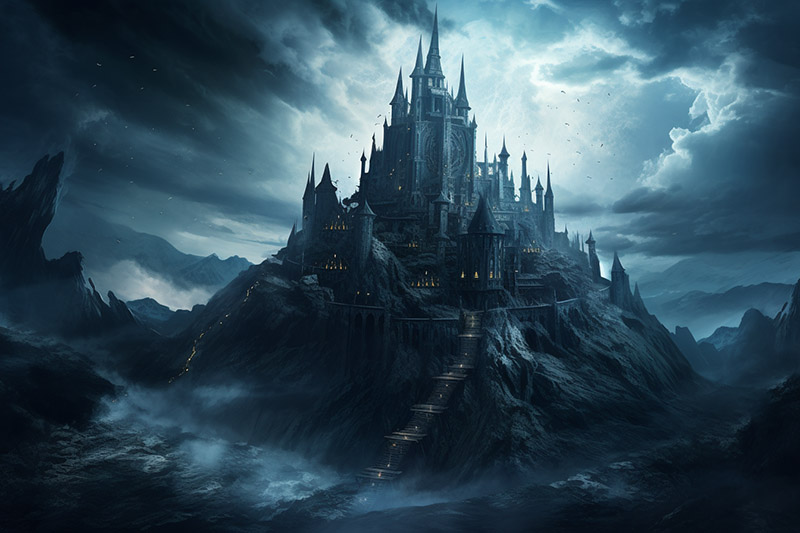
Tell us about “Echo of the Mists” in a nutshell. How did you design the campaign? What was your inspiration?
Answer: Echo of the Mists is a homebrew campaign based in the Ravenloft setting combining classic Ravenloft lore, 5e lore, or homebrew content (whatever speaks to me or works in the moment). Although it has yet to be revealed to my players, they will eventually learn that an “echo” refers to the manifestations of specific, powerful entities that exist throughout the multiverse of D&D as “variants” of those entities. One such entity has unwillingly trapped itself within the cage of Ravenloft and is using its power to draw in (and devour) its own echoes in an effort to gain more power and escape.
Why did you choose Ravenloft as the setting for your campaign? How does the setting complement your plot?
Answer: I love vampires, werewolves, ghosts, and all things spooky, so Ravenloft was a natural choice. Admittedly, our game is more “dark fantasy” than “horror,” but it still allows for me to explore dark themes and spooky stories.
Your wiki section details a lot of domains, but some don’t have a wiki page. Do you add the details of these domains as the players move from one domain to another?
Answer: There are A LOT of Domains in Ravenloft – too many for me to possibly develop between my family life, work, and creating terrain, painting minis, and creating content. So I develop the world as the players move through it and help guide what needs to be developed and what doesn’t. I also love having my players contribute to the world, so whenever I can, I have them make decisions about the world and characters within it. For example, there are times I’ll ask my players to create features in the world like a family estate or a describe the people from their past. I’ll take their ideas and integrate them into the stories, scenes, and settings that they will explore.
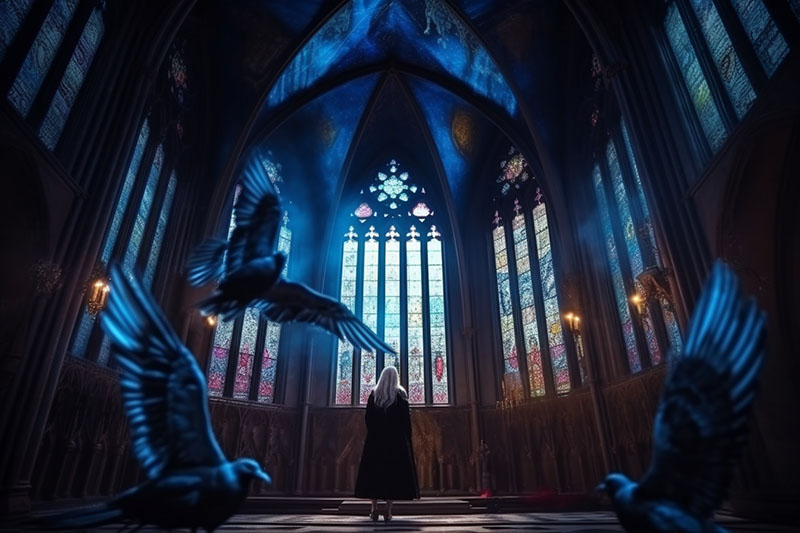
Dungeons & Dragons 5th edition has relatively few Ravenloft books. Are you using any materials from previous editions for your domains?
Answer: Oh yes, the older lore has lots of great content. I routinely incorporate “canon” material into my game, but love to fill in the gaps with my own homebrew. I’ll even try and marry the old and new lore on occasion. For example, in 5e they gender bend the ruler of Falkovnia – Vlad Drakov – into Vladeska Drakov. In my game, Valdeska is the daughter of the original Dark Lord who has systematically butchered her many, many siblings to take the reigns of power as the undisputed ruler of the land.
How much time is usually spent preparing your game sessions? Describe a typical session.
Answer: Its hard to say how long I prepare because I do it in bite sized chunks after my kids go to bed while I’m watching Netflix with the wife! I’ll write it little notes and ideas to myself and come back to it later. As any DM knows, some content you make gets completely bypassed by players, but I’ll often “recycle” that content. The old catacombs that the players never explored becomes and underground fortress of a necromancer of laboratory to a mad scientist. I’ve learned that if you “save it for later,” later never comes!
How long have you been using Obsidian Portal? What brought you to the site and what keeps bringing you back?
Answer: I think I started in 2022 as a way to store my ideas and content. I would never be able to remember everything, so having a man repository that is organized the way I like it is super helpful. I’m 99% sure my players don’t even use this wiki, but it sure is helpful for me to keep my world straight and organized.
If you had to pick just one thing, what would you say Obsidian Portal helps you with the most?
Answer: Organization for sure. Visuals help me remember things far better than names and texts, so having things arranged exactly the way that makes sense to me is very helpful.
What would you say is the biggest highlight of your game so far (please also provide images and links if possible)?
Answer: Anytime I can get the reaction of “I REALLY hate that guy” from my players regarding an antagonist feels like an absolute victory to me. Also, when my players geek-out over my table setups, it makes all the work I put into them worth it.
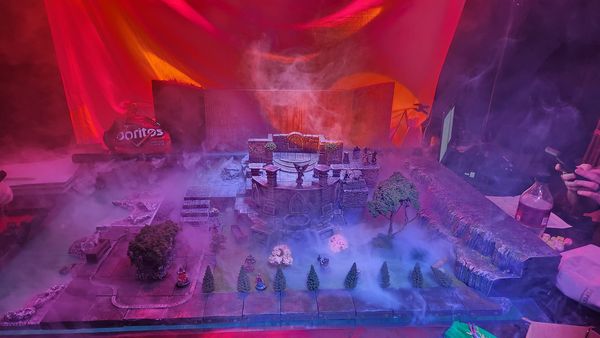
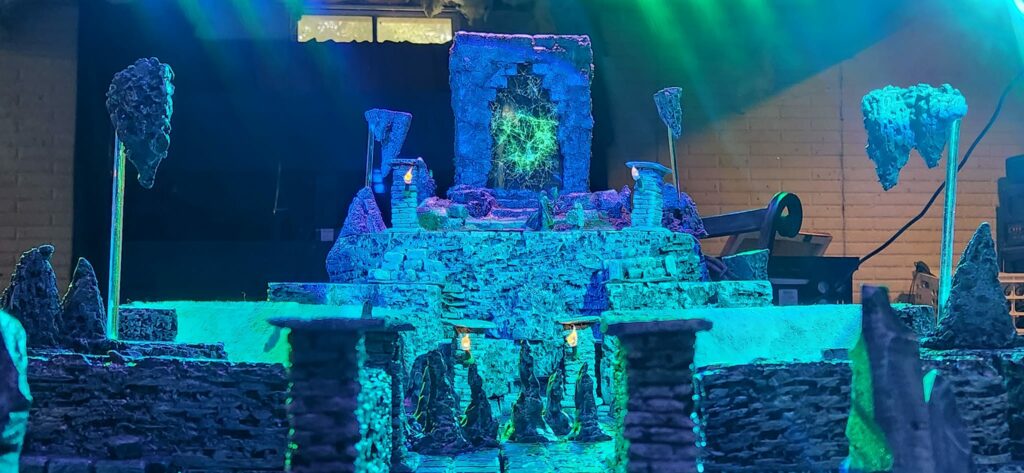
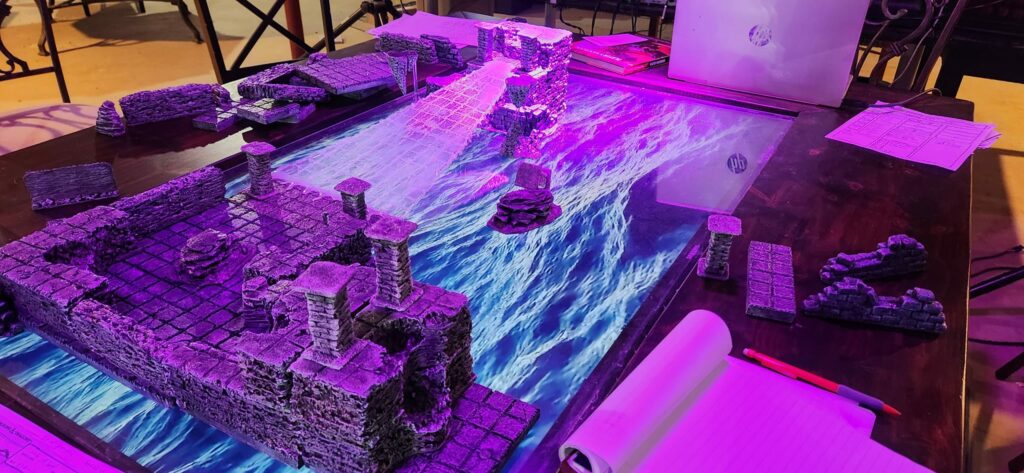
Okay, as a last question, we always ask for the GM’s “pearls of wisdom”. What GM insights can you offer the community this month?
The game and story are better if you don’t stubbornly cling to what you think SHOULD happen, but instead let the story naturally progress. The classic saying is that no story survives the encounter with the players, so let that inspire you. I often will come at a setting with the mentality of “what would happen if the players did NOT intervene?” Then, I use the choices the players make inform what DOES happen, and more often than not, its unexpected and better than what I would have planned. I love not knowing what will happen, so every session is exciting and rewarding for everyone at the table.
Thank you to the community for making this campaign of the month possible! That’s all for now, join us on our next adventure September 1st, and don’t forget to nominate your favorite campaigns for our next Campaign of the Month!
Obsidian Portal Campaign of the Month July 2024: Ars Magica, Umbra Quercus Saga

“Gather your grogs and call upon the covenant of Umbra Quercus, our new Campaign of the Month winner! At the helm, the madirishman and his mystical magi, who have collaborated for several years to produce a fascinating fable steeped in deep lore, strange sorceries, and a setting and story that reads like a great adventure novel. Wander onward to gain a glimpse of this admirable Ars Magica campaign.”
You’ve worked professionally with Atlas Games so you probably have a better understanding of Ars Magica than most. For those who don’t know the game, can you briefly describe the system and setting?
Hoo boy, you’re really in danger of putting me in full proselytize mode when asking about Ars (ArM is the semi-official shorthand I guess, but we always just call it “Ars”). I discovered the game in the mid-90s or so when it was Third Edition and immediately fell in love. It’s my favorite setting/system and our current saga is the sixth I’ve played in.
My initial draw was undoubtedly the magic system, which has rightfully been much acclaimed. It’s incredibly flexible and after five editions, remarkably internally consistent. Spells are generally in the form of “verb + direct object”: a Technique and a Form, and your magus character will have varying scores in the Techniques and Forms depending on what you choose to specialize in. Because of the setting, these are in Latin, but once you get past that, it’s remarkably easy to design spells that are consistent in power relative to one another. Your standard Fireball (more prosaically named Ball of Abysmal Flame in Ars) would be a type of Creo Ignem (‘I create fire’) spell, but if your score is high in Creo you might also use it to effectively Creo Corpus (‘I create body’) to heal someone. (Note there is no resurrection in this game, but magi typically live many years beyond those of normal men through longevity rituals.) Likewise, laboratory activities are well defined and tell you how to make new spells, magic items, etc. While you gain experience points like in other games to advance your skills, it is generally these lab activities that increase your power. Over years of game time you pursue these to achieve truly epic magical abilities.
Secondly I am a bit of a Medieval history buff and while you could use the rules to play in, say, Middle Earth, the default setting is “Mythic Europe” of 1220 AD: basically our historical Europe, but the things people believed then are literally true. Magic exists, demons corrupt the unwary, faeries perplex travelers, you encounter angels and dragons, etc. I particularly love trying to reinterpret actual history through the lens of this setting. Sure, the Mongols sacked all of Medieval Rus but spared the great city of Novgorod. Was it because the Russian ground became too swampy for them to attack the city? Did Novgorod avoid destruction by paying tribute to the invaders? Or maybe magic was used to influence the general’s mind and convinced him to spare it?
Yet slapped onto this quasi-historical Europe is a completely ahistorical political entity. All the magi are members of the secretive Order of Hermes, which governs how magi may interact with not only each other but the “Mundanes,” as people without the Gift are known. (Beats “Muggles,” IMO.) So you can also milk a lot of great stories out of these interactions, even though in our current game we decided to set our saga in the Hermetic boonies specifically to tone down this particular dimension of the game.
What is the main story, so far?
Our characters are magi fresh out of apprenticeship who have stepped into a mystery. Instead of founding their own covenant, they were invited to join an existing one founded by a trio of powerful magi. Yet not only have these founders disappeared, the wizard who recruited them was likewise nowhere to be found when they arrived at their new home.
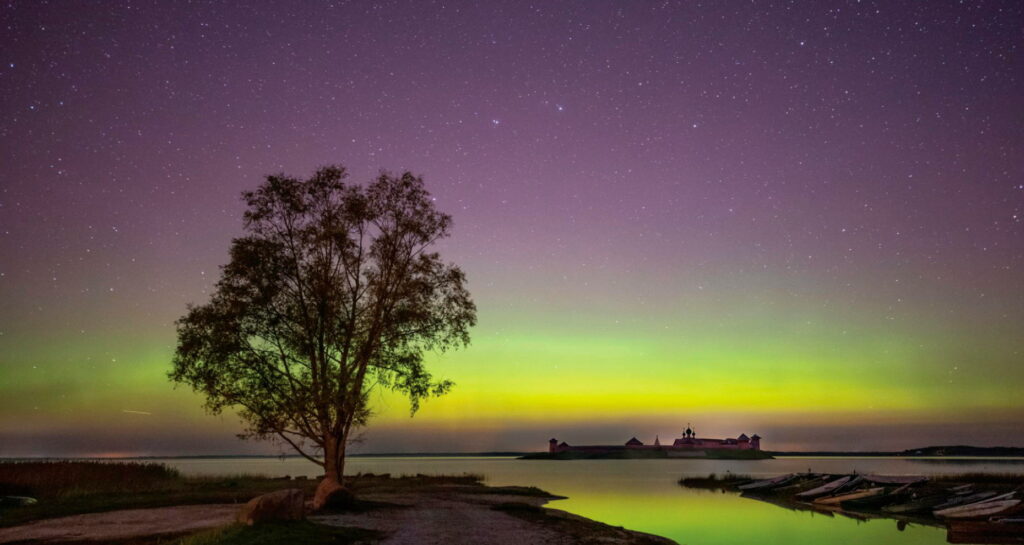
Their covenant home is a small island on a remote lake with impressive fortifications in Livonia (modern-day Latvia), where German crusaders are fighting against native tribes to Christianize the last pagan part of Europe. The players have learned that the covenant has some connection to a prophecy about the destruction of the Order of Hermes, and the founding magi apparently were there to investigate. So finding their predecessors has taken on a new urgency.
Just recently they have unearthed the remains of one of the founding magus’ apprentices. Speaking to her shade, they have gained new insight into the last known appearance of two of the three founders. She was seemingly sacrificed by their as yet unknown enemies; what is less clear is the nature of the involvement of one of those founding wizards.
Along the way, the young magi have encountered menacing packs of wolves, a mysterious bird woman, and a faerie living in their bathhouse. They have chased an escaped pig, parlayed with mudmen, and encountered a mystical site that seems to produce doppelgängers of people under certain circumstances…
Umbra Quercus involves a good deal of collaboration, shared tasks, and organization with your gaming group, where Obsidian Portal is only one tool among many. Could you explain how your group typically uses OP, the campaign forums, Discord, Dropbox, email, and any other tools and tricks to help you play the game and coordinate all those wonderful tales that we get to read in your adventure logs?
OP has been critical for our many and varied campaigns. We’re big on Troupe play and there’s a lot of collaborative world-building. We also seem to favor somewhat Byzantine plots. :^) OP gives us a centralized place to store character stats, discuss rules or logistics by thread, keep track of when our next game session is, and more. Considering those Byzantine plots, I think the Adventure Log is among the most useful for keeping track of just what the heck happened last week or three months ago,
We started as a face-to-face group but like many others, COVID-19 forced us to move to Discord for actual game play; we’ve only met a few times in person since. Discord, however, has its advantages: it’s easy to share maps, links to web pages, and other resources in the middle of a game session. Like OP, there’s a paper trail as well; you can look back at the chat log and remind yourself of important details. I won’t dwell on my failed attempt to use voice modification software to simulate speaking to the dead…
Ars can get kind of complicated and so we have used numerous aids like Excel spreadsheets and files for (the now-defunct) Metacreator. Dropbox and Google Drive are great ways to let us share those files as well as PDFs for rules or character sheets.
Google Maps has also been huge in allowing us to share a map with all of the important sites of the campaign: other covenants of the Order, towns and fortresses, mystical sites, and so forth. Useful for translating those real-world sites into saga locations, and even ballparking travel distances. Take a look at our Map of Fortifications and Mystical Sites of the Region.
What moments during the campaign stand out to you and your group as real highlights?
In “The Crossroads,” the magi and their grogs avenge a young boy and rescue a local girl from the clutches of a corrupt Sword Brother by slaying him, only to encounter him limping down the road towards them only a few hours later.
In “The Evil Medieval Weevil Upheaval” (Beta Storyguide Ted has all the best names), the magi encounter a demonic centipede with a human face that casts a dire influence upon the innocent men and women of the local village with its ugly glare.
In “Puerulus Amissa,” the magi and their grogs, using earth, fire, mental manipulation, and induced hallucinations, protect a young Russian boy with the Gift from a group of soldiers determined to take him back to his harsh uncle.
In “This Little Piggy Went to Market,” a covenant guard is suddenly and mysteriously overcome with admiration for a piglet belonging to some German soldiers, and runs away with it, to the chagrin of his companions and causing all sorts of legal problems. If your game doesn’t feature a pig chase, you’re doing something wrong!
What are the advantages and disadvantages (if any) to having more than one Storyguide in an Ars Magica campaign?
The Troupe style of play was baked into Ars from its early days, and this was something of a revelation for me. Due to time constraints imposed by schoolwork, I was used to the idea of rotating DMs all the way back to playing AD&D 2e in college, but Ars was the first game I encountered that was really pretty much designed to have people play different characters depending on the needs of the story. In fact, the characters’ covenant (where they live together and practice their magical arts, be it a castle, sailing ship, or traveling caravan) is really the central character of any saga. Instead of having to have everyone meet in a tavern and then get hired to rescue the princess, the covenant concept is a natural impetus for driving all manner of stories, and the covenant itself evolves just like the player characters do.
Each player has a Magus—the most powerful characters in the game—and a Companion: a character of note who has some reason for affiliation with the magi. (These you might think of as the other “character classes”: a knight errant, a traveling troubadour, a curious monk, etc.) If it makes more sense for your companion to participate in a story, you might play them instead of your magus. Then there are the Grogs: background characters that may be swapped between players when they’re not playing either of the above. Think foot soldiers, the blacksmith, or that book merchant who occasionally visits.
This means even the GM gets to play every once in a while, and while there’s always the dangers inherent in design by committee, I’ve found that if you have multiple creative and knowledgeable people working to build the game world, it’s often more detailed and interesting than anything one could come up with on one’s own. It’s certainly more satisfying for the players to have a voice in the bigger story. It also helps when you have a group of busy professionals that no one person is on the hook all the time for creating stories! To avoid any problems, the Storyguides typically have ownership of their own story arcs, and any story abutting one of these arcs is talked through in advance. This also keeps spoilers to a minimum.
Ars Magica has what some players consider the best (or at least the most interesting) magic system in table-top roleplaying. Would you agree with that idea and why?
It’s definitely the most flexible simulationist system I’ve run across, as I think becomes clear when you think about my description above. In fact, it gets kind of hard to give it up if you go back to another system (A brief primer worth mentioning). We played a group of wizards in our last (non-Ars) game and while it was a lot of fun, we kept saying in many situations, “well, if this were Ars, we could…” While your characters will have a set list of spells they can cast relatively effortlessly, the system allows you to spontaneously “invent” spells at a cost of Fatigue. Ars Magica Fifth Edition has a robust set of guidelines that allow you to be creative with magic in any situation, yet also tell you what your limits are. Want to dig a hole magically? You look at your Perdo (I destroy) Terram (earth) scores. Want to dig it in stone? Well, the rules tell you that’s harder. Similarly for parameters like how big the hole is or how long an illusion spell lasts. It allows players to be very imaginative in coming up with magical solutions. (“Well, I don’t think I have the scores to fling my jailer across the room, but I might be able to levitate those keys off the hook on the wall…”)
Sounds like magi can do anything, right? Well, with the right scores, they can. But they bleed just like everyone else.
Also, Ars Magica’s best days may yet be ahead: Atlas has announced the Ars Magica Definitive Edition for this fall, which will revise and consolidate the current Fifth Edition rules, but perhaps most importantly, inaugurate an open license which will allow for a host of new materials.
By way of your Obsidian Portal profile page, we discovered that you’ve done a great deal of wonderful character sheet design work over the last quarter-century or so (http://www.mad-irishman.net) and generously shared them with the gaming world. What elements make up a very good character sheet, in your opinion? Or, to put it another way, what common problems do you find on some standard character sheets that often need to be fixed?
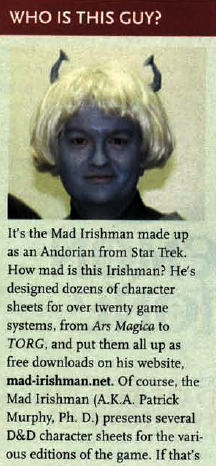
It’s gratifying that people have found my stuff useful…and my site afforded me an appearance in Dragon magazine with a picture of me dressed as an Andorian, so there’s that.
Designing character sheets is a bit like designing user interfaces for web pages. You want to have the information you need at your fingertips. Typically, sheets focus on information that is unique to your character, but sometimes there are frequently-accessed rules that everyone needs to hand.
Character sheets for RPGs used to be almost an afterthought. Typically I could open an RPG book, flip to the last page, and see something that was like the last thing anyone worked on and seemingly created by someone who hadn’t actually played the game. Having desktop publishing software at hand, at first I was just using it to create copies of existing sheets that I could print rather than photocopy, but it was only natural I started making sheets for how I played the game and what information I thought I needed to record.
But people have different needs, one size does not fit all, and games have certain options players may choose to adopt or ignore. This is why some of my later sheets utilize PDF layers: by toggling these layers on or off, the same space on the page can be used for different blocks of information, or at least different styles.
As someone with gaming industry experience in writing, layout, font design, and even a bit of cartography — what do you love most about the creative process with regard to games?
I guess the problem with answering that is I love all of it. There are many games and gaming products I adore, and some of them may have had, say, a great story, but looked like they were produced on a 1940s typewriter and then Xeroxed. But when I think of some of my favorite products, many of them feature multiple impressive design dimensions.
AD&D’s Desert of Desolation series? An evocative setting replete with Jim Holloway artwork. Woodcuts by Eric Hotz define Ars Magica and Hârn. Similarly, where would the World of Greyhawk be without Darlene’s cartography? And nothing says “Gamma World” to me like that Shatter font, or anything Middle Earth and an uncial font (thanks, MERP and Ralph Bakshi).
When Victory Games’ James Bond 007 RPG came out, I was struck by the loving *design* of the products: prop handouts replete with the “For Your Eyes Only” folders, eye-catching layout, and a splash of color in the text itself…which in the mid-80s, was quite the change. This was all *on top of* innovative rules like ease factor bidding and chase scenes.
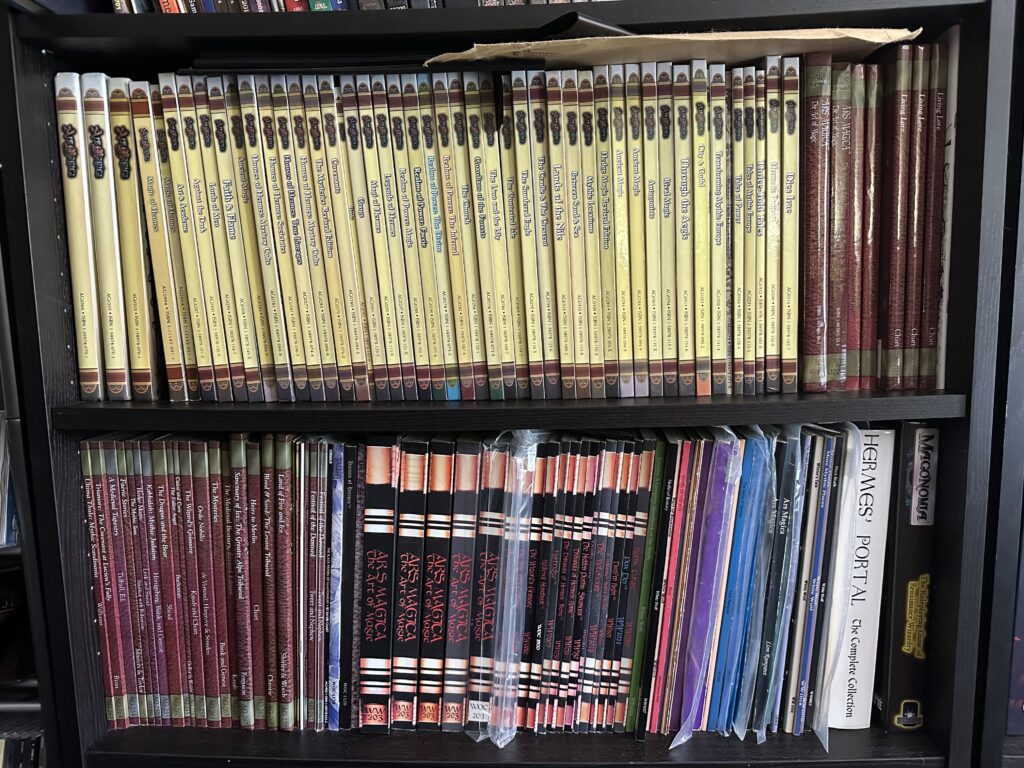
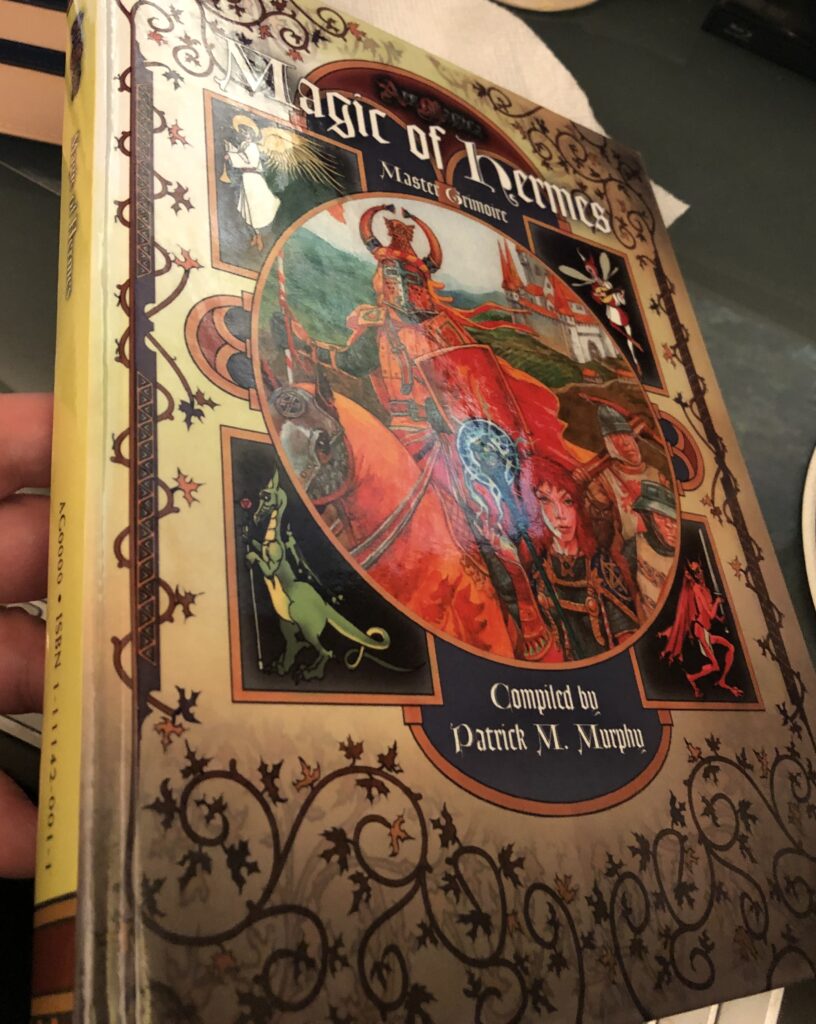
All of these areas of design are great fun as far as I’m concerned. Perhaps a more extreme example of me having that kind of fun (also outing my compulsion to compile information I guess) is my Ars Magica “Master Grimoire” that I have been compiling for the last 20 years. It contains all of the spells and spell guidelines from the official Ars Fifth Edition products, but also those from earlier editions, fanzines, web sites, and so on. Invaluable for our game play. But of course I also had to lay it out exactly like an official Atlas Games product and mimic their trade dress. It currently weighs in at 455 pages! It’s pretty awesome, if I do say so myself…I just wish I could share it with everyone, but unfortunately it uses like a million different people’s intellectual property.
Anyway, I guess this is why I’m master of none of these areas but have dabbled in them all. :^)
This question is for those among us looking for new RPGs to play and hidden gems outside of the mainstream. Out of all the RPGs that you have played or own (and I know there’s a lot), what are some of the lesser-known game systems or supplements that you might recommend and why?
Man, another toughie, where I’ll want to go on and on. You can look at my other OP campaigns or the list of games I own (over at my Mad Irishman page) and get some feel for a few of them. I do have a ridiculously large RPG collection that includes many unplayed games to go with all those unpainted miniatures. <eyeroll>
Another setting I love—maybe my second favorite—is that of Space: 1889. Victorian adventure with scientific romance elements. Like Ars, it’s great for taking real-world history and giving it a twist, just sci-fi this time. The Great Game played out on the surface of Mars, with native cloudships dueling with Earth flying gunboats. You can also probably find it in a rule system you like: it’s been through its own GDW system, Savage Worlds, Ubiquity, and most recently, the Empyrean system.
While we’ve played that, one that’s still on my bucket list is Lace & Steel by Kitsune Press. Swashbuckling fantasy a la The Three Musketeers, but in a more fantastic world with centaurs (sorry, half-horses), ogres, and pixies. I love the mechanic for conflict: there are card decks to simulate fencing, sorcery, and that most dangerous of duels, verbal repartee!
If you like the idea of playing wizards in a quasi-historical setting, but like your rules lite, take a look at Magonomia: Renaissance wizards using the FATE system.
2300AD. Pendragon. Iron Heroes. I still want to play a straight Western game that doesn’t have steampunk, magic, or zombies. Many great games out there to try. The World of Synnibar is not on this list.
As is tradition, Obsidian Portal always loves to ask if you have any tips or sage advice to share for those of us who want to create and run games like this one?
There’s already tons of great gaming advice out there, so I’ll start with a focus on Ars and other “quasi-historical” games.
Real world history is your friend. You don’t have to be beholden to it, but it’s great to mine for ideas, since you don’t have to go to the library anymore to find out everything about Hungarian mythology or Venetian history. You can pluck many great story ideas straight from Internet resources on these topics and others. Then just think about how things might play out a little differently if magic or sci-if tech were involved…
I’d also put in a pitch for collaborative world building. If your players are game, you’ll get more buy-in from them if they’re all involved to some extent in setting the story. Lean on each player’s strengths and interests, and outsource some of that design and bookkeeping.
Pax, and may your Stress dice roll lots of ones!
Thank you to the community for making this campaign of the month possible! That’s all for now, join us on our next adventure August 1st, and don’t forget to nominate your favorite campaigns for our next Campaign of the Month!
Obsidian Portal Campaign of the Month May 2024: The World of Elurah


Flickering candlelight illuminated the sage’s page as he worked his quill furiously over the parchment’s surface. He squinted with the effort of finding the right words to put to page and illustrate his thoughts.
“Hope here is not yet extinguished. While civilization is taking its first tentative steps towards recovery, danger lurks around every corner. The monsters of the Dark Tide have not disappeared and even in the reclaimed land nature’s wrath and magical anomalies pose formidable challenges.”
His hand paused as the dinner bell rang, and sighed.
More of his thoughts would have to come later. He signed the page, “LucasValenti”.
And more writings would soon come… join us as we talk to LucasValenti about The World of Elurah and read on further into his scrolls of knowledge!
Q. Congratulations on The World of Elurah’s selection as the Campaign of the Month for May!
We’d like to get to know more about the icon behind the GM Section! Tell us a bit about LucasValenti… Where are you from? What do you do aside from gaming? Alter Egos? Life partners? Family? Where can we interact with you on the internet?
A. Thank you! I wish I had some sort of fascinating story to tell but at the end of the day‒surprise, surprise‒I’m just a huge nerd. I live in the Seattle-area of the US with my girlfriend. She and I have been together for the past 8 years. We spend our days playing TTRPGs, making geeky stuff and annoying our cat, Ashamane. My day job is in construction, where I model out plumbing systems for commercial buildings and hospitals. Exciting, I know. I partake in the SCA (Historical re-enactment, check them out!) and do a bit of cosplay. Outside of that, I just love making anything and everything. We’ve got an array of laser engravers, 3d printers and other funs toys. Drawing, painting, sewing, sculpting, resin casting, leatherworking; we do a bit of everything. She has recently relaunched her business and we’re starting to set up booths at conventions and are working on setting up an online store where she sells dice bags, gaming accessories, hand-made dice and art. Check out Celestial Peryton on various social media to see her stuff!
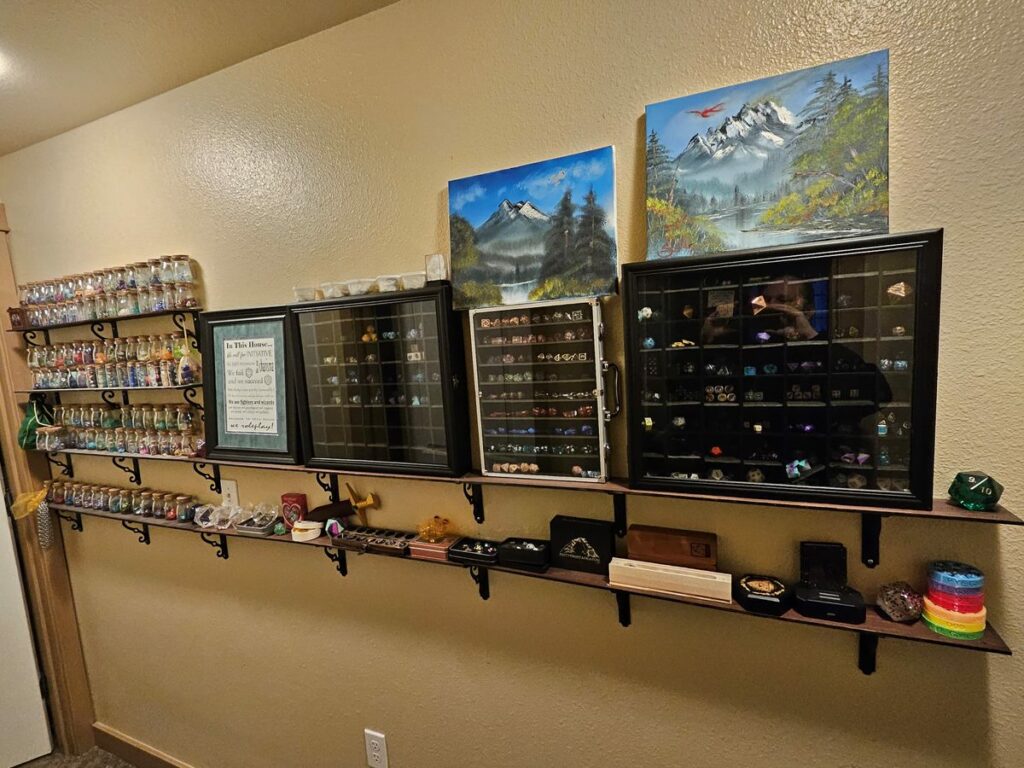
Here’s a small portion of her dice collection that has gradually taken over our hallway over the years. Many of the sets here are various experiments we’d made over the past few years learning how to mold and cast resin. Not featured are few large cookie jar-sized containers filled the brim with more dice and a few bags scattered around. She’s recently been upgraded from Dice Goblin to Dice Dragon on account of her horde.
We just spent 4 days at a local convention called Norwescon. I don’t tend to meet a lot of players outside of my game group and social media, so it was a great experience. It was a ton of fun to spend a few days chatting with a bunch of other gamers and talking about character creation and world building with everyone that stopped by our table. Everyone was super friendly and really excited to just spend some time geeking out about shared interests. It was also really promising to see so many newer players that are just getting into gaming! I got to feel like some kind of wise old sage dispensing out advice, haha. The event went really well and we’re looking forward to doing more soon!
Q. The World of Elurah is a Dungeons & Dragons 5E campaign. For those in the community who have not yet seen your site, and reveled in its glories, tell us a little bit about the setting you have created for the game, and what sets it apart. How did you create that awesome map? Where did you use Inspiration most during your campaign’s creation? Was it gained through Bardic Inspiration, or did you earn it through your pursuit of an Ideal?
A. Right, so on to the real reason I’m here. Elurah, as a setting, is something of a life’s work. I’ve been playing TTRPGs for the past 20 years or so and started GMing shortly after starting. Even before that, I’ve always been a huge fan of fantasy literature and D&D, in particular. I remember reading Brian Jacque’s incredible Redwall novels in elementary school and later moving on to the Shannara books, Dragonlance and Forgotten Realms. So, when I started actually playing D&D in my early 20s I had plenty of inspiration to draw upon. The first game I ever ran was in a small kingdom I created called Hairen. As I went on to run other campaigns I started sprinkling in NPCs and small nods to the games I had run before, which eventually led to everything naturally interconnecting. Finally I just sat down and officially tied all these disparate stories and locations together and Elurah officially was created. It all happened rather organically. But I can only take proper credit for the structure. So much of the world and its background owes to all of my players over the years that have added to and “lived” in it.
And then there’s the stealing. We’ll call it inspiration. There are entire swathes of the world that reflect what my current interests were back when I was making those parts of the setting for a campaign. Names and locations based on a game or a book series I was into. Character that were tweaked slightly and dropped into the world, etc. I used to try really hard to make everything new and unique and different. Eventually I realized that I didn’t need to try so hard. Tropes aren’t strictly a bad thing. When my players catch on to references to Monster Hunter or Warhammer 40k or other things, they aren’t upset or call me lazy. They see them as fun easter eggs. Heck, a lot of the original lore was just directly ripped from the Forgotten Realms. Kailea is just Netheril with a new coat of paint slapped on it, amongst many others. But all of those things are what me and my friends enjoy, so I want to bring those things in and have fun with them.
The gist of the setting, in the current timeline, is that it’s set after the Dark Tide, a massive magical apocalypse that unleashed hordes of monsters across the world. For the past few centuries, civilization has been relegated to living in massive walled cities (there’s that “borrowing”, again). However, the current period sees the world beginning to reclaim what was lost. Trade routes, while dangerous, have been re-established. New towns are being built and old ones reclaimed. There’s something of a tension to the setting, a precipice where they’re on the edge of either reclaiming what was lost or losing it all again. The through-line of this setting is this delicate thread of hope the world managed to weave, and whether the players are able to preserve and strengthen it. I didn’t want a setting that is full of grim chaos and despair. That period happened in the skip of the old version of the world to the current time and the effects of it can still be seen, but I wanted to provide my players with a setting that can grow alongside their actions.
The current main party is trying to piece together sparse information from the lost period of time and figure out the origin of the Dark Tide. This was the first game I started in the current timeline after the setting jumped ahead a few hundred years. I was stagnating on stories to tell, so I wanted to shake things up and create an opportunity for a bunch of new mysteries and plotlines. The appearance of the monsters that swept over the continent and how the world got to the point it’s found itself in are two of the biggest mysteries.
Meanwhile Hairen, due it its isolation, was spared the brunt of the Dark Tide and is even somewhat prosperous. Currently the party there is working to unravel an ominous prophecy with grave implications. This was my original setting I made years ago. Back then the campaign was called the Sundered Kingdoms. But due to the players in those original campaigns unifying the fractioned nations and re-founding the kingdom, well….it wasn’t very sundered any more, haha. This part of the setting is a little more advanced after the skip, with a strong budding aetherpunk vibe that I’m really into.
Lastly, the disparate shipwrecked crew on Haven have uncovered a secret that could change the course of the world. The mysterious vanishing island is, in fact, one of the lost floating cities of Kailea. With the help of an Archmage they woke from a magical stasis, they’re working to restore the arcane engines that power it. However, the Archmage guiding them may not be quite what he seems. This game has been fantastic. It’s the newest one I’ve started and we’ve only been player for 5 or 6 months. My players are all my GF’s family, from be brother and sister-in-law to a cousin and her nephew. Aside from myself running and Skylar playing, everyone else is basically a brand new player. So it was a lot of fun to create a game and really focus on building an experience tailored for teaching and slowly introducing them to mechanics and concepts of the game. Everyone really seems to be having a great time so far, and the setting itself is a lot of fun. The island is designed to be something of a…limited sandbox. I wanted to give them the ability to explore and hunt around without overwhelming them with too much content. But, as with the other two games, everything here ties into the overarching plot of the setting. In fact, this game will probably have the most immediate impact on the world depending on how it resolves.
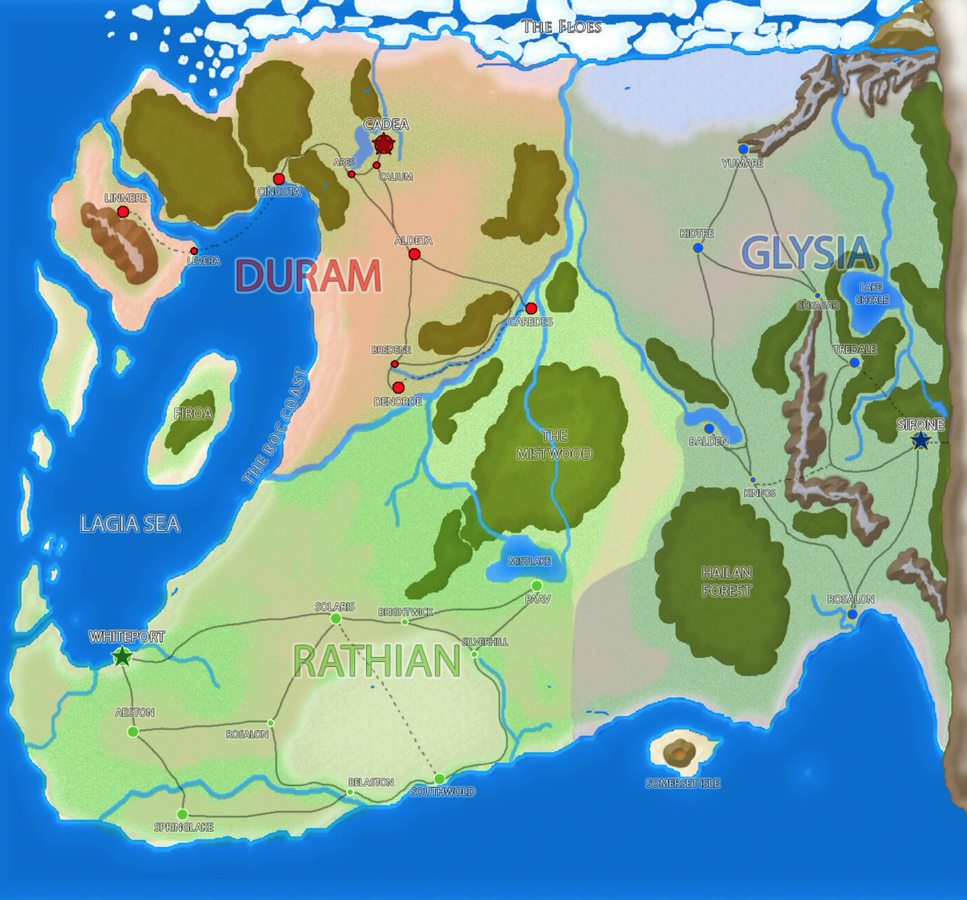
As for the map, you can thank Inkarnate. Huge shoutout to them and their tools. I was able to take years of hand-drawn maps and notes and combine them all into the current version on the site! I’m really good with character illustrations and creature design. I have come to realize over the years that I am…not a cartographer, haha. I was able to find a map on Inkarnate that was pretty close in overall design to the world and was then able to import and modify it to reach the version you see now. Though, the way things are going in-game, it may be due for yet another redraw soon. Here’s one of my older maps from when I was first trying to transition over to digital and attempted to update the map of the Sundered Kingdoms. It’s not…the worst, but the new version of Hairen is clearly much, much better, haha.
Q. How did your group meet up? How often do you play? What are your sessions like? I would be very interested in seeing some Adventure Log posts in the future about your group’s trials and triumphs – does anyone in your group plan to take on a role as Chronicler?
A. Currently, I have 3 groups all playing in different parts of Elurah, with a total of around 13 players spread across the different games. Some of my players are friends I’ve known since I was in school, used to be co-workers at previous jobs, or were just friends of friends. We play in-person, weekly, which means I’m currently running 3 nights a week. It’s a ton of work, but I genuinely love DMing so I don’t have any plans on slowing down. Our average session is about 3-4 hours. We’re all quite tight-knit, so our sessions tend to be quite relaxed and most of us have been playing together long enough that we just sort of have a groove we fall into. Lots of jokes, teasing, goofing off and we play some D&D in-between. We skew more towards roleplaying, so there are many nights where we don’t even throw all that many dice and just enjoy interacting with the characters and world.
As for and Adventure Log…I have plans! Before anything else, I have to give the biggest shoutout to one of my players, Seoc. She’s been playing with us for well over a decade now, and she takes the most meticulous notes. We’re talking stacks of binders over the years, hundreds of pages for each game. Check one of these things out!
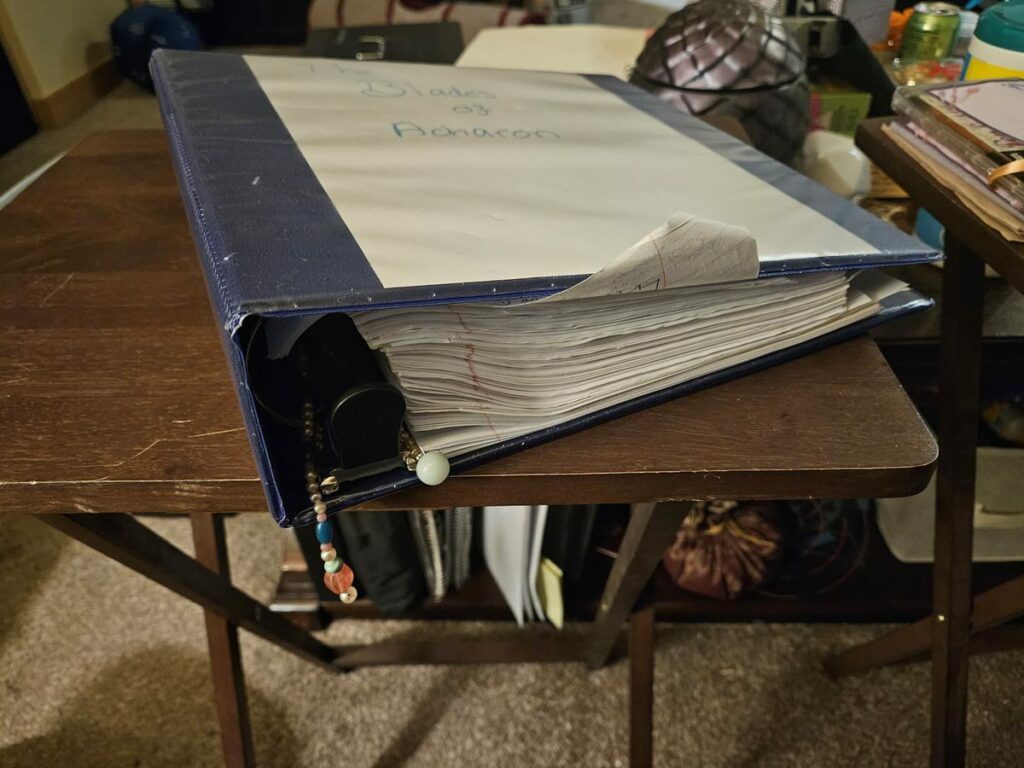
There have been times where I’ve been struggling to remember the name of some random NPC from a single session 5 or 6 years ago. She snags a binder from the shelf, spends a couple of minutes flipping through some pages and BAM, there it is! I seriously cannot throw enough praise her way for all the work she puts into it. The only downside is, well, they are all handwritten. I’m planning on writing up some synopses for each game in order to have a starting point for visitors to the site to see how the setting is actually being used and the current adventures that are taking place. Look forward to it!
Q. Your site has quite a lot of interesting features that I have noticed you update very frequently. From the navigation banners’ design, to the linked banners on each page, to the way you have set your backgrounds to match the color of the corresponding navigation banner. There are so many interesting tidbits that it is difficult to list them all! Do you have a background in design? How did you piece together all of these ideas to use these features and put them together to create your site?
A. I don’t have any real experience with web design, per se, however I do have a background in art and print design. I also have a fascination with color. That said, if there was one overarching design philosophy it would probably be “readability.” At the end of the day, the Elurah wiki is intended to be a repository of information, and that information being presented is always the focus. Everything is aimed towards helping the reader, I don’t want the site itself to be a distraction. So I use color to break things up and divide information in an unobtrusive way. I’m a simple man, but simple doesn’t have to be boring. The color-coded backgrounds, for example. The wiki currently has sections for Elurah – the primary continent, Hairen – a smaller isolated kingdom, and Haven – a mysterious lost island in the Thirhe Strait. When viewing a page related to information on one of those three, the background changes color to match, as well as the color of the various badges and buttons. Since there’s quite a lot of information available it helps keep the reader from getting too lost, you always have a sense of where you are. It’s all tied into the site Tag system with a bit of CSS I cobbled together from the forums. Using a [class*=”arilon”] or whichever campaign before my line of code, as long as I tag the page with the name of the campaign it belongs to, the backgrounds and set dressing are automatically applied. That said, it’s a bit of a shotgun approach because it’s not *just* looking for the tag, but really anything to do with the page information, haha. So if the page name happens to have the word in it, it’ll apply the effects regardless. Thankfully for me, I don’t really have any pages with the campaign names that aren’t for those campaigns.
The Nav bar is another good example. If you take a closer look, you’ll see that the 3 bars for those sections are primary colors, and are of a higher saturation than the others. It’s just a subtle way to naturally draw the eyes towards them, since those pages are the primary focus. Aside from that, the page layouts have a consistent formatting intended to present information and guide readers towards related pages. I like to break up larger blocks of text with buttons and images to add some visual interest and make them feel a bit less daunting. Walls of text can be scary! The consistent and somewhat understated design is something I’m most proud of. I recently decided to add some fun little deocartive corners to the page…and subsequently had to reformat basically every wiki page, haha. They were cutting off the text in the upper left of every wiki page, so I had to go through and add page titles to every wiki page. I’m actually really happy with the end result. I forgot how helpful something as simple as a page title can be, haha.
All of the various assets around the site like the buttons, icons and mouse cursor are either designs I created or ones that I found and edited to suit my needs. I do all of my editing in ClipStudio, since that’s the program I use for my Illustration work. I like everything to match and co-ordinate, so I reuse and modify a lot of my assets in different ways. For example, the NavBar icon is actually the same as the main decorative title buttons. I just lopped off one side, added a decorative caret and compressed the height into more of a banner shape. Like a nice rug, it really helps “tie the room together”, haha. As for actually coming up with ideas for what to add, really I just shamelessly steal from all over the web. Sometimes I’ll be on a random website and see something neat that catches my attention. Then off to google and down the rabbit hole I go. Not everything works, but it’s fun to just test out new things and see what I like and come up with interesting ways to implement them.
At its core, the site is mostly just the original layout with a handful of tweaks and a shiny coat of paint on it. I added in a few additional Nav bars for each of the current campaigns so they could live on the side. I hid a few elements for a more streamlined look and used my illustration and art experience to build a unified aesthetic. Most of the CSS invested isn’t for any flash or spectacle but, rather, to make using the site easier and more natural. I try to make sure that everything works equally well on both Desktop and Mobile, since often my players are looking up information on their phones or a tablet.
If anyone is interested in the code for any part of the site, I’m more than happy to share! I can’t promise it’s the most efficient, though, haha. I’m available on the OP Discord server or just via a PM.
Q. Your Timeline for The World of Elurah is a fantastic feature! I feel certain that a lot of GMs would be interested in knowing your process for building that page. Tell us a bit more about your thoughts behind its design, and how you went about putting it all together!
A. The Timeline! So this was literally the first major CSS tasks I undertook, because apparently I hate myself. I do not have any background in coding or web design, so naturally I decided to tackle the hardest thing right away. The base code for the timeline was provided by Keryth987 on the forums from his Phoenix Rising campaign, and from there I spent probably a week smashing my head against it to get it to work properly on my site. His version has some really slick animation to it and is really just incredible. It didn’t quite fit what I wanted, however, so I spent a lot of time teaching myself the basics of CSS and HTML in order to understand how it worked. So much trial and error and I constantly kept breaking it. But I finally figured it out enough to make it work, and I’m really very happy with the end result. One thing I do need to figure out is a way to indicate that the timeline entries are actually links! A lot of people viewing it don’t realize you can click on each entry for a full writeup. In the end, I gave up on the animation because I just had too much information I wanted to fit in, so I kept the timeline entries to short descriptions and linked them to full wiki pages, instead. It was honestly such a great learning experience. It’s really uses quite a few different aspects of CSS and so I was able to learn the difference between the different elements.
The anchors to set the dates, in particular, were a major pain. Every time I would try and tweak something they’d just randomly move around, misalign or just disappear entirely. Thankfully with the original code as a reference and a couple online guides, I was able to figure things out and get them working. I think the best thing I came away with was an understanding that it’s fine to just try thing out and test stuff. Sure, I might end up breaking things, but the code can always be removed or edited without any permanent damage. Once I realized that, it’s really helped me moving forward with just testing out random stuff and seeing what works! Also big shout out to Keryth987, Abersade, Nuadaria and the rest on the Discord server, they’ve been awesome and have helped me out with various random bits of code and other ideas since I started working on this.
It was sort of a trial by fire that I unintentionally set for myself. I’ll usually just sit there with a ew different pages open so I can just tweak the CSS, adjust the HTML on the page and then refresh to live page. Just…changing things and seeing what happens. “What happens if I add a span element here?” “Oh, a line break would be good here…annnnd everything exploded all over the page. Let’s take that out.” It’s definitely a bit tedious, but I’m feeling much more confidant now and have been trying a bunch of new things recently. I actually just added a second timeline for Hairen that I’m working on, and it’s a night and day difference in how I understand everything now. I duplicated the code so I could have a color variation on it and just…the speed at which I can parse what originally felt like some kind of alien language is so much better. Changes that would have taken me 10 or more minutes just to figure out how to swap out a color…now only take a moment. It was daunting, initially, but I was able to find so much information and help from the Forums to the Discord server. Honestly, if I can figure this stuff out anyone can. Just maybe start with easier things, first, haha.
Q. As we follow along with The World of Elurah and watch it grow, do you have any particular additions planned that you’d like to tease us with?
A. I think I’ve already teased a few, haha. There’s still a lot left to add in. I have pages and pages of notes and descriptions to still be added. Hairen and Haven were added recently, so their wiki pages are going to need quite a bit of fleshing out. I also want to go through and do a better job of hyperlinking between pages so that if something is mentioned, you can just go straight there instead of having to dig around for it. I feel like the overall design could also use some more touching up. I recently added some nice decorative borders to the content pages. Extra flourishes. Lots and lots of little things. I would say the next big thing to tackle is the Adventure Log. I’ve already got some CSS in place the spruce it up, and I’m figuring out my plans on how to best make use of it so I everyone can keep abreast of our adventures!
Oh, right! The main page. With the current design, the Main Page was quite unused. I’m starting in on repurposing it into shining a spotlight on our current Adventurers and showcasing them…hopefully it’s finished by the time you’re reading this. I’ve got some really fun code using a mixture of scaling, opacity and hover effects to give it a sort of fighting game Character Selection look. I’m so happy with how it’s coming out so far. Also, there are a few more sections of the world to add in addition to the current 3. But I want to finish fleshing the current ones out, first, since they’re being actively played in at the moment. I’ve also found out some really neat examples for CSS to add a bit of visual interest and fun, so I’m still deciding exactly how I want to implement those. You’ll just have to check in periodically to see!
Q. How long have you been using Obsidian Portal? What brought you to the site and what keeps bringing you back?
A. I first joined back in 2014. I really wanted a way to provide my players with access to all of my notes and information. You had various sites around, including tons of fan wikis for all kinds of various properties, so I figured I’d find some sort of free wiki site and just make something like that but for my D&D setting. A bit of poking around later and I what did I stumble across, but a site designed for the exact thing I needed! Seriously, I was really excited. I think for the first year or so I mostly just used it to keep track of NPCs and a handful of pages with basic information. Not exactly what I had planned. It wasn’t until I created the wiki for my Nexus campaign after a few years or using OP sporadically that I really started making full use of the site. Since it was for an entirely new setting and I was getting into it from ground-level, I really invested into building it out. I learned a ton from that and finally committed myself to doing it properly. It only took me nearly a decade.
Where was I? Oh, right. I really love that you can get as much or as little as you want out of the site. Whether that’s just keeping track of some NPCs or an entire world. Everything is easy to use and I got used to the basics in a day or two. I’ve also been really happy to see all the new features and updates that have been added recently. The Character and Item page update that was put out a bit ago was huge for me. There is such a massive roster for Elurah (seriously, there’s currently around 150) that the ability to break things up and organize them was a lifesaver. I’m really looking forward to seeing what else is in store.
Q. If you had to pick just one thing, what would you say Obsidian Portal helps you with the most?
A. My players. It really helps so much at the table. A lot of the smaller questions that we’d have to take small pauses for “Who was the wizard we met in that one town?” or “Where was that place, again?” have slowly began to lessen. They can just pop onto the wiki and look it up without having to stop game. It also means they have access to all of the information away from the game table. It’s been a huge help. Also, personally, just the act of building the site and creating everything is very…therapeutic, is the word, I suppose. I just get to sort of zone out for a while and create.
Q. What you say has been the biggest highlight of your game so far (and please provide images and links if possible)?
A. While it’s not a single specific event, exactly, it would have to be bringing my players back to Hairen. It was the first game I ran. And, as established, I clearly am a glutton for punishment so I made this entire setting and storyline for it. We played games in Hairen for 3 or 4 years before moving on. A couple of years ago, after about a decade, I found my old Sundered Kingdoms campaign notebook and decided I’d start a new game there, with a significant time skip for the world, revamping the entire setting of that kingdom.
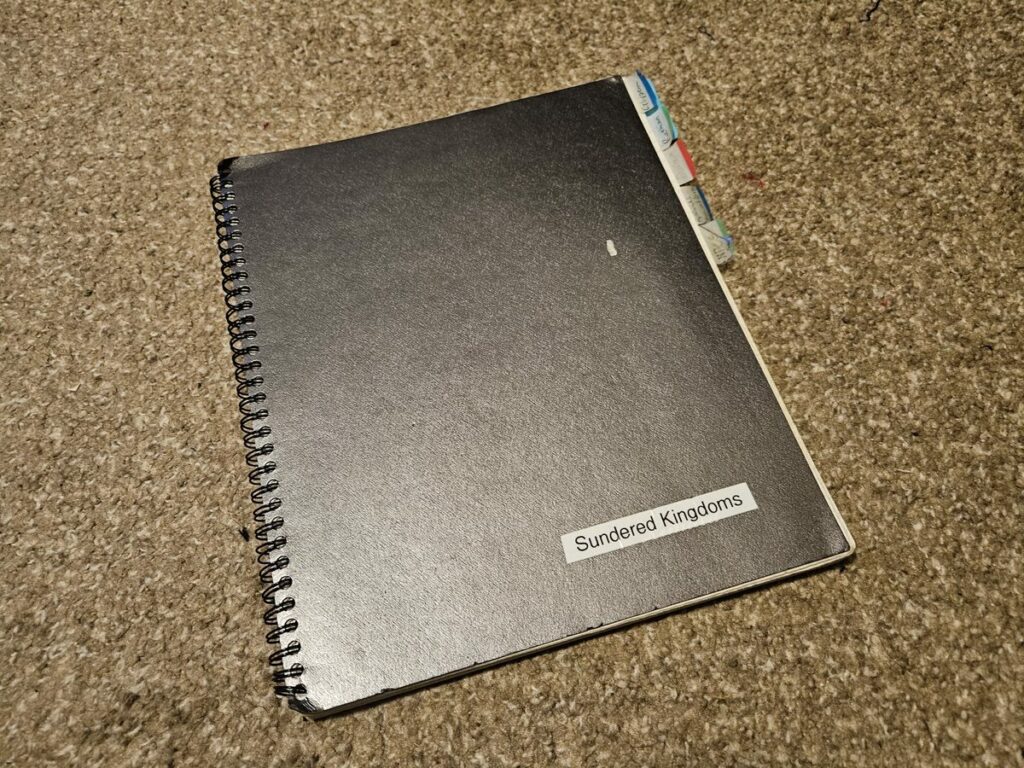
3 of the 5 players were in those original games. It’s truly been so much fun being able to let them explore that world again and see all the changes they brought about and how it shaped everything. Towns named after NPCs they fondly remember, bards singing tales of their previous characters and adventures. Some old foes reappearing…It’s really been a delight.
Q. As a grand finale, we always ask for the GM’s “pearls of wisdom”. What insights on how your GM style impacts play within your group to best facilitate a great time at the table with your gaming group that you’d like to share with the community?
A. Be flexible. An issue I dealt with when I was a newer DM and that I’ve seen others struggle with is learning to adapt and change their ideas. It can be very easy to pour tons of time and effort into creating a world and a story only to inadvertently lock yourself into how something ‘should be’. Nothing is sacred. I’ve been talking a lot about my world and how I built it, but that’s really rather disingenuous. So much of my world was made together with other people. Players, friends, internet strangers. Whenever one of my players makes a character in my games, it’s a co-operative affair. There are tons of locations, organizations and peoples in my world that came about as a direct result of my players want to play something I hadn’t prepared for, or potentially even directly contradicted established lore. Instead of forcing them to fit, I let the world adapt around them. Orc samurai? Sure, why not. Hell, why not an entire NATION of orc samurais? That sounds awesome. Tiefling Viking barbarian? Love it. There’s some icy tundra up north, why don’t we drop some reclusive tribes up there?
“Let your players build you world.” Noble houses to add in, new races to include and flesh out, entire cities and cultures to incorporate. Brainstorm, discuss and weave them into the history and lore. Let them see the effects those things have on the world. Take them there. Show them. I genuinely believe it’s the reason I have players 20 years later that are still excited to come back to a setting that they have been to a dozen times already. We’re all invested in it and have each left our mark. Plus, it’s just a ton of fun. Share what you’ve made and be proud of it, while staying open to new suggestions and ideas.
Thank you to the community for making this campaign of the month possible! That’s all for now, join us on our next adventure June 1st, and don’t forget to nominate your favorite campaigns for our next Campaign of the Month!
Obsidian Portal Campaign of the Month March 2024: Wrath of the Highborn
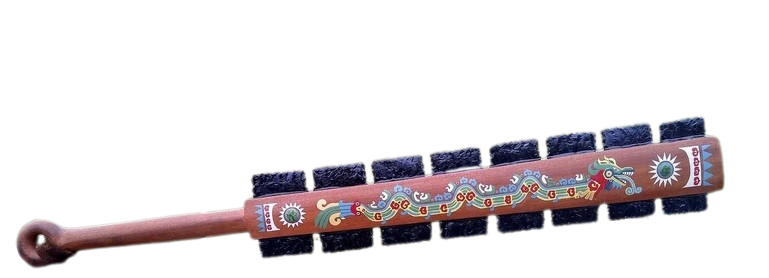
You search the lands for treasures and find them within the Obsidian Portal, in a land called Beregond. Like a glittering, magical jewel, one campaign shines brightly — it is “Wrath of the Highborn” by Keryth987! Within its many facets, you behold lands many decades in the making, fantastical stories written by a true entertainer, animated visuals and videos, and some surprises… is that a Klingon Bat’leth? Step forward into the not-quite-forgotten realms of this multi-award-winning GM to find out how he did it and how you can improve your own campaigns…
- Congratulations on your third, winning campaign! We know from your previous interviews that you’ve been playing since 1991 and have been using Obsidian Portal for almost a decade and a half, now. What changes in the world of gaming have you seen in that time which have had the greatest impact on you and your group?
First off, thanks. It’s nice to see what is a Labor of Love for me to get acknowledgement. Regarding changes in the world of gaming, I’d have to say the presence of computers and technology, along with the growing popularity of TTRPGs in general. When my group began playing it was 2nd Ed D&d and everything was pen and paper with dice, some miniatures, and a GM screen. Now everyone has a laptop or pad at their seat, with Obsidian Portal and D&D Beyond open as we play 5e for the current game (Other non-D&D Campaigns well, no Beyond being used of course). It’s also been nice to see gaming go from a fringe hobby to the popular activity it is now.
- The Chronicle section of “Wrath of the Highborn” details the journey of your players with some very excellent writing, from a simple village meeting to epic battles with dragons and demons. Can you give us a brief synopsis of the campaign, so far?
Well, this campaign actually comes out of my previous D&D Campaign, “A Rising Darkness.” In that campaign, the group of PC’s ended up needing to free a powerful elven sorceress to obtain something they needed to stop the Big Bad. That sorceress helped them in turn by also eliminating one of the lieutenants of the campaigns Big Bad, who just so happened to be the Elven Queen who had exiled her in the first place. She then went on to take over the city her rival once ruled and began building an army and playing conqueror, all while sending those she dubbed Her Chosen (and provided with a means of automatic resurrection should they die) with recovering some powerful magic relics called The Jewels of Aelis. The current party, through discovery, divine messengers, and prophecy, learned of this and have taken up the cause of defeating The Highborne Queen, recovering The Jewels of Aelis before she does, and destroying them.
The campaign began with them escorting the daughter of a prominent merchant from Goldshire, along the Sword Coast, across the Trackless sea, to Maztica, where they journeyed to Fort Flame. It was about the time of their arrival in Maztica, that they learned of the Jewels and The Highborne Queen’s goals. Since then the group has been following what evidence they have gathered as to where the various Jewels are, recovering them, and trying to find a way to destroy them, all while dodging The Highborne Queen’s Chosen, as well as some other enemies they have made along the way. As of the writing of this, they are off in Kara Tur, trying to infiltrate the Monastery of the Black Moon, to recover the last of the Jewels that have not already been recovered by either them or The Highborne Queen.
- “Wrath of the Highborn” is set in Beregond — a world adapted and expanded from Forgotten Realms material — and is also part of a shared set of worlds called “Chornalth” which are written and organized by other GM’s. Are there any challenges or advantages when dealing with interconnected planets and stories managed by other game masters?
Not really. We’ve been sharing “Chornalth” now for some time (The other two worlds being Liga – a heavily modified Oerth/Greyhawk Adventures, and Krynn – a highly modified Dragonlance world with some Dark Sun and others thrown in). Everyone in our group is pretty good at separating player knowledge form character knowledge, so when there is crossover, we are usually able to confer well and still not ruin the RP and sense of wonder while ensuring no one steps on another GM’s toes or messes something up in the other GM’s world. It also is a nice thing to have the shared world, as the last campaign on Liga (a Pathfinder Campaign) and actions taken by those PCs were what was utilized by the Big Bad of “A Rising Darkness,” to release his evil Over-Deity from his prison, which the events of, in turn, provided the villain for Wrath of the Highborne. It’s fun being able to play in one’s own sandbox sometimes as well, so, having the crossover ability allows that to happen both character wise as well as lore and interaction.
- Decades of work have gone into Beregond and it shows — one of your previous winning campaigns was set in the same world. Is “Wrath” connected in any way to the previous stories of “A Rising Darkness” or are your players treading on entirely new territory?
Well, as mentioned previously, the villain of “Wrath,” The Highborne Queen herself, was a sort of ally of the PCs in Rising, and two of the PC’s in “Wrath” – Shalryssia Peshlakai and Vimesh Damocles, are related to two PC’s from “Rising” – Sylmara Skystriker and Vito Damocles respectively. However, the party has covered far more territory than in past campaigns as they’ve also adventured outside of my modified Faerun, venturing to the continents of Maztica and Kara Tur, and even up into Selune’s Tears via spelljammer.
- Your site visuals are always outstanding and you’ve been incorporating video and audio components with your games for some time now. For GM’s who want to emulate those same techniques, what advice would you give or what digital tools and resources would you recommend?
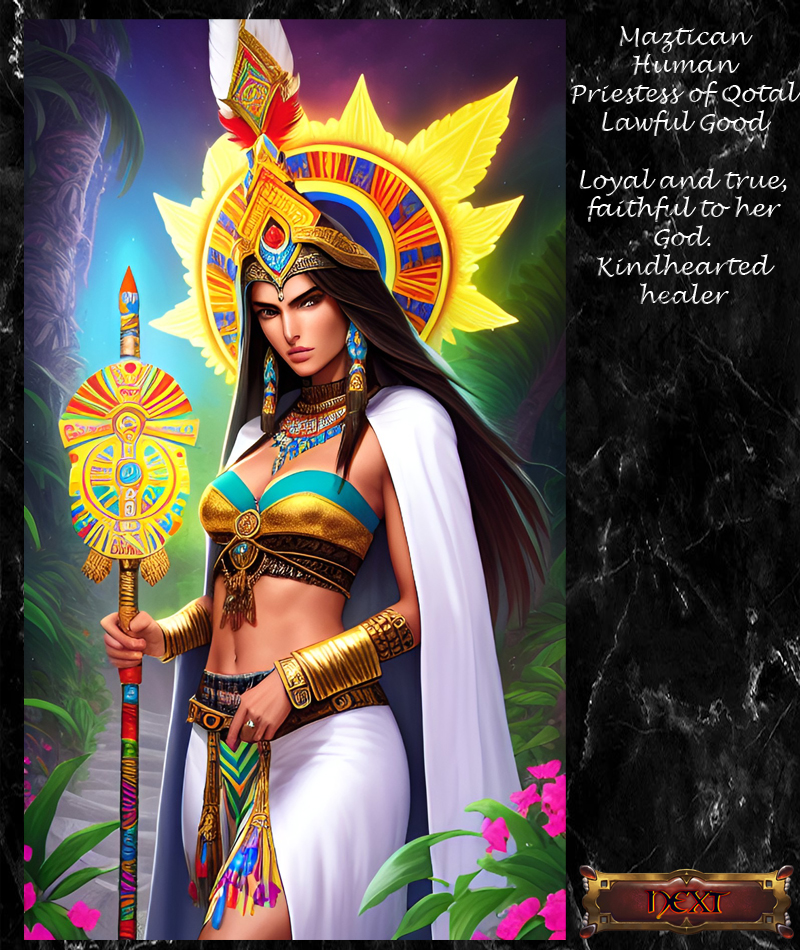
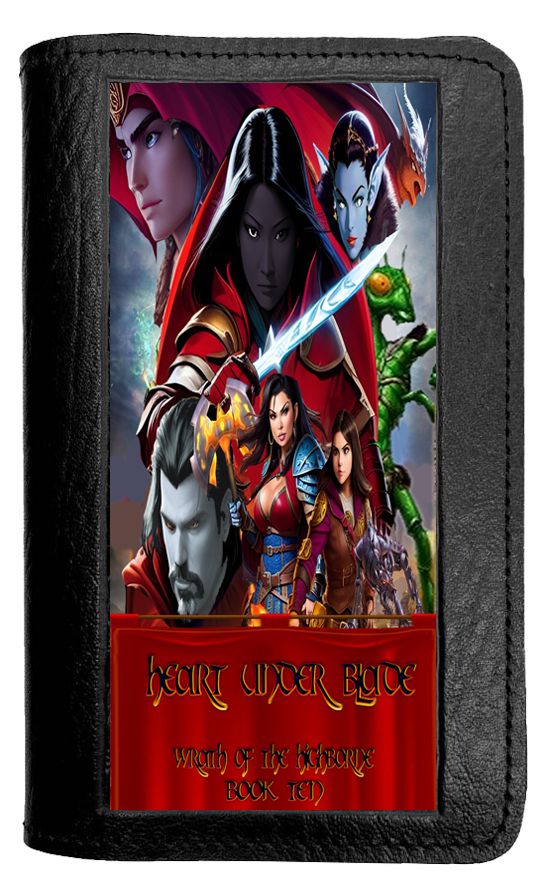
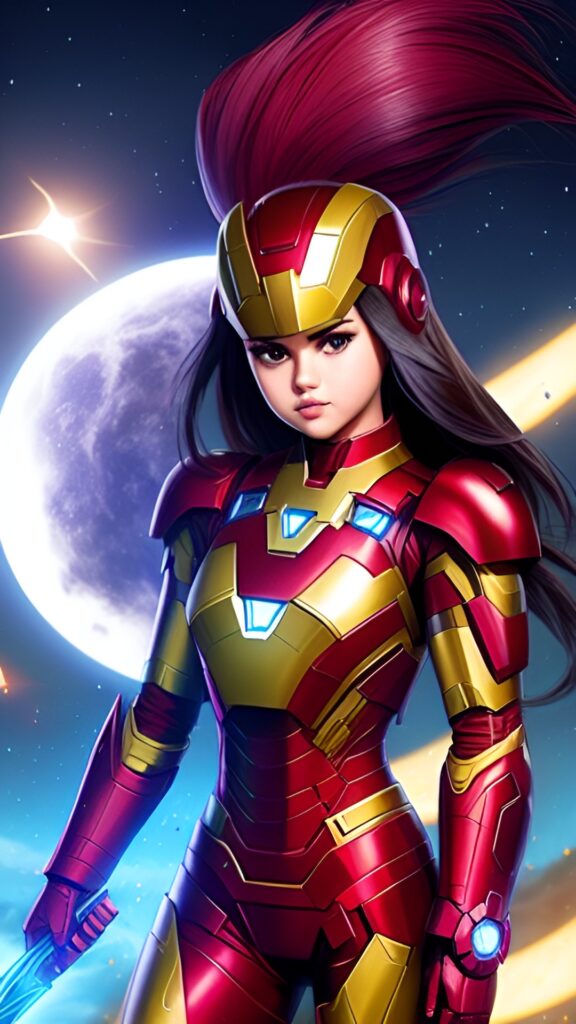
Well, the videos are made using Wondershare Filmora, and the music is usually edited as needed in Audigy. I’m rather proud of the two videos for “Wrath,” both the Teaser on the Main page as well as the Introduction/Opening Credits that is listed as the Prologue for each Book on the site). As for the artwork, lots of Photoshop work, and, I have to admit some AI tools for base images. – Specifically Dream by Wombo. I know many frown on AI art, but were I to rely on my art skills, everything would be stick figures and such. The AI lets me take my ideas and those of my players and turn them into images that can be used, though not a single on has not been manipulated via photoshop, whether it’s to create and entirely new image such as the campaign background (there are, according to the folder on my PC, 20 separate images utilized in that), creating the many Book Covers (angain 8-10 base images to produce the various components and then Photoshop to put the elements all together), to modifying the skin colors and eyes of images so Night Elves and Genasi and Half Drow match the player’s vision of their character. It also lets us let our characters not only be “This character looks like Alessandra Ambrosio as a Maztican Priestess of Qotal” as a text or vocal description, but actually be able to see the character’s physical appearance.
- You have extensive experience with lots of different gaming systems — story-driven like Dresden Files, more rules-focused like D&D, and everything in between. In your opinion, is the game system critical to the success of a campaign or is it just a personal preference?
To be honest, the system isn’t as important to a campaign’s success as much as those involved in playing it – both GM and Players. My group’s been blessed for many years to have had plenty of great players and storytellers. Some have since moved on from the gaming table either due to Real Life commitments or moving out of the area, and others have joined the group to take their place, but in a gaming group that meets regularly every week and has done so since the 90s, we’ve only had to ask 2 people to leave the group due to issues. The heart of any successful campaign is not the setting or the system, but the people playing the game.
- You don’t shy away from mixing and matching elements from different settings to get the kind of game you want, like bringing in a race from a futuristic TV series or movie into a fantasy game like “Wrath.” Have you ever run into any unexpected problems when introducing something like this? Is there a lot of prep-work involved to make it all fit together or can you just make adjustments after enough years of GM experience?
Well, in “Wrath,” adding in Mass Effect’s Asari was a bit of a challenge…but eventually I found a way to make it work based on the lore I’d created for Beregond and “Chornalth” in general. Others, the idea of how to bring them in just came to me suddenly. And some, like the Draenei and Night Eves of World of Warcraft, well, they were simply a modification of their origins as provided in their original source material. To be honest, the biggest problem caused by this would be a toss up between trying to figure out how to make Klingon weapons work stat-wise, or finding a location to place the Tharks of Barsoom. Seeing as how every race that has been added has been because I wanted said race available, it’s not been too much trouble. And now, with resources like OP and Beyond, it’s even easier as I am able to find resources for these already available to use rules wise.
- Without giving too much away to your players, can you give us any hints about the future direction of “Wrath of the Highborn?”
Well, as mentioned they are working on retrieving the final Jewel that they know has not already been recovered. This is forcing them to infiltrate the Monastery of the Order of the Black Moon, a group of Shar worshiping Shadow Monks in Kara Tur (and something that came completely out of the background of one of the PCs, Koumori Shojo). This will bring the group into conflict with the Order’s Master Monk, as well as his followers and probably some Priests of Shar as well, After that, the players have indicated to me that they want to deal with the Red Wizard of Thay that once possessed one of the Jewels and that they have come into conflict with, as well as eliminating the remaining of The Highborne Queen’s Chosen. They also have a side quest for the Sha’ir Warlock in the group, Vimesh , to finish, as well as recovering the remaining Jewels from The Highborne Queen (which might cause them to destroy her). And then, finally, they need to discover the location of The Hall of Bones, to destroy the Jewels.
- Any plans for future campaigns that you would like to disclose? Or are you looking forward to a break while someone else runs the next game?
Well, I always am working on new campaign ideas. I have at least three concepts I’m tinkering with on OP now. But, the current plan is to resume our Savage Worlds campaign that was put on hold, then after that it looks like we might be playing a Planescape campaign, and one of the other players is hinting he is ready to start running the sequel to his last Pathfinder campaign. Honestly, the fact that pretty much everyone at the table is capable of and enjoys being a GM, is one of the reasons our group has lasted this long (the other being strong bonds of friendship). So, it looks like it will be a bit of time before I’m behind the screen again after this.
- Finally, Obsidian Portal readers are always hunting for helpful hints on how to better run their own games or build their sites. Do you have any particular tips or tricks that you would like to share?
Well, Obsidian Portal has been a godsend for me, enabling me to organize my thoughts and concepts and get them down somewhere solid, as well as to keep track of previous events in campaigns. As for developing sites themselves, Wolfhound’s tutorials over on his “Dresden Files Dallas” site are still a good place to start, as are the Obsidian Portal forums. However, the biggest help for me has been the Obsidian Portal Discord Server, where I have repeatedly gone for help and assistance on how to take an idea and make it work Textile/CSS wise (I’m looking at you Nuadaria and Abersade and others) and i highly recommend anyone interested in using Obsidian Portal go there, socialize, bring up their questions, and share their creations.
Alas, adventurer, our journey into Beregond is brief and too swiftly ended. With thanks to Keryth and his players, we turn our sights to other realms and future jewels of wondrous writing, clever coding, and delightful design. Do you know of a campaign worthy of notice? Perhaps your own, even. If so, send us word on the Community Forums or the Obsidian Portal Discord so that we may share the creativity of our gaming greats with everyone. Until next month, traveler!
Thank you to the community for making this campaign of the month possible! That’s all for now, join us on our next adventure April 1st, and don’t forget to nominate your favorite campaigns for our next Campaign of the Month!
Obsidian Portal Campaign of the Month January 2024: More Things in Heaven and Earth

Get ready to jump into the mystical techno-magical future of North America after “the Awakening”. The year is 2082. The place is “The Emerald City”, where people are willing to risk it all and walk on the bleeding edge, making deals with anything. The GM is Dropbeartots. The runners are a rag-tag group of humans, an elf, an ork and a troll. They adventure in a Sixth World Shadowrun game called More Things in Heaven and Earth.
First off, feel free to tell us about the person behind the GM screen. Where are you from? What do you do aside from gaming? Alter Egos? Life partners? Family? Where can we interact with you on the internet?
I’m just an Immortal elf hanging around waiting to see the Awakening happen still! My alter-ego is a dropbear, of course. My folks were military, so I really didn’t settle down anywhere for very long until my Dad retired. Since then, Ive been in Texas. Aside from gaming, I work a lot and try to make enough money to keep up with Shadowrun’s new releases and increase my collection of older edition books. Two of the gamers in my group are related to me: Ringpop is my wife, and Nomad is my youngest son. My internet activity has decreased quite a bit in the past few years, but I have a neglected site on WordPress called When Dropbears Attack! I really should get back into it…
You are running a Shadowrun Sixth World Game. Are you familiar with the previous editions and if so, can you mention any differences, or talk about the evolution of the Game? What are the things you most enjoy about the Shadowrun world in general?
Shadowrun has been the single game that’s really carried my interest across all editions. I’ve been the forever GM with it since first edition came out! The most captivating thing for me about it has been the evolution of the story of the Sixth World across the decades, and the back cover blurb of the first edition core rulebook just grabbed me more than any other game ever has. It has always been a game about three worlds – Man, Magic & Machine – that kept me engrossed the most as a reader, player, and game master. I keep coming back to it time and again even when I get distracted with my interests in a wide variety of other games. When most people can point to D&D as their definitive TTRPG starting point, I can honestly say that yeah I started with it but I never really loved gaming as much as when Shadowrun was first plopped down in front of me.
Sixth World, for me, has a plethora of good points. In the first five editions, the skill lists were pretty extensive. As a skill-based game, on the surface this always seemed appropriate. But this often seemed to me to cause characters to have a lot of spread-out skills distributed at a low level just to cover all of their bases. With Sixth World, the skill list has been very condensed, and I have found that a lot of my long-time players are happier with building characters.
Another good point to me is the Edge system. As a sort of advantage mini-game, it has encouraged a lot of thought by the players into roleplaying seeking out various environmental and situational advantages
in their exchanges, both in combat and social encounters. I will admit to it being a lot of work to keeping up, but I think if used and taken advantage of, the system offers a lot to players.
Mechanically at its heart, SR has always been a d6 based dice pool system. Since 4th edition, the target of rolling has changed from a sliding scale Target Number that varied wildly to 5 or 6 being a “hit” and the more hits you collect the better off you are at whatever you want to be doing. I think that’s great, as it puts less mathematical work into the rolling part of the game. Although I personally never had a problem with doing the math (and never had any issues with THACO, either!), more people seem to be into less math with their math rocks, so it meets that desire well.
I‘m well aware of a lot of the editorial and mechanical issues with Sixth World. I think the recently released corrected Seattle and Berlin city editions of the core rulebook have done a fantastic job of correcting a lot of errata and injected pieces that were missing with the original core rulebook. Also, the Sixth World Companion offers up a lot of optional rules to flavor your game to taste. Overall, I find Sixth World to be superior in every way to the previous 5th edition of Shadowrun.
As I’m sure most fans of Shadowrun will agree, the biggest draw to the game for me is the game world itself. From the 2050s to the 2080s, the game‘s writers have built up a backdrop of shadowy intrigue, corporate espionage and betrayal, magical wonders, ancient mysteries working their way into a postmodern cyberpunk world, and moved that world through some strange, weird, off-the-wall and sometimes downright head-scratching moments. In the end, it’s largely what you make of it at the table as a group though. And I personally have the most fun with it over all other games.
As far as my thoughts on the most complete, most well-written, and well-tested edition of Shadowrun? I would have to say I’m mixed on that. I find both 3rd and 4th edition to be the ones that grabbed me the hardest of all. I’d put Mike Mulvihill, Rob Boyle, and Adam Jury on my list of those who produced my overall favorite stuff for Shadowrun. Why don’t I stick with those editions instead, you might ask? Hrm, have you seen the prices people are asking for some of those out-of-print books? Can you say “collector gouging”? 😉
How did your group meet up? How often do you play? What are your sessions like?
I have known Bowynn, Krysa’s player and Kwaba, Robot Jones’ player, for an exceedingly long time, I think it’s going on thirty years now. We’ve played SR since Third Edition. It seems like I have known Nomad’s player all of his life 😉 It’s sorta my fault he got into gaming, after all. Twitch and Little Doll’s players, I met through my wife. She met them on the Amtguard field, and introduced them to me and we tried out gaming with D&D for a while, then i finally had to start them playing Shadowrun. I seduced my wife into the dark side of Shadowrun shortly after we met, and I think that she fell in love with the game just as much as she did with me, lol.
We have been playing weekly together for a while now, with game night settling on Tuesdays. My wife and I have been travelling a lot for her job as an RN, so there’s been a lot of play through voice calls on Messenger for a while. Since I recently settled into a new job a few months ago, I’ve been more localized to our house and our in-person gaming has resumed.
Our sessions can usually be boiled down to one word, lol. Chaotic! If you know, you know…
You have a very innovative Navigation System on your site. What inspired you? How did you go about setting it up? What advice can you give for new GMs on Obsidian Portal who want to do the same?
Really, I have to give a lot of props to the site’s design here. It gives the opportunity for Ascendent
members to edit, add, remove, and modify the navbar to their heart’s content if they wish. And I speak only for myself here, but it is a GREAT feature that I was super enthusiastic about when it came up.
I was particularly intrigued by the way you extended your Experience Point Awards to cover three different sections – Heat, Reputation and Karma. I know you also had this on your previous award-winning site, “Wildside”, but what inspired this, and in what way does it help you and your players?
Karma is the real “experience point” value among the three here, although all three are earned by characters in Shadowrun through play. Reputation is how well-known a character becomes among other groups of the world by their actions in-game – its not always positive, either! And Heat measures how much characters have screwed up and both how well-known among and how wanted by the authorities a Shadowrunner has become. The lower the better there 😉
Your “Critters” section is very cool. Which ones have been the most memorable in your game so far? And DO tell us more about the “Drop Bear”…
A lot of the threats a character will run into are human in Shadowrun, but there are other… things out there as well. In Shadowrun, these critters are normal animals that have changed somewhat due to the influx of magical energy into the Sixth World over the seventy-some-odd years of the alternate history. I wanted to build a section for my players to be able to see some of these things and reference rumor of their various capabilities. Most of the time, I add to the critter section before one is potentially encountered.
Well, the Drop Bear is kind of exactly what is described in the Critters section. An awakened koala with very sharp teeth and claws that fall off of trees to drop on their unsuspecting prey – which often tend to be humans! The group has managed to find one of these critters well outside of its native habitat that was subjected to a variety of experimentation in a corporate lab. Ringpop, the resident animal lover, has ended up sort of adopting it and is trying hard to tame it and teach it tricks. She named it Tater Tot. She gets a lot of static from the rest of group because of that…
How involved are your players in the site? Who tends to do what? Do your players add their own Adventure Logs?
The player of Little Doll, the group’s social butterfly and face, tends to post the bigger updates on the Adventure Logs from her character’s perspective about all of the goings-on. When other players are able, they have added to the Adventure Logs as well.
I tend to use the site as a whole as a reference and tracker for our game, and the Adventure Logs to post contacts reaching out to various members of the group to set up jobs, or to frame events that occur in the world that are outside of the characters’ spheres of influence but might affect them in some way.
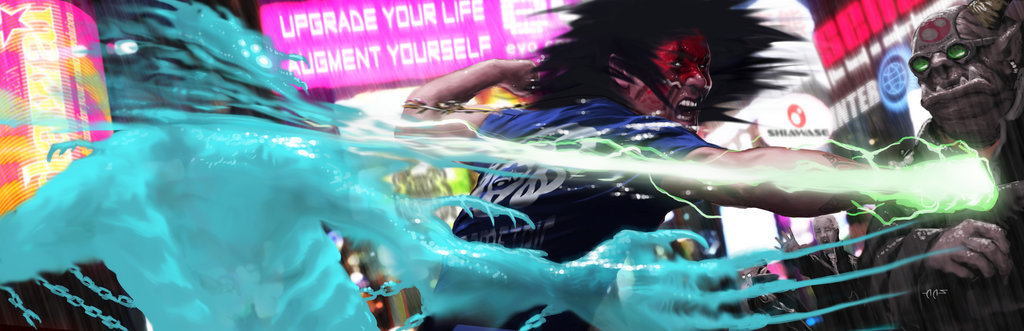
How long have you been using Obsidian Portal? What brought you to the site and what keeps bringing you back?
I have been using OP since 2009. I had been looking for a campaign journal site, and I really enjoyed the features OP offered a lot. What keeps me there is the fact that they are so devoted to continually improving the experience of use and site utility, and the community built up around the site that is so supportive among the users.
If you had to pick just one thing, what would you say Obsidian Portal helps you with the most?
I would say that Obsidian Portal is awesome for giving me the means to keep my campaigns’ details
organized, cataloged, and documented. And it allows me to customize so much of the way I would like to do that.
What would you say is the biggest highlight of your game so far (please also provide images and links if possible)?
Little Doll and Nomad say that Tater Tot (https://morethingsinheavenandearth.obsidianportal.com/characters/drop-bear) is the highlight of the game 😀
Ringpop says it was the time her character got stuck in Dante’s Inferno and was singled out by Dion (https://morethingsinheavenandearth.obsidianportal.com/characters/dion), the lead singer of Thursus (https://morethingsinheavenandearth.obsidianportal.com/characters/thursos), for romantic overtures only to find out that he is actually a dragon! She ran so fast… Ringpop does not like dragons at all, they make her very nervous and she already has a difficult time in social environments.

Okay, as a last question, we always ask for the GM’s “pearls of wisdom”. What GM insights can you offer the community this month?
In Shadowrun especially, if you can set up paranoia, do it! Use what the players tell you about their perceptions of what’s going on to feed the flames. Don’t always confirm what they say, but do confirm enough to make them feel what they are thinking is right before you introduce a twist and pull their rugs out from under them.
Always keep pressure on the characters, keep them hungry, use external organizations to push them and show them the sharks swimming alongside them, and give them enough rope to hang themselves.
Be sure to reward them well when they pull off something ingenious, give their characters’ actions, relationships, and personal motivations weight, and make them matter in the world at large.
And last, but, not least, if they decide to take on an MCT Zero-Zone, go hard. Make them work.
Thank you to the community for making this campaign of the month possible! That’s all for now, join us on our next adventure February 1st, and don’t forget to nominate your favorite campaigns for our next Campaign of the Month!