Author Archives: Vanillabean
Campaign of the Month August 2025: A Manifestation of Chaos: Extinction Event!

The lands of Oerth have endured generations of turmoil – still reeling from the Chaos War, still watching Iuz gather strength in the shadows. Magic falters where once it flowed freely, trade routes fracture, and even the once-stable Free City of Greyhawk teeters under the weight of corruption and conflict. Yet, amid the lingering darkness, Overking Stefan Boarke’s efforts to reunite the Great Kingdom have begun to shift the tide. Fractured alliances, long-soured bloodlines, and the ghosts of heroes past all circle a rare moment of potential unity: a long-anticipated celebration where whispers hint at something far greater than mere ceremony. This month, we’re thrilled to feature A Manifestation of Chaos: Extinction Event!, a richly layered Greyhawk saga helmed by GM Leonidas300, whose worldbuilding and attention to continuity breathe new life into an ever-evolving continent.
First off, feel free to tell us about the person behind the GM screen. Where are you from? What do you do aside from gaming? Alter Egos? Life partners? Family? Where can we interact with you on the internet?
I was born in California, grew up in Iowa but moved to St. Louis when I was 25. Aside from gaming, I do more gaming lol, pretty much the whole of my hobby time is gaming related or adjacent. Insofar as career, I’m an Accountant, I’m married, with step-kids. I am mostly on FB, in most any D&D related room. I’ve got a FB page called Metzgers Dungeons but I am terrible at updating it.
Tell us about “A Manifestation of Chaos: Extinction Event!” in a nutshell. How did you design the campaign? What was your inspiration?
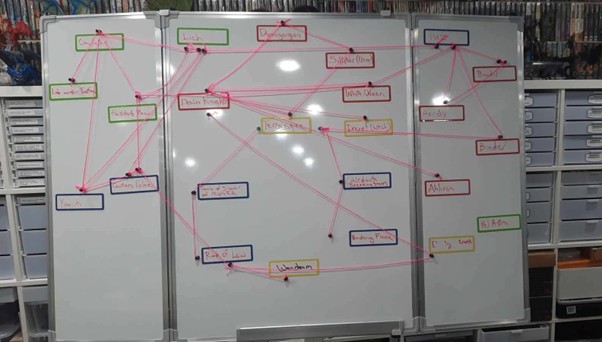
This either requires a book of an answer or what I’ll try to do here… The design for this one was in response to my players’ feedback on the 1st Manifestation of Chaos campaign. They asked that this one have more intrigue and politics and to a man; I believe they would say that I have delivered on that. They bought an old school whiteboard to track campaign threads
How regularly do you play, and where do you play? Tell us about your current group of players.
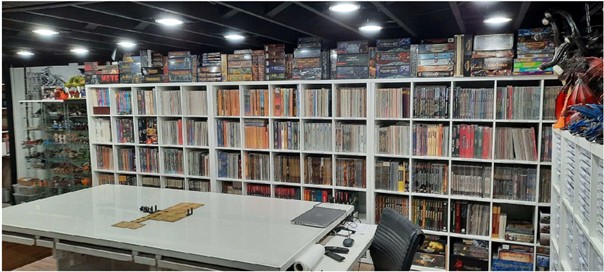
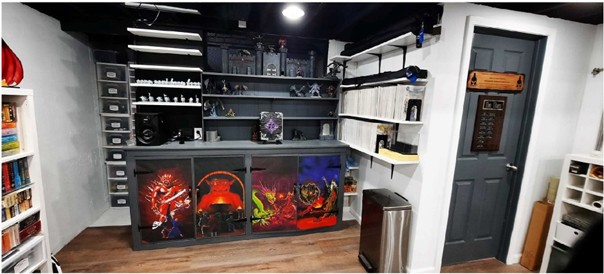
We play 2-3 times a month in The Legendary Lair.
I have run some excellent groups over the decades, but this group is hands down the best. My current group, much as myself, are at the 50-55 mark, are comfortable with who we are and realize the precious free time we have should be spent with friends having fun. Most have been in the group for between 6-15 years.
Every one of them has helped with the portal. whoppermd does the images and banners for the adventure logs, Jurgen1 has written the majority of the logs since session 40, but every player has written a log or two as well. Our player rblaine15 has won the Titan award which is normally reserved for the end of campaigns.
What made you choose the Pathfinder? How does that system complement your campaign?
My guys and I like crunch; we like the limitless options/customization that Pathfinder 1e allows. The fact that PF 1e, is essentially an extension of D&D 3.5 means that the wealth of material to draw from is immense. I do a lot of custom monsters (campaign related) but having that material to draw on is great.
This campaign is part of a trilogy of campaigns. Please explain how a trilogy of campaigns work? What is the connection between the campaigns?
The events of the campaigns build upon what happened in the prior campaign, but the characters are different Towards the end of this campaign some of the old characters who are still around may get a chance to show up, depending on certain future in-game decisions ). I run my games from 1 to between 22-24th level, in truth after that level, most players are looking for fresh changes and challenges.
For example, in the original MOC, there were a great deal of things regarding ithilids, subspecies of ithilids and chaos creatures that went unexplored/addressed. That is going to have a major role in things, for this campaign.
The bones of these first two campaigns are stiped in the deep lore of D&D (Greyhawk specifically) but other D&D lore as well, including nearly 35 years of home brewed campaigns. If they are successful in this campaign, The next and last MOC campaign will deal with the aftermath of the events of this one… It will be a Mythic Pathfinder 1e game.
If they fail, there will not be a 3rd MOC campaign as envisioned; I will instead take that opportunity to switch over to a conglomeration of OSR systems I am working on (Old School Essentials and Shadowdark as the bones, with elements of Dungeon Crawl Classics, Hackmaster and Hyperborea. It will use the Age of Hyboria as the setting.
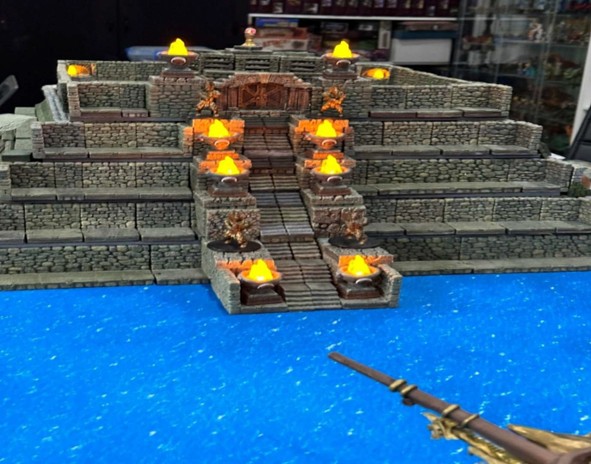
You completely redesigned the Obsidian Portal interface, including the mouse cursor. What is the inspiration for that design and how long did it take to program?
Our member Glyph3x did the lions share, he is super talented in coding, it took him about a week to do the core design, the cursor, is the Atlantean sword from Conan; there is nothing more quintessentially adventure gaming than Conan. I did some of the coding and the vast majority of the wiki pages, (like all of them-lol). My players do adventure logs and work on the Latin spell pages when they want PRP’s.
How much time is usually spent preparing your game sessions? Describe a typical session.
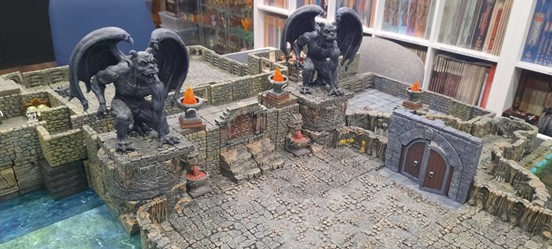
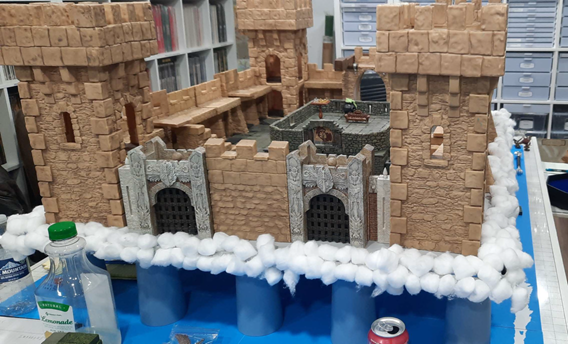
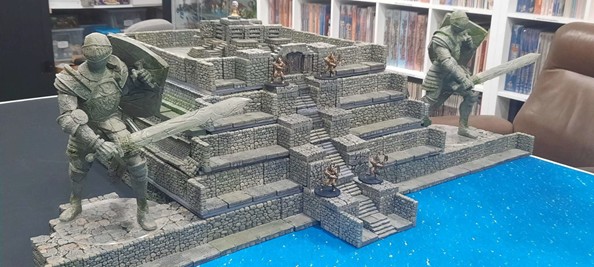
In general, I spend between 4-8 hours preparing a session, upwards of 20+ hours if it is a dungeon or combat heavy session. I use a great deal of 3-d terrain and am known for massive dwarven forge set ups.
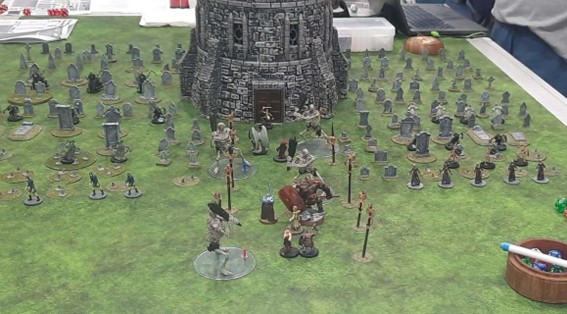
You split your character page into several sections (other than PC and NPC). Please explain the different sections.
This was a feature I was so glad the portal added. There are an enormous number of factions, characters, NPC’s, people of import that are in this campaign, this feature allows much easier access to them.
In your wiki section, you put a lot of emphasis on the game mechanics, like XP and gold division, but what I find most interesting is the Graveyard section. Can you please explain what the graveyard is and why it is needed in addition to the “Dead” section in the characters page?
The graveyard is reserved for actual PC deaths. A resting ground for those who gave all… The dead section on the character page is for NPC allies and “respected foes”.
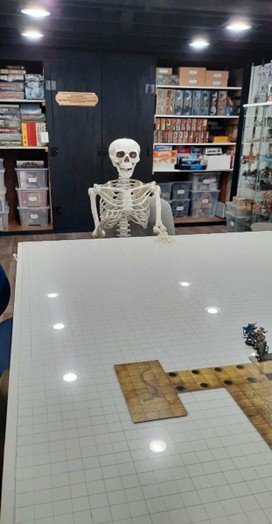
You make a lot of “real-life” connections – you have the “Lair” section, as well as a wiki page designated to your players. What made you make this connection?
Our page comes off a bit heavy on the meta and even though it really does not play that way, we felt that having something to reflect that we are people with a good sense of humor and relatable to other gamers is important.
In your site, you say you moved from Obsidian Portal but decided to give it another chance. What made you stay?
… prior to the reforge, I was a very active member on the portal community pages but in the aftermath of the reforge trust and respect was broken, and I left in disgust. After OP was acquired by Thaen; Kallak, I heard some positive things and reached out to Twiggyleaf and GamingMegaverse and I found that they told it true that the portal was much improved and headed in a good direction.
If you had to pick just one thing, what would you say Obsidian Portal helps you with the most?
Transparency. I run a large group, having a centralized place where they can access everything campaign related is fantastic. They can access the rules, XP, PRP’s, Treasure and so on.
What would you say is the biggest highlight of your game so far (please also provide images and links if possible)?
Normally, I would have had my players answer this one, however I am going to be selfish and take it. The biggest highlight of the game so far for me (and I believe most of the others would agree) were sessions 38–39.
Backstory: My older brother jurgen1 taught me and my younger brother, Charles, to play D&D in 1981 and until he left for college in 86, we played every Sunday. I took over as the DM after that and started DM’ing other groups too. Charles dropped out of TTRPGing in high school (1990) and had very sporadic forays in gaming after that, Jurgen1 stopped TTRPGing altogether in 86. I, sans covid have run the entire way with a consistent game/group.
Anyway, Charles was due to visit us in St. louis and (not for the first time) I tried to get them both to agree to play. And for whatever reason they agreed, for the first time in almost 40 years, we played together again. I had come up with a scenario that I was able to fold into the current campaign and hubris aside, it was spectacular, everyone was on point, especially jurgen1 and Charles. Charles ran a clinic on how to run a thief. Jurgen1 immediately established a dungeon discipline that the others took to. Earnestly had the campaign not already had an over-reaching arch, the events of those sessions would have provided it easily.
For jurgen1, even though months had become years and years had become decades, the fire of the adventurer was still in his blood! He joined our group as a permanent member after that.
Okay, as a last question, we always ask for the GM’s “pearls of wisdom”. What GM insights can you offer the community this month?
Sadly, this “pearl of wisdom” has been the most grievously learned. Our dear friend and longtime member RenegadeRed very unexpectantly passed away a few months ago. Ren’s enthusiasm for the game was infectious and he was always willing to help, big Dwarven Forge set-ups, he was there. Helping me work out some deep lore for the campaign, he was there. Coming up with completely outside the box stuff in game, he was there. Doing some unwise actions that sometimes drove the other guys crazy, he damn sure was there.
The “pearl” is to make sure you take the time to appreciate your group and the adventures you have in the moment because you never know when they won’t be there.
Steel your nerves and ready your spells—this land holds no peace for the unprepared. We’ve lingered long enough in the shadow of crumbling thrones and rising powers. Our thanks to the ever-watchful Leonidas300 and his steadfast companions, whose tales echo like legends across the Flanaess. If you know of another campaign that deserves a place in the halls of greatness, don’t stay silent—nominate it in the community forums for a shot at the coveted Campaign of the Year!
Campaign of the Month June 2025: Shadowrun Returns

In 2050, a Shadowrun team was obliterated in an explosion that lit up the Redmond Barrens.
Official story: gas leak.
Unofficial story: no one’s talking.
Reality: a megacorp cover-up with body bags and black ink.
Every trace of the team was scrubbed. No names. No records. Just scorched ruins, whispered rumors, and a few scattered ashes.
But the dead left behind people.
Each player character is connected to someone who died that night. A sibling. A lover. A partner. A friend. They never worked together – until now.
Brought together by grief, by questions, by fragments the corps missed, the runners are chasing a truth that got six people killed. And if they find it, they’ll have to decide what to do with it.
This is a campaign about mystery, memory, and revenge.
About digging through the ruins of a lie and finding out what was worth killing for.
The Sixth World doesn’t care if they succeed.
But someone does.
And they’re watching.
Come join us in exploring the world within Shadowrun Returns in our interview with Grand_dm below!
Let’s start with the crew. Who are the players behind the runners? Tell us a bit about your group: how did you all come together, and what led you to dive into the world of Shadowrun specifically?
I run with a crew that bleeds story. No rules lawyers, no tourists – just folks who want to make something unforgettable. They’re the kind of players who don’t ask what the bonus is, they ask what it costs. Some of them are friends I have been gaming with for four decades. My wife and adult son are also part of the crew, which is really special to me.
Why Shadowrun? It’s a dirty mirror, and we wanted to see what stared back. We set our campaign in 2050 for a reason – before wireless, before upgrades got sleek. This is a world of tangled cables. We didn’t just choose Shadowrun. We made a deal with it.
What’s your play setup like? How often do you run sessions, and do you play in person, online, or somewhere in between?
Roll20. Custom sheets. Homebrew logic. House rules with claws. We play once or twice a month, adult schedule permitting. The latter is the ultimate final boss of TTRPGs. Every November we get together in person to play a long weekend. Our group is scattered to the four winds so it’s almost like a mini con.
For newcomers to the Sixth World, how would you describe the tone of your campaign? Shadowrun has a wide spectrum of vibes, where does your game land on the scale from neon noir to full-on dystopian chaos?
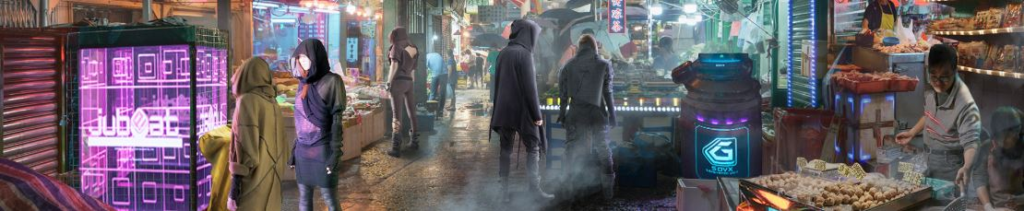
The tone? Street-level survival with mythic echoes. It’s not just dystopia – it’s personal. It’s rusted chrome, smudged rituals, and memories that bite back. You won’t find shiny futures or sleek solutions here. You’ll find a warehouse full of tagged bodies, a decker staring too long at the static in their feed, a burned-out shaman muttering to something only they can see.
The world doesn’t explain itself. It pressures you until you adapt. This isn’t about saving the world.
It’s about stealing back meaning in a world that already sold it.
The visuals on your campaign site are incredibly cohesive and atmospheric. Can you walk us through your process for sourcing or creating the artwork? Any tips for maintaining such a unified visual style across characters, maps, logs, and wiki entries?
Everything gets filtered through intent. I don’t care if it’s stock art or AI generated – if it looks like it’s right, I will use it. I’m picky when it comes to imagery, since with an RPG you’re deleting the mind’s eye. If you decide that THIS is how the thing looks, it needs to be right.
You’ve clearly spent a lot of time wrangling your campaigns on Obsidian Portal. Which features have become absolutely essential to how you organize and run your game?
The wiki comes first. Not for the players – for me. It’s how I understand the world. I make one for just about every campaign I run. It’s not a vault of facts – it’s scaffolding for story, memory, and consequence. I recommend that approach to new gamemasters. YMMV
Your site design has a unique and gritty feel that’s perfect for Shadowrun. Where did the inspiration for your site’s look and layout come from?
I mine like a pro and reshape it like a hammer to the skull. Blade Runner, The Fifth Element, Neuromancer, Hardwired, Dirty Harry, random junk from old game manuals – I take it, twist it, and make it bleed my tone.
The site isn’t “designed.” It’s assembled like a weapon.
I homebrew everything. I borrow anything. So should every GM.
Steal it all. Make it yours. The game doesn’t care where the pieces came from – only what you build out of the wreckage.
Your adventure logs are rich, detailed, and consistent, clearly crafted with care. How do you approach writing them? Do you use them to recap, expand the world, or even foreshadow future events?
The logs are part mission report, part ghost story.
Sometimes I write them. Sometimes the players do. They’re not just recaps – they’re threads of memory. If someone misses a session, they don’t get a summary – they get a story. Written by someone who was there. Through their lens. With their fear or bias or spin baked in.
But the real power?
Logs aren’t just about what happened – they’re about what gets built from it. Players use them to shape backstory, rewrite assumptions, and plant seeds. Some of the best reveals in the campaign started as a sentence in a log someone thought didn’t matter.
Between sessions, we run a downtime phase – like old-school play-by-mail, but through chat. Conversations. Flashbacks. Deals. Confessions. The logs and downtime play feed each other until they blur. That’s where the world grows teeth.This isn’t bookkeeping. It’s legacy in real time.
Give us a highlight reel moment. What’s one scene or session that still gets talked about to this day?
Whether it was hilarious, heartbreaking, or just plain badass, we’d love to hear about it.
The Garden of SIN. A graveyard for the forgotten of Seattle. A cleansing.
The new group of PCs came to clean up the wreckage – ashes of a team that never got to finish the story. They consecrated ground. Bled for it. Made it matter again. It changed them. A quiet kind of rebirth, soaked in rain and ruined memories. That was the moment the team became a crew. Not because they survived. Because they refused to forget.
And finally, we always ask: What’s your ‘secret sauce’ for running a great campaign? If you had to bottle up your GM philosophy, what are the key ingredients that keep your game compelling and your players coming back for more?
Everything is earned. Everything costs.
And when the big moments come they shine brighter because of the darkness they rose from.That’s my job. That’s the gig.
I build the pressure. I light the fuse. But the story? That’s on them.
The players shape it with their doubts, their decisions, and their scars.
I don’t give them the win. I give them the weight.
Because when they finally pull it off – when something truly lands – it’s not luck. It’s not XP.
It’s the long shadow of a story they helped build with both hands.
That’s the kind of game they remember.
Thank you to the community for making this campaign of the month possible! That’s all for now, join us on our next adventure July 2nd, and don’t forget to nominate your favorite campaigns for our next Campaign of the Month!
Campaign of the Month April 2025, Department 7: Crescent City

Greetings Adventurers, come gather ’round for a tale unlike any other we’ve shared before! Set in a modern landscape, our tale follows a series of individuals who serve as agents who walk the line between the known and the supernatural. Join us in talking with GM Dungeon Master Loki as he walks us through this fantastic world of intrigue and action in Department 7: Crescent City.
First off, feel free to tell us about the person behind the GM screen. Where are you from? What do you do aside from gaming? Alter Egos? Life partners? Family? Where can we interact with you on the internet?
I’m an 8th generation New Orleanian of French Creole background, so I was raised in a storytelling culture. I started playing D&D in the White Box era while undergoing leg surgeries at Children’s Hospital, beginning a lifelong love of RPGs. After years of working in music clubs and restaurants I changed gears and began working in online communications (web content, community management and social media) for clients including the Open Society Institute, The National Association of Broadcasters, and The VCU Brand Center.
In 2003 I took on the position of co manager of Planewalker.com, the Official Planescape fan site, where I stayed for over a decade. That and my involvement with Spelljammer.org gave me a taste for sharing my game oriented fevered rantings with others. Since 2014 I have worked as a Table-Top Role Playing Game designer. A two time Silver ENnie award winner, some of my design and writing credits since include the ENnie nominated DarkRoads and Golden Hells, the upcoming Gloomhaven RPG, XCrawl: Louisiana Rising, Bloodlines and Black Magic: The Crescent City, The City of 7 Seraphs, The Pop Culture Catalog series for Starfinder, and many others.
In 2021 Hurricane Ida drove me out of my native New Orleans and I ended up in Cincinnati. Now I teach Introduction to Game Design at the University of Cincinnati and try to freelance enough to keep the bills paid. My family is pretty much all back home in New Orleans so I don’t get to see them very much. Up here in Cincy my family includes my girlfriend, who plays the party cleric / spelljammer pilot, a few close friends, and my two preposterous felines, Puck and Gremlin.
As to where I lurk online, I”ve cut down a lot on that due to spam, AI, and turbulent politics. My website (sorely in need of updating), my Obsidian Portal profile, and my profile on Start Playing Games are really the best ways to contact me these days.
Tell us about “Department 7: Crescent City” in a nutshell. How did you design the world? What was your inspiration?
When I decided to run a modern game using my home city was an obvious way to make it easy on myself. I’ve already written books about using the Crescent City as a site for modern occult and cyberpunk games so I even had a good bit of material already developed for it.
Since several of the players have lived in New Orleans and played at my table ever since, I knew they had familiarity with the city’s culture and terrain. The others would play new transfers to the city from other branches of the Hoffman Institute. Additionally, it’s New Orleans. Our city is full of atmosphere, especially when you consider the folk tales and ghost stories to be true.
Scouring the internet for fringe stories about dinosaur sightings, alien abductions, and ghost stories made it easy to rapidly build a robust and crazy urban fantasy world with some roots in reality. The ones I thought would add to the world or provide good plot hooks would then get added to the game’s Google map. In addition there was an extensive array of such incidents / locations in the original Dark Matter game that I added.
How regularly do you play, and where do you play? Tell us about your current group of players.
We play on an irregular basis since the same players run different characters in some of the other campaigns in the series. Usually about once every month or two these days. We play online using my private server on Discord for Voice/Video/Text and Owlbear Rodeo for our VTT.
As to the players, they are a delightfully motley krewe.
Gary (Jacquemeaux DuBois) has played through several campaigns with me and is one of my old New Orleans crowd, now here in Cincy. Always good for extremely bad jokes and excellent food bribes for the GM (he’s a former chef).
Drew (Leif Luftson) is another who started at my table in the 90s when we worked in restaurants together. Now in Colorado he has returned to the table via Discord. Survivor of three Planejammer campaigns so far.
Desiree (Eulalie Anastasie “Stazzie” Dugas) another one of the New Orleans gamers at the table, despite now living in California. My former roommate (proving she is tolerant) and favorite Cajun who I got to return to the gaming table for the first time in decades.
Jaime (Michi “Michelle” Aoki) my girlfriend, and one of the team’s combat specialists. She’s been rolling dice with us since 2008 when I lived in Cincy once before. As a matter of fact one of her characters is an easter egg in City of 7 Seraphs.
Zan (Cole Morrin) A fellow pro game writer that I got to know while working with them on the City of 7 Seraphs. After playing Munchausen together at Gen Con 50 I knew they would be a perfect fit for the table. Zan rounds out the West Coast contingent at the virtual table. So far they have survived almost five years at my table without having to roll a new character.
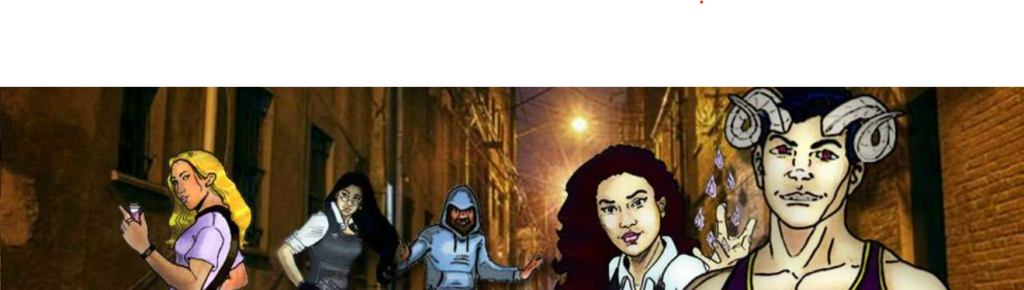
Emily (Victoria Union) our campaign artist and mad journaler. Em is another Cincy gamer that came to the table in 2008 when I lived in Cincy a decade ago. Over those years she has become integral to the look and feel of the game. For example, the upcoming Planejammer Tarot deck coming soon from Evil Robot Games.
What made you choose Pathfinder for your system? How does that system complement your campaign?
The campaign series started back in first edition Dungeons and Dragons days, and has evolved embracing each edition until Pathfinder forked from DND 3.5. Since then Pathfinder 1e has been the baseline. My players like the granularity of control over their character the system gives them. Since it is a system I have written more products for than any other it’s also a matter of rules familiarity and comfort zone I suppose. One more point in its favor is that translating rules from one d20 based system to another is comparatively easy, opening up even more options for my players.
Your campaign integrates the real world with fantasy. Can you tell us a little bit about the immersion of the two? How do you decide which parts of fantasy are too much for the real world, and what is acceptable?
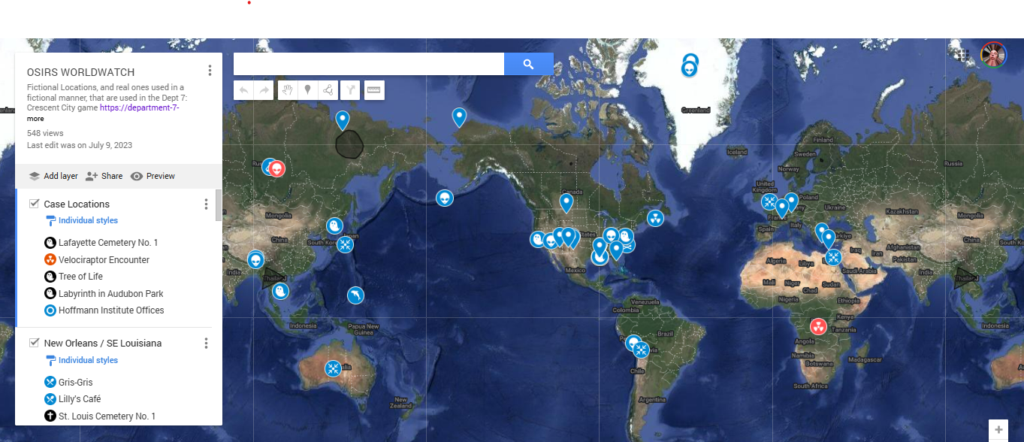
One reason I decided to run a modern sci fi / occult game was an idea I had for leveraging Google Maps as a game tool. Using a custom Google Map (OSIRS Worldwatch Global Anomaly Tracking) I was able to create entries for a lot of the high weirdness from Dark Matter, and other weirdness from Louisiana folklore, to create “known sites” around the world. Being able to fire up the map and see everything from reconstituted dinosaurs to secret alien colonies really helped my players with immersion.
It also allows for a lot of improv based on current events. The news and weather reports of the day set the tone If we are playing during Essence Fest or Jazz Fest, for example, they will have to deal with crowds, traffic and hordes of drunken tourists as well as chance celebrity encounters and the occasional musical interlude..Since it is a present day game I often use Google Street View to show them where their characters are and use screencaps from an aerial view to create any battlemaps I need. I’ve found that from the GM side of the screen it makes it a lot of fun and adds a lot of verisimilitude without a lot of extra effort.
As far as what is off the table? Not much. It’s a low to mid level game at present, but I do like big and flashy games almost as much as I love convoluted conspiracies.
Can you explain the structure and setting of your campaign? Your adventures are “cases” that your characters solve as agents in their agency?
In Dark Matter the players are agents in an X-Files style setting, so they work as paranormal agents for the Hoffman Institute. Much like the Men in Black movies reality is not far from what you see in the craziest tabloids.
This means that most of their adventures are assignments, while a few here and there are during their character’s personal time. This simplifies a few aspects of game play. Equipment other than personal items is requisitioned on a mission by mission basis easing the gear tracking part of the game. It also provides clear direction on what the mission goal is each time. For instance their most recent mission was testing out the Tangent Tunnel, an experimental device for travelling to alternate realities. While trying to rescue a lost exploratory team they ended up stranded in the Land of the Lost for three sessions. The upcoming session takes place after more testing of the Tangent Tunnel with them arriving on an asteroid city in the Tears of Selune in the Forgotten Realms.
That ties us in to the big picture. This campaign is part of a linked series of games that started in 1979. Events in one game can directly influence the others as they are all in a shared Omniverse. Currently one of the NPCs in the game is the cohort of Emily’s PC in The Spelljoined who got bounced into an alternate reality during a massive battle with the illithids (mind flayers).
How much time is usually spent preparing your game sessions? Describe a typical session.
It varies. Some of the episodes require several hours of prep time, but with the amount of info I’ve developed for the series over the decades, session prep is usually a short and sweet two to three hours if I’ve kept up with my notes (always a challenge). Since it is more of an event based sandbox game with an overarching metaplot, the players control a lot of the direction things take.
Sessions are usually about ⅔ investigation / role playing and ⅓ combat. Usually it takes about three sessions to resolve a case so far. Each case starts with a mission briefing and familiarizing the players with the mission and the current gear assigned. From fighting escaped, genetically engineered velociraptors through the streets of the Bywater to communing with nature spirits under Audubon Park’s Tree of Life the missions can encompass many story styles and objectives.
What can you tell us about the art presented in your campaign? Who is the artist? What made you choose this art style?
Things like the Hoffman Institute logo are taken directly from the Dark Matter game. The character art and most of the other incidental art is created by a freelance artist in our group: Emily “Syreene” Vittori. She’s been playing at my table since 2008 and has been the primary artist for the campaign series. She is also responsible for hundreds of pages of journal entries and campaign notes.The style is entirely her own choice and there are a variety of styles in her art for our games including classic game art, art nouveau, and even a few chibi images.
In addition there is art created by various players over the decades and a few professional pieces by Jacob Blackmon, done for the Starfinder game in the series, Catch My Drift.
How long have you been using Obsidian Portal? What brought you to the site and what keeps bringing you back?
Roughly 15 years nos. I stumbled across it ages ago and upgraded from the simple wiki I was using prior to that. When it comes to the things that keep me here the wiki is a big one, especially the ability to have sections that are for private notes between the players and myself. I also find that player participation away from the table, i.e. journal writing and such, increased when the adventure log became an option. It has a great set of features and solid organizational structure. All in all, other than some improvements to the backup downloads it is pretty much perfect for my needs.
If you had to pick just one thing, what would you say Obsidian Portal helps you with the most?
Creating an atmospheric portal for my players that organizes the ridiculous amount of house rules into a (hopefully) useful and appealing format. Even without knowing any CSS it is pretty easy to make it sing and it has much greater “out of the box” functionality than setting up a fully customized website. In addition the community is pretty great across the board.
What would you say is the biggest highlight of your game so far (please also provide images and links if possible)?
During one of the adventures that led them to Greyhawk I had the honor of having a special guest. Mike Nystul played with Gary Gygax in the days before D&D was published and the game has included spells named for his wizard, Nystul, ever since. Nystul’s Magic Aura being the most well known. Having him join us and play an updated version of his original character from Gygax’s table was an honor and a pleasure.
Okay, as a last question, we always ask for the GM’s “pearls of wisdom”. What GM insights can you offer the community this month?
It’s all about a combination of organization and improv. In the hopes it will be helpful to someone here is my approach.
If you have trouble making stuff up spur of the moment make a few lists as part of your prep. Each one can be as few as five items.
- A list of names appropriate to your setting
- A list of species/class combos that are common in your setting.
- A list of quirks or behaviors, i.e. constant toe tapping, a lisp, or a tendency toward puns.
With these three lists you have instant NPCs, just roll or choose one item from each list when you need it and the three combine to give you the basics.
For organization I use a triple monitor rig set up as follows:
Left Monitor – Combat Data Browser Tabs:
- Initiative Tracker Opponent Initiatives already pre-rolled and added. I advise adding the Dice Roller plug in.
- One Tab for each creature, trap, or hazard in the encounter
Middle Monitor – Interaction Browser Tab:
- Discord Video and text chat
Right Monitor – Maps and Rules Browser Tabs:
- Owlbear Rodeo Virtual Tabletop
- Obsidian Portal – Planejammer Hub for Core House Rules
- Obsidian Portal – Dept 7 Crescent City or current campaign
- Archives of Nethys Pathfinder 1e rules
- d20pfsrd.com Pathfinder Psionics rules
I keep a pad and pencils on my desk for notes. If I create an NPC on the fly their name / class / and defining mannerisms get noted as does any loot acquired, or major events / accomplishments of the session. (Add these to your wiki on OP immediately after the game because if you’re like me they can easily get misplaced before your group meets up again). It’s also worth noting that if you have trouble taking notes during games you can try recording audio or video of the sessions and go back to them to write your notes and recap. Just make sure to let your players know if you are recording!
That’s about it! May your 20s be both frequent and natural!
Thank you to the community for making this campaign of the month possible! That’s all for now, join us on our next adventure May 1st, and don’t forget to nominate your favorite campaigns for our next Campaign of the Month!
Campaign of the month February 2025: Stream of Kairos

So, have you ever wondered what it might be like to be the Captain of a Timeship on the Temporal Sea? Well, wonder no more, because when you delve into the depths of imagination on this particular campaign, you can do just that! Join us as we chat to previous Campaign of the Month winner, Abersade, discussing The Kairos Delta, Realspace, and the dreaded Orkehds in his new campaign, Stream of Kairos.
First off, feel free to tell us about the person behind the GM screen. Where are you from? What do you do aside from gaming? Alter Egos? Life partners? Family? Where can we interact with you on the internet?
Hi! My name is John and I’m from Flatlandia, also known as Northwest Ohio. Being born and raised here, there really isn’t much to do except for gaming, gardening, and reading in my opinion. I’ve been with my wife (user Saintdiane) for eighteen years now, and both of my daughters are grown, in their twenties, and have long since fled the proverbial coop.
You had previously won Campaign of the Month in April 2020 for” Core: The Ashes of Alcarna”. Both that game and the new one are using the Dungeons and Dragons 3.5 Systems. What keeps you motivated to designing your Campaigns within this system?
There are four main factors at play for me here:
1. I have almost every official rulebook that was published for 3.0 and 3.5.
2. 4th Ed D&D, 2nd Ed Pathfinder, and 5th Ed D&D all lack the sheer number of crunchy options for characters, rules, feats, and classes.
3. Everyone who’s playing (with one exception) is already very familiar and comfortable with 3.5
4. We use a bunch of tacked on systems like Roleplaying Points (an extra way to advance characters) and House Rules that are specific to 3.5 and which were developed over several years.
How different is your current campaign from the previous one? Are any of the players the same? Are the characters related in any way? Are there any cross connections between the two campaigns?
Have you ever had a concept for a game that was probably too weird or borderline nonsensical, but that you just couldn’t get out of your head? That sort of idea just stays there lodged in the bizarre section of your brain, fermenting like juice that’s gone a bit off.
Most of the time these sorts of ideas slowly wither away, eventually fading completely, leaving only a mild sense of relief. Sometimes though, instead of fading away the idea persists, eventually becoming a monster that must be freed. That monster is Stream of Kairos, which slowly morphed from “an underdeveloped idea involving a stream of water with islands in it, floating in the Astral Sea” into “the Grand Unifying Theory of every TTRPG game that I’ve ever run, while still somehow involving streams of water just sort of floating around with bits of land in them”.
Though it links everything together it is important to know that Stream of Kairos is drastically different from Core, and that Stream of Kairos is also drastically different from Rise of the Durnskald, despite it literally containing multiple elements from both games. Also, some Old World of Darkness content for questionably good measure with just a dash of Warhammer 40k thrown in because who doesn’t like it when things get Orky?
As for the players, the players who returned for Stream of Kairos are some of the same players who were around for Rise of the Durnskald and the last game I played in called The Price of Magic. I have a whole page dedicated to them on our wiki, which can be found here.
Your current landing page outlines future journeys on the “Great Temporal Sea”. These adventures seem like they will incorporate some pretty “deep” concepts. Can you give us all a bit of information about the Temporal Sea and the use of “Timeships” in your campaign.
It all ends with a time loop… all the best nonsense does, really.
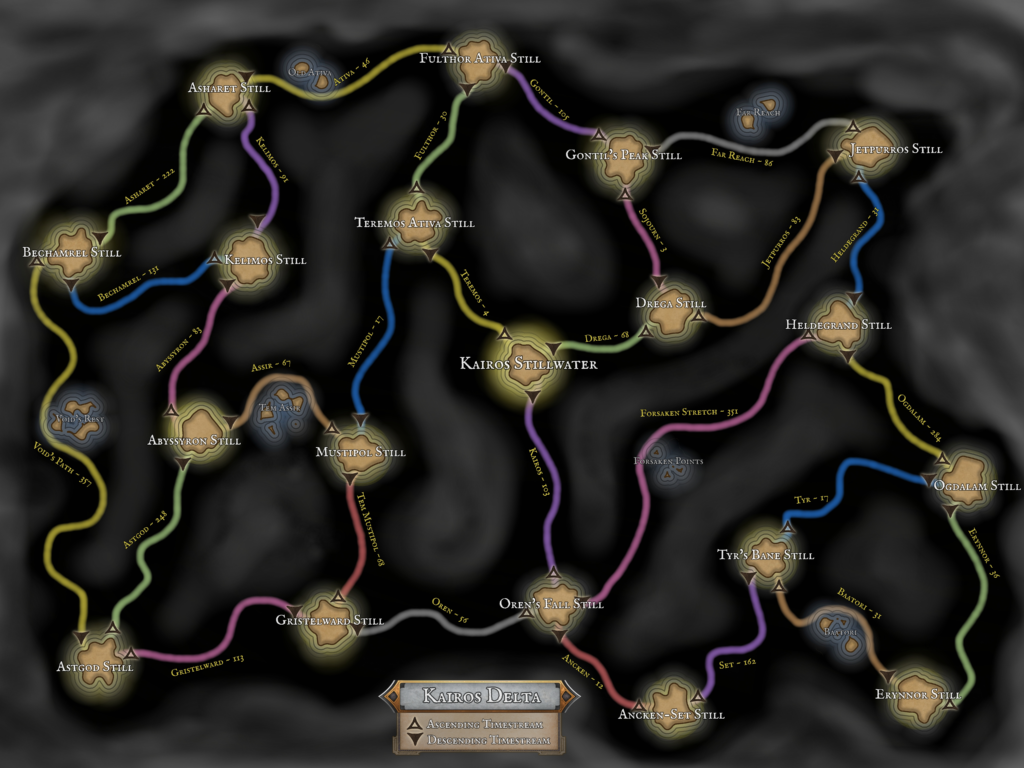
The easiest way to picture the Kairos Delta (and thus the Great Temporal Sea) is thusly: imagine an unbelievably large cloud of dark grey faintly luminescent fog, which takes up the entire known volume of the plane, throw a mess of looped waterways floating through the fog, and plonk down a landmass floating in a small ocean everywhere that the waterways intersect. Now consider that the streams of water are composed of this grey fog, but condensed, and flow in specific directions. These streams of time will either cause something to drastically age upon contact, or will do the opposite, depending on which end of the timestream you entered it from.
In order to traverse the streams folks need protection, which is usually composed of the combined auras of intelligent life. Get enough people together, along with enough Stillwater, and their combined auras will push back the ravages of time. Stillwater isn’t exactly travel friendly though; it takes up literal tons of weight and touching it causes you to become locked in stasis until you are removed from it, so captains aren’t exactly keen on keeping it on board.
That’s where the fuel cells come into play! Maybe don’t ask too many questions about how they are charged though. Slap a couple of fuel cells into a Timebreaker class ship and you have a vessel that can not only traverse the streams, but can forge new ones too, provided you brought a Navigator along.
You remembered to bring a Navigator with you, right?
From where did you draw your main inspirations for the current campaign? Books, gaming modules, films, a vivid imagination? What concepts can explorers in your world expect to encounter?
This one is equal parts easy and difficult to answer. Inspiration comes from all sorts of places, but in this case mainly three sources: a story called “Timeless” from a very popular webcomic (Sluggy Freelance) from back in 2005; the short story “All You Zombies” by Robert Heinlein which I read when I was about ten years old; and the concept of “Arcane Resonance” from a game I’m still fleshing out called Forbidden Empire, which is the second game in the Wrath of the Fallen Goddess planned trilogy.
Arcane Resonance was also featured heavily in Rise of the Durnskald, and also Core, though it wasn’t named. Basically, magic causes ripples in the fabric of reality, bigger magic means bigger ripples, and ripple something hard enough and new stuff happens. Crash a big enough magical meteor into a planet and you can hurl the collective idea of the planet straight out of time itself, left to float around all shattered in a cloud of energy, while the original version slowly heals. Now add a bunch of power hungry Kjerne Runecasters to the mix and, well, though that all happened in the past I’m getting ahead of myself.
As I stated before, Stream of Kairos is my TTRPG Grand Unified Theory, bringing everything and everyone together. I remember reading that D&D cosmology, at least back in the day, theorized that all of the games that everyone ran were tied together by existing in the infinite deep astral, with each game existing within its own prime material plane. In Stream of Kairos, the Kairos Delta exists as the broken shadow of the astral plane, and features scenes and elements from many of the games that I’ve run in the past.
This time around though, the players are seeing the events from different perspectives. Helping to complete the missing portions of the narratives that they played through years ago, and in at least one case drastically changing the course of a doomed world. I mean, it’s probably still doomed, but now it’s different doom.
Sometimes you just have to focus on the small victories.
For more info on all of these concepts and sources, look here: https://streamofkairos.obsidianportal.com/wikis/behind-the-screen
Your campaign has some very innovative design elements. What tools did you use to create it and set it all up? Any recommendations for new GMs starting to design their campaigns?
The campaigns look is done via CSS, paint.net, and flamingtext.com, with a generous splash of google image searching thrown in. W3Schools.com can be a great resource for folks who are interested in learning to use CSS, as can the Obsidian Portal forum and Discord.
What is the importance of the “Orkehd Raiders” in your Campaign. They seem to be integral to the geographic area of “The Kairos Delta”. Please, tell us more…
The Orkehd Raiders are among the most fearsome opponents a ship captain could ever have the misfortune to meet. Piloting vast ships made of iron and steel, armed with cannons and rockets, and frequently protected by powerful energy shields, the Orkehd are a foe you don’t want to meet lying down. Or standing for that matter. Hailing from a different dimension, the Orkehd are powerful and quite technologically advanced, though their skill in magic is extremely lacking.
Oh look, here’s one now: https://streamofkairos.obsidianportal.com/characters/oggie-bigteefs
Without divulging any major plots, what plans do you have for the player characters as they progress through your campaign?
What the characters know: That they are eventually all killed by their sorcerer, ReDyns.
What the players don’t know: One of the players actually knows how this happens, and hasn’t revealed it as of yet.
Having been a member of Obsidian Portal for over ten years, what would you say are the most useful benefits for you as both a Campaign Designer and as a person running a campaign?
I quite like a cohesive theme, and easily accessible info, and eleventy billion rules and systems. Obsidian Portal is, in my humble opinion, still the best platform that allows for easy customization and wiki building without explicitly requiring proprietary software or access fees for everyone involved in the game. Also, I really like the community.
Are there any specific adventures you have yet to have that you are particularly looking forward to that you can give us a glimpse of, without ruining the surprise for your players? You can be as cryptic as you like.
I would suggest that folks read up on what Kairos is, and how it connects to the theme of this game and others I’ve ran. I don’t think that there’s enough clues around to actually ruin the surprise, but maybe someone will figure it out.
Here’s a hint: It all starts with a time loop… all the worst nonsense does, really.
Okay, as a last question, we always ask for the GM’s “pearls of wisdom”. What GM insights can you offer the community this month?
Previously I mentioned learning CSS, and spending extra time getting the world ready to play in so that it sort of becomes self-sustaining.
While those concepts are important, I want to focus on something else this time around. Engage with your players, and your world. Create unique concepts, or monsters, or classes, or races. Create new legends and folktales, maybe songs that tell tales of heroes long gone. Anything really, just make sure to create something, to bring life to your world and vision. You and your players are far more likely to tell tales of the door that made a friend and sacrificed itself to let the heroes continue on their quest than of yet another encounter with a pile of orc guards.
Don’t be afraid to make mistakes, or to be extra goofy with the world (depending on the theme of course). Maybe your world is infested with giant insects that lay eggs that look suspiciously close to oranges, but not quite? Maybe the sewers have Gelatinous Tubes instead of Gelatinous Cubes? Maybe one of your characters is named Lolph Dundgren and you’ve said it so many times over the course of the game that you no longer can remember which way is the actual actor’s name? Maybe try D&D&Space?
And if you’re one of the players?
Maybe, just maybe, play a talking horse who goes out of her way to teach one of her friends how to speak horse. It’s a heck of a story.
Thank you to the community for making this campaign of the month possible! That’s all for now, join us on our next adventure March 1st, and don’t forget to nominate your favorite campaigns for our next Campaign of the Month!
OBSIDIAN PORTAL CAMPAIGN OF THE YEAR 2024- WINNER’S ANNOUNCED!!!!!

A HUGE CONGRATULATIONS TO OUR WINNERS!
FIRST PRIZE:
KERYTH987 WITH WRATH OF THE HIGHBORNE!!!
RUNNER UP: HUMANNOYD with CYBERPUNK 2077:FATE ACCELERATED!
(winners will be contacted by OP staff to connect you with your prizes)
It’s about that time again- time to celebrate some of the very best of our OP Community! 11 great RPG sites, each awarded the prestigious “OBSIDIAN PORTAL CAMPAIGN OF THE MONTH” award in 2024, stand in line to be considered for the OBSIDIAN PORTAL CAMPAIGN OF THE YEAR 2024! And YOU get to decide!
THE DETAILS:
Voting will open Monday December 2nd, is open to ALL, and will close Monday December 9th. The winner will be announced on Friday December 13th. Check Obsidian Portal, Facebook and Twitter for further details.
THE CONTENDERS:
January 2024: More Things in Heaven and Earth
February 2024: Cyberpunk 2077 Fate Accelerated
March 2024: Wrath of the Highborn
April 2024: Season of Strife
May 2024: The World of Elurah
June 2024: The Planewalker’s Guild
July 2024: Ars Magica, Umbra Quercus Saga
August 2024: Freeing Phandalin
September 2024: Echo of The Mists
October 2024: Aloft!
November 2024: Dark Conflagration
THE PRIZES:
This year we have some AMAZING sponsors including Paizo, Killjester, Crit Academy and Syrinscape!
1st Place
- 1 year subscription to OP
- Paizo: Digital copies of Pathfinder Second Edition and Starfinder First Edition Beginner Box PDFs as well as a PDF of Abomination Vaults (Pathfinder Second Edition or Dungeons and Dragons 5th Edition, winner’s preference)
- Killjester: A physical Copy of Sanctimonious Slimes vs Expired Epicures
- Crit Academy: Digital Copy of Memorable Monsters
- Syrinscape: A subscription (Supersyrin trial vouchers, each for two months x 2)
Runner Up
- 1 year subscription to OP
- Killjester: A physical Copy of Sanctimonious Slimes vs Expired Epicures
- Syrinscape: Syrinscape: A subscription (Supersyrin trial voucher, for two months)
Obsidian Portal Campaign of the Month October 2024: Aloft!

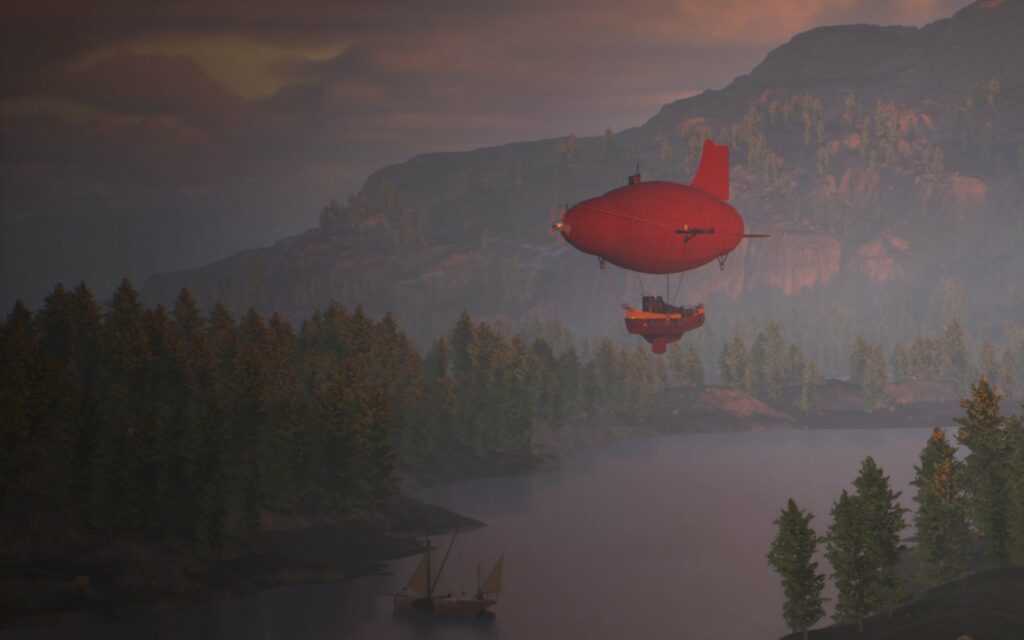
Join the ranks of great literary heroes like Francis Grimm, Tristan Thorn and Darian Frey, fly aboard a merchant airship and explore the world from above! In this homebrew world (and system!), the heroes embark on a great journey that takes them high above the clouds. The characters are deeply entrenched in this medium-fantasy world, with their attachments and goals guiding them as they plan and prepare for their future. Detailed, layered maps, deep roleplay and memorable antagonists – all are waiting for you inside GM rus1001‘s adventure, Aloft!
First off, feel free to tell us about the person behind the GM screen. Where are you from? What do you do aside from gaming? Alter Egos? Life partners? Family? Where can we interact with you on the internet?
I’ve travelled the world and done many jobs – some of which most people only see on TV. I try to tell myself that it’s not just about bringing authenticity to my tabletop and live roleplaying games. Sadly, as a saggy 50-ish adult with a kid, I’m not likely to be making it into space anytime soon, but I’m content with what I’ve done and where I’ve been.
I try to match my fantasy life with some real-life adventure; thus wild-camp and Canadian canoe in Scotland – a dawn on a Scottish loch and watching sea-eagles hunt is as close as I’ll get to my game for real. If anyone wants tips on visiting Scotland, feel free to contact myself through Obsidian Portal.
Tell us about “Aloft” in a nutshell. How did you design the world? What was your inspiration?
Aloft is a medium-fantasy game, where the players have decided to take a gift of a ridiculous airship and found a trading company.
In the last ten years, I’ve run some lengthy war-campaigns that stretched between players in two continents. They were exciting but quite serious games. I wanted something more whimsical. And I was inspired by the latest D&D movie – what fun!
Aloft takes me back to delivering great locations, great NPCs, complex and layered plots to the tunes of Led Zeppelin. Just like I did in the ‘good-old-days’. But with more adult themes than the teenage me would ever had dared.
How regularly do you play, and where do you play? Tell us about your current group of players.
I play online every two weeks, using Zoom. And four times a year in person for weekends, or a whole week on a small Scottish-island rocked by the Atlantic rollers.
The core of my players have been in my games for about 30 years. I play with great friends. But there is always opportunity to add new chums. I had a diverse and wonderful group after co-founding the Gulf Roleplaying Community (https://www.facebook.com/groups/gulfroleplayingcommunity/).
I interview rigorously for my games, as I know they are marmite. If you love them you’ll stay for years or decades; if not, you’ll be gone in three sessions. For people who know me they’ll compete to join the campaigns if a space comes up.
What game system are you using? What made you choose that system? How does that system complement your campaign?
I started life with AD&D 2nd ed. Stayed with that for years, and now run my own homebrew system. It has everything I need: narrative based PC build, and no initiative in combat.
The system allows me to run nerve-wracking combat, either at the personal level or to enact huge battles and campaigns at various levels. More importantly, the system allows me to bring the past 6,000 years of history of my campaign to reality through rules.
Your landing page puts a lot of emphasis on the flying ships, including propeller gifs. It gives a sense of exploration and wandering. Can you tell us what role exploration takes in your campaign? How do you handle it?
Exploration of ideas, themes and places is at the heart of any roleplay, and with my shift from a ‘serious’ campaign to something zestier I’ve given myself space to play as a ref. I also got used to travelling PCs with my sc-fi campaign.
With a whole world before them I rely on my players being the veterans they are. They have fully formed PCs with motivations and attachments to the world (baby dragons, family and businesses); therefore, they don’t just ‘fly off’ randomly. They are also adults, and know that I have a life too, and need a bit of planning to map out and deliver regions. Younger-in-service and more impulsive players are kept in check by the oldster’s social-norms.
And I’ve given myself the luxury of a long campaign. Aloft is likely to last for another 4-5 years. My players may think they have settled in the, Kingdom of The White, but they have much, much more exploration to enjoy and be challenged by.
In your maps section, you have several identical maps with different layers on them. Can you please tell us a little about your campaign setting and the use you make of the map section?
I have two brilliant players who manage the uploading and meta-tagging of OP. They also manage the maps. The maps are used extensively by players/PCs during the games. They are used for different levels of planning, understanding the world, and acting as a prompt and a reminder to the politics of the world. My players use them in and out of time frequently.
How much time is usually spent preparing your game sessions? Describe a typical session.
I must balance my sessions between those who want to swing a sword and roll dice, and those that want political and adult-themed intrigue.
With my DMing experience the more romantic, sexy, political, moving, and personal angles I usually sketch out when doing sport, and they will end up as three bullet points, written in twenty minutes and will last for about 12 hours playing.
Sadly, online roleplaying is much more demanding of a ref’s time. As soon as you want combat or dungeons, you cannot just draw them on a white board. It’s much easier to write for a week of face-to-face than it is for two months of online sessions.
And a lot of that is my fault. I want to make the world engaging and real for the players. I want them dreaming of it and lying awake after sessions obsessing about what has just happened. Therefore, I will construct my own maps in Fractal Worlds, Campaign Cartographer and Photoshop.
I do a lot of 3-d modelling as well. Most of my PCs I will render out in Daz3d, which despite its appalling misogyny, is still a great resource.
On the more creative side I will build very simple models and animations to illustrate a session, such as in Sketchup with a castle. If I have time I will render in Unreal Engine 5, which allows me to prepare videos such as ‘sneaking’ around Sturmburg or even to quickly render out on the fly when players choose a different route with the balloon. You’ll note I don’t do NPCs – UE5 is awesome, but I don’t have the time to master that – yet. I have managed to make one with a moving dinosaur, I’ll post the link here, but I cringe a bit as it’s only my third animation in UE5 and clunks – but it mesmerized my players.
What I do is to show my players my dungeons. These are quite rough and ready, I’ve often only a few evenings, say four, to build or buy models, learn how to use lighting, animation and texturing in Unreal and then pose and photograph them. The players love it and said ‘dungeons’ and the like utterly grip and involve them. My favorite is probably this, with this being a close second (for scale.)
With many of the zeppelins I will sometimes create ‘playable’ UE5 levels that my players can download and run around the interiors – as I said I want my players as immersed (and obsessed) as me.
In your wiki section, you link to several other campaigns. Can you please explain what these campaigns are and how they are connected to Aloft?
Aloft sits as one of my current campaigns in a world I have been reffing and creating since I was 12. I got ‘serious’ about the internal logic of my world at about the age of 21. Since then, no matter where I have lived, or whom I have reffed, I have played in that world. My campaigns tend to last for 4-12 years in real life, with PCs retiring into my stable of NPCs. My world has been shaped by my players and me for about 30 years.
It has great mapping and moons and its technology has evolved over the decades (out of game) and centuries and millennia (in game – I’m not that old).
I am currently running another campaign that is running concurrently with Aloft, which is set in a major city of the world.
How long have you been using Obsidian Portal? What brought you to the site and what keeps bringing you back?
I have been using OP for over 11 years, and I love it. It was the most prominent site like it at the time of joining, and it has weathered well.
If you had to pick just one thing, what would you say Obsidian Portal helps you with the most?
Helping old and new players explore, in their own time, or during time-ins the rich and decades old world we have been building.
What would you say is the biggest highlight of your game so far (please also provide images and links if possible)?
The biggest highlight of my game has been having the PCs have their own baby dragons for the first time in any of my campaigns. Watching my players get competitive and protective of them has been a joy to watch.
Okay, as a last question, we always ask for the GM’s “pearls of wisdom”. What GM insights can you offer the community this month?
Use great music. I have over 70GB of music that I use in my games. Get to know your music, make up playlists for general types of play (sneaking, battle, the tavern), and then run special sessions to the second using a soundtrack of your own making.
Thank you to the community for making this campaign of the month possible! That’s all for now, join us on our next adventure November 1st, and don’t forget to nominate your favorite campaigns for our next Campaign of the Month!