Tag Archives: dnd
Campaign of the Month January 2026: The Island of the Prince

They call it The Island of the Prince – England, a realm scarred by pestilence and bled dry by war. The Black Death has emptied the villages, leaving fields untended and halls in ruin. Those who remain send their sons to die on foreign soil, as the endless struggle with France devours the kingdom’s strength. Join us as we take a journey through the adventurous mind of GM Terrancedavis in the first interview of 2026

First off, feel free to tell us about the person behind the GM screen. Where are you from? What do you do aside from gaming? Alter Egos? Life partners? Family? Where can we interact with you on the internet?
My name is Terrance Davis, I’m from Queens, New York, and that background has shaped how I see the world and how I run games. I’m an Army veteran, which taught me discipline, responsibility, and how quickly situations fall apart when people stop paying attention. Those lessons carry directly into my work behind the GM screen.
Outside of gaming, I run a small welding subcontracting business. It’s practical, physical work where shortcuts show immediately and mistakes carry real consequences. Metal either holds or it doesn’t. That mindset influences my campaigns as well. Preparation matters, choices matter, and immersion only works if the foundation is solid.
I’ve been with my fiancée, Crystal, for nearly eleven years. She has supported me through long nights of prep, creative risks, and the constant balancing act between work, life, and storytelling. She keeps me grounded when my head disappears into medieval France or a war-torn future America. I have a Daughter and three sons.
I don’t really think in terms of alter egos. I’m a welder, a veteran, a business owner, and a lifelong storyteller, and all of those parts show up at the table in one way or another.
People can reach me and interact with me through;
Obsidian Portal (https://www.obsidianportal.com/campaign_invites/891a9b47a897f93793a80bbb/accept),
Discord (where you can hear our Deep Dive Podcast about Island of the Prince topics) under the name terrancethedungeonmaster,
Startplaying
(https://startplaying.games/gm/islandoftheprincecampaignsetting),
Chronica, you can further explore the Island of the Prince,
( https://chronica.ventures/join?ref=495d44d05607ceb91af5)
Patreon, you can read short stories and learn other lore (https://patreon.com/Islandoftheprince?utm_medium=unknown&utm_source=join_link&utm_campaign=creatorshare_creator&utm_content=copyLink).
I stay engaged with my community and enjoy talking about campaign design, history, and what makes a story feel real rather than staged.
At the end of the day, I believe tabletop games can be more than entertainment. They can feel like shared history.

Your campaign is set in the historical world of the 100 Years War between England and France. What inspired you to create a fantasy role playing game during this time? What sources did you use? What adaptations have you made?
The Hundred Years’ War appealed to me because it was a time when the world genuinely felt unstable. Borders shifted, loyalties fractured, the Church was under strain, and ordinary people lived with war, famine, and plague as facts of life. It’s a perfect historical backdrop for fantasy because the fear, desperation, and moral uncertainty are already there. I didn’t need to invent a grim world. History did that work for me.
The campaign itself grew out of a much older place. My older brother, Darren, has been the one consistent player since the very beginning, going back decades. We started imagining this world as kids, long before it had a name. Even now, with all that shared history, he’s still a player at the table, which means I deliberately keep information from him like I would any other character. That tension between shared roots and narrative secrecy is part of what keeps the campaign alive.
In terms of sources, I lean heavily on historical material. Contemporary chronicles, military histories, maps, church records, and firsthand accounts of medieval life all inform the setting. I pay attention to things like travel time, weather (which we track in our Chronica calender, along with events), food shortages, social class, and how authority actually worked on the ground. Fictional influences matter too, but history is always the spine.
The adaptations come in where fantasy needs room to breathe. Supernatural elements exist, but they are rare, feared, and costly. Magic is dangerous and often misunderstood. Monsters don’t replace human cruelty, they sit beside it. I’m not trying to rewrite history so much as thread dark fantasy through the cracks that already exist in it.
The goal has always been to create a world that feels lived in. A place where legends are born not because they were destined to happen, but because someone survived long enough to be remembered.

You are using some version of Dungeons and Dragons for your campaign. What version of the game and what made you decide on the particular system.
I use a hybrid of Dungeons and Dragons Fifth Edition, primarily drawing from the 2014 rules and selectively incorporating elements from the 2024 updates. The main reason is practicality. We’ve been playing almost entirely online for the past year, and Fifth Edition remains the most accessible, well-supported system for virtual play. It’s familiar to players, easy to reference digitally, and flexible enough to be shaped into something more grounded.
That flexibility is the real reason I chose it. I’m not interested in running Fifth Edition “out of the box.” I ban a lot of options, starting with the most obvious one: this is a humans-only campaign. The setting demands it. The tone, the historical grounding, and the horror elements all work better when characters are fragile, limited, and unmistakably human. Many abilities, ancestries, and character options that lean toward high fantasy or power fantasy simply don’t fit, so they’re cut.
Using Fifth Edition as a framework lets me keep the mechanical language familiar while enforcing a very different philosophy of play. Choices matter, resources matter, and survival is never guaranteed. The rules serve the setting, not the other way around. Fifth Edition gives me a sturdy chassis, and everything that doesn’t belong gets stripped away until what’s left supports the story I want to tell.
Tell us about your players and your typical gaming sessions. How often do you play? Online? Tabletop? Who does what in any typical session?
I’ve been a Dungeon Master for many years (since 1985), and one of the things I value most is a table where players take the world seriously and respect each other’s role in it. I’m fortunate to have exactly that.
Christian acts as my co–DM and moderator, especially since we play online. He helps keep sessions running smoothly, manages logistics, and serves as a sounding board when I’m stress-testing ideas. As a player, he’s exceptional. He plays Sir Wilhelm, an English lay knight fighting in France, and when I run one-shots he also steps into the role of Sir Guiscards de Beaumont, a French Hospitaller. He understands tone, restraint, and character motivation, and he elevates every scene he’s in.
Kurt plays Absolon Gyllenstierna, a rogue from Gotland who fights alongside the Ravenguard in France. I’ve run games for a long time, and I can honestly say he plays a rogue better than most. Absolon isn’t underhanded or treacherous. He’s a dashing, capable fighter who uses skill and intelligence in service of the group. He proves that the rogue archetype doesn’t need to rely on deception or selfishness to be compelling.
My big brother, William “Darren” Davis, who is in Law Enforcement in real life, has been the one constant player since the very beginning of this campaign’s long history. He plays Sir Arkan Warwind, a Moorish convert to Christianity and a Hospitaller knight, and in one-shots he plays Sir Michael Brigge, an English Hospitaller stationed at Sainte-Flamme du Refuge in northern France. Despite our shared history and decades of worldbuilding, he’s still just a player at the table, and I deliberately keep secrets from him like anyone else. That boundary is important, and it keeps the game honest.
We play once a week on Sundays, entirely online, which has been our format for the past year. Sessions are structured but flexible. I handle narrative, pacing, and adjudication. Christian supports moderation and flow. Players drive the story through choices, roleplay, and hard decisions rather than mechanics alone. Combat is tense and grounded (we use a brutal critical hit and miss table), but much of the session time is spent on investigation, moral dilemmas, and character interaction.
Looking ahead, I plan to expand in 2026 by running additional sessions through StartPlaying, but the heart of the game will remain the same. A consistent table, serious roleplay, and a shared commitment to treating the world as real, dangerous, and worth caring about.
Your adventure logs are well written and seem to be in the form of tales told by “Carla the Serving Wench”. Tell us a bit about her. Why is she an important chronicler? Is it just you as GM writing, or do other players get involved?

The adventure logs are written as tales told by Carla the Serving Wench, and she has been part of the campaign for its entire life. Carla is a bard, a traveler, and a witness. She isn’t powerful in the way knights or monsters are, but she survives by listening carefully and remembering accurately. In a world where most lives pass unrecorded, that makes her quietly dangerous.
Carla is important because history in this setting is not written only by kings, generals, or the Church. It is shaped by rumor, song, and repetition. Carla moves freely between taverns, villages, camps, and courts, hearing things no official chronicle would ever record. When events are remembered clearly, it is often because Carla chose to tell them straight.
She also stands in contrast to the other storyteller who circulates through the campaign, Martha the Goodwife. Martha is well known in markets and village greens, and her stories are always louder, juicier, and far less accurate. She exaggerates, slanders, and reshapes events to suit gossip, personal grudges, or whatever will hold an audience. Between Carla and Martha, players see how the same event can become either history or rumor, depending on who tells it.
Players write their own adventure recaps in Chronica.
The style of the logs reflects my own background. After leaving the Army, I briefly studied journalism, and that perspective never really left me. I’m interested in how truth is filtered through bias and voice. Before the Army, I went to welding school, which reinforced the same principle in a different form. Structure matters. If it doesn’t hold, it fails.
I write the Obsidian Portal logs as the GM, but they are never written in isolation, and are always wrong in many ways (stories change as they travel). They are shaped by player decisions, table conversations, and moments that genuinely land with the group. Carla does not invent heroics. She reports what she believes to be true, while Martha ensures that exaggeration and slander spread just as quickly.
Together, they show how legends are born, not from facts alone, but from who gets believed.

Tell us a bit about the central characters in your campaign. What roles do they play, and how do each of the players contribute to their game personalities.
At the heart of the campaign are a small number of central figures whose choices shape events far beyond themselves. Some are player characters, some are NPCs, but all of them matter, and all of them carry consequences.

Sir Arkan Warwind, played by my brother Darren, is a Hospitaller knight and paladin, a Moorish convert to Christianity who lives with constant tension between faith, identity, and duty. Arkan is not a simple holy warrior. He questions authority, struggles with the Church’s failures, and yet remains deeply committed to his vows. Through him, the campaign explores faith as something lived and tested rather than assumed. Darren plays Arkan with restraint and seriousness, treating belief as a burden as much as a strength, which gives the character real moral weight.

Sir Wilhelm, played by Christian, is an English lay knight fighting in France. Where Arkan wrestles with belief, Wilhelm represents loyalty, discipline, and endurance. He is a professional soldier who keeps moving because stopping is not an option. Christian brings a grounded, steady presence to Wilhelm, anchoring scenes that might otherwise drift into abstraction. When I run one-shots, Christian also plays Sir Guiscards de Beaumont, a French Hospitaller, which allows the story to show both sides of the war without flattening either into stereotypes.

Absolon Gyllenstierna, played by Kurt, is a rogue from Gotland who fights alongside the Ravenguard. Absolon defies the usual expectations of the class. He is not underhanded or deceitful, but a dashing and capable warrior who uses agility, intelligence, and timing in service of the group. Kurt plays him as a hero who solves problems through competence rather than treachery, often bridging the space between investigation and violence.
Traveling with the Ravenguard are two NPCs who are just as central to the story.

Lady Athena is a Hospitaller knight whose presence challenges every assumption about power, gender, and leadership in the medieval world. She is an extraordinary warrior, but her importance goes far beyond combat. Athena represents idealized knighthood colliding with a corrupt and compromised reality. Her choices force the party to confront what honor actually means when institutions fail.

Sarah Marsh is equally important, though in a very different way. She is a seer and survivor, marked by loss and guided by visions she does not fully control. Sarah brings the supernatural consequences of the world into focus. Where others argue about faith, politics, or duty, Sarah shows what happens to ordinary people caught in the wake of those decisions. Her presence keeps the campaign grounded in human cost rather than abstract morality.
Opposing these characters are larger, darker forces, most notably the Order of Judas, a shadow successor to the destroyed Knights Templar. Led from behind the scenes by the Black Pope, the Order is driven by vengeance against a Church they believe betrayed them. Sir Jordan, once a knight of the faith and now bound to that betrayal, embodies the cost of choosing revenge over redemption. He is not a simple villain, but a man who refuses to admit that his choice may have damned him.
All of these threads converge around the campaign’s central struggle, a brutal race for the True Cross. It is not merely a holy relic, but a symbol capable of legitimizing power, justifying war, and reshaping belief itself. Arkan sees it as a test of faith. Wilhelm treats it as a duty. Absolon views it as something that could either save lives or destroy them, depending on who claims it. Athena and Sarah understand that whatever happens, the world will change afterward.
Each player contributes not just a character, but a worldview. Together with the NPCs who travel beside them, they turn the campaign into a story about belief, loyalty, and consequence in a world where even holy things can be used for terrible ends.

How close does your game run to historical fact? What embellishments have you added? I note that you have dragons within the campaign. Tell us about them.
The campaign stays very close to historical fact in its foundation. The political landscape, the Church, the conduct of war, travel times, social class, famine, plague, and the general instability of the Hundred Years’ War are all grounded in real history. England and France behave as they did in 1356. The Church wields power the way it historically did. Most suffering in the world still comes from very human causes: ambition, fear, and betrayal.
Where I embellish is in what history could not record, only explain away.
Dragons exist in the campaign, but they are not common, casual, or heroic adversaries. They are closer to natural disasters than monsters. Their appearances are rare, cyclical, and catastrophic, and they leave scars on the land that shape history for generations. In that sense, they function much like real medieval events such as famine, plague, or mass slaughter. People plan around them, fear them, and build belief systems to explain them.

The two most important dragons are Flame (True Name: Pyraxia) and Pyre (True Name: Voradracus), both red dragons whose names are spoken with dread. Flame is the younger and more frequent of the two. She appears roughly every two years and is remembered for cruelty and spite rather than strategy. She can change her color to hide like a chameleon. Her attacks focus on crops, livestock, and forests. Flame causes famine. Villages don’t fall immediately under her shadow, they starve months later. To the common folk, Flame is remembered not as a battle, but as empty granaries and buried children.
Pyre is far older and far more destructive. He appears roughly every five years and devastates entire regions. Pyre does not harass. He erases. Castles, fortified towns, and armies are reduced to ash when he awakens. His attacks are remembered as historical ruptures, events that reset borders, depopulate regions, and force mass migrations. Entire political decisions are made based on when Pyre is expected to return.
No one has ever slain a dragon in the campaign. Knights who try become footnotes, if they are remembered at all. The Church teaches that dragons are hellspawn and must be destroyed, but history quietly shows that faith alone has never been enough. This tension between doctrine and reality is intentional. Dragons expose the limits of power, belief, and heroism.
In short, history remains the spine of the game. The embellishments are deliberate, restrained, and consequential. Dragons do not replace history. They complicate it. They give the medieval world another reason to fear the sky, another excuse for atrocity, and another legend that future generations will argue about, long after the ash has settled.
You have described your campaign to me as a low magic campaign. How do you fit magic into the historical context? What else have you added to “spice up” the historical context?

I describe the campaign as low magic because magic exists, but it is rare, feared, and costly, much closer to how medieval people actually believed the world worked than to a high-fantasy setting. Most people will live and die without ever seeing a spell cast. When magic does appear, it is treated as an event, not a convenience.
Magic is woven into the historical context the same way superstition, faith, and rumor were woven into medieval life. The Church condemns arcane magic as heresy or witchcraft, while tolerating miracles so long as they fit doctrine. Folk magic exists at the margins in the form of charms, blessings, curses, and whispered rituals, but even those carry risk. True spellcasting shortens lives, attracts attention, and leaves marks. People who practice it rarely live long or openly. If someone can hurl fire or heal the dying, the question is never “how?” but “who is coming for them now?”
Divine magic is not treated as guaranteed or transactional. A prayer is not a vending machine. Miracles are rare and often ambiguous, and even holy power demands sacrifice. Faith can protect, but it can also be tested, withheld, or misunderstood. This keeps belief meaningful instead of mechanical.
To spice up the historical context, I add pressure rather than spectacle. Weather is tracked. Food shortages matter. Wounds linger. Rumors spread faster than truth. Relics like the True Cross are powerful not only because of what they can do, but because of what people believe they justify. Institutions such as the Church, knightly orders, and secret societies actively respond to anything that threatens their authority.
Supernatural elements like undead, witches, or dragons exist, but they are treated as existential threats, not encounter fodder. When the unnatural appears, it warps the world around it, changing behavior, belief, and politics. The result is a setting where magic deepens the horror and the stakes rather than softening them.
The goal is always the same: to make the world feel real first, and uncanny only when it absolutely has to be.
I see you have customized the layout of the campaign. What tools did you use in setting things up? What advice can you give for new GMs who want to do what you have done?

I’ve customized the campaign layout primarily through Obsidian Portal’s built-in tools, using custom CSS and careful page structuring to control tone, readability, and atmosphere. The goal was never flash for its own sake, but immersion. The site should feel like it belongs to the world, not like a modern wiki with medieval content pasted into it.
I’m fortunate to know someone who is very strong with coding and troubleshooting, especially when it comes to working within the limitations of hosted platforms. Having access to that kind of expertise made a huge difference, particularly when dealing with finicky CSS rules, browser quirks, and the trial-and-error that comes with customization. It allowed me to experiment without breaking things permanently and to recover quickly when something went wrong. My pages are still a work in progress.
Beyond that, I rely heavily on consistent structure. Clear navigation, predictable formatting, and restraint go a long way. I use Chronica for in-world timekeeping and event tracking, Discord for communication and session management, and Patreon for community support and extended content. Each tool has a defined purpose, and I avoid overlap wherever possible.
For new GMs, my advice is simple. Start small. Don’t try to build everything at once. Focus first on content, tone, and consistency. A plain site with strong writing will always outperform a beautifully styled site with nothing to say. Learn just enough CSS to make meaningful changes, and don’t be afraid to ask for help from people who know more than you do.
Most importantly, remember that the tools exist to serve the game. If the world feels alive at the table, everything else is just scaffolding.
Whereabouts are your players in the 100 Years War? Are there any specific adventures you have yet to engage in that you are particularly looking forward to that you can give us a glimpse of, without ruining the surprise for your players? You can be as cryptic as you like.

At the moment, the campaign it is in the month of March of 1356, with the party operating in northern France, moving through contested territory during a tense lull in the Hundred Years’ War. This is the period before open catastrophe, when armies are maneuvering, supplies are thin, and everyone knows something terrible is coming but no one knows exactly when. Historically, this is the calm before the storm.
The major historical event looming over the campaign is the Battle of Poitiers, which will take place in the fall of 1356. Poitiers is significant because it is not just a battle, but a rupture. The English capture King John II of France, shattering French authority, destabilizing the realm, and turning the war decisively in England’s favor. In the campaign world, Poitiers represents the moment when order collapses. Alliances break, mercenary bands multiply, the Church scrambles to control the narrative, and entire regions are left exposed. Everything the players are doing now exists in the long shadow of that coming disaster.
As for what lies ahead, there are threads already tightening.
Relics are moving when they should be hidden. Old oaths are being tested by new commands. Certain factions are racing toward the same destination for very different reasons, and not all of them plan to arrive openly. Some truths about the Order of Judas are closer to the surface than they appear, and some allies are carrying secrets that will not survive the summer.
By the time the leaves turn and Poitiers comes, the players will understand that the battle was never just about armies. It will be about who controls belief, who survives the collapse, and which stories get told afterward.
That’s as much as I can safely say.
Okay, as a last question, we always ask for the GM’s “pearls of wisdom”. What GM insights can you offer the community this month?

My best advice is this: write a story worth interrupting.
Give your campaign a grand narrative, one with real stakes and a clear sense of direction. A larger story, made up of many smaller ones, gives players purpose. It helps them understand why their choices matter and why the world keeps moving even when they aren’t looking. Momentum is not railroading. It’s respect for the setting.
At the same time, build your world to respond honestly. Don’t protect plans that no longer make sense. Let player decisions alter outcomes, break assumptions, and force you to adapt. If the world bends, it should bend for reasons the players can see and feel.
Finally, remember that immersion comes from consistency, not spectacle. Keep your rules, tone, and consequences steady, and players will meet you there. When the world feels real, the stories that emerge will stay with your table long after the dice stop rolling.
Thank you to the community for making this campaign of the month possible! That’s all for now, join us on our next adventure February 1st, and don’t forget to nominate your favorite campaigns for our next Campaign of the Month!
Campaign of the Month November 2025: La Compagnie du Dragon Blanc

Finally, we are pleased to present you our September Campaign of the Month, La Compagnie du Dragon Blanc – join us in our exclusive interview with GM jean_luc_rousseau to gain a special insight on the mind behind the work!

Let’s start with the group: who are the players around the table?
Starting with 5 players, the White Dragon Company now has 8, ranging in age from 16 to…57 for the GM, which is me!
Tell us a little about your group: how did you meet and what led you to immerse yourselves in the world of Faerûn?
I’ve been playing AD&D 2nd Edition since 1984 and I’ve been passionate about the Forgotten Realms from the very beginning. I wanted to form a group, including two of my three children who discovered role-playing games through this. Other passionate friends have joined us for the past 3 years. Next March, our Company will be 4 years old!
How do your games unfold?
We play at my place and at our association, the Circle of the 3 Kingdoms, in Agde, in the South of France, usually in the evening.

How often do you organize sessions? Do you play in person, online, or in a hybrid format?
We play monthly, sometimes bi-monthly, and always in person. For me, distance breaks the immersion.
Most people here are familiar with D&D, but perhaps not the 2nd edition in particular. What appealed to you about this version?
I started with the first edition, then naturally moved on to the second. I like the fluidity of its rules. And it constantly takes me back to my teenage memories. I’m completing my collection for my son, a mage in the Company, who also loves this universe. The components of the second edition are magnificent, especially the cards. I love them!

You’ve certainly spent a lot of time on your various campaigns on Obsidian Portal. Which features have become essential for organizing and running your games?
The website is a very useful tool, providing a complete summary of each of our sessions. We add to it as we go along, and it’s a valuable reference tool. The character recall and management features are particularly useful.
I notice you have an eclectic mix of different fantasy worlds that many will recognize.
I agree, but I remain faithful to the overall storyline of this period in the Middle Lands. I incorporate elements that I adapt intentionally, but always respecting the story and the main events. I’m passionate about it, and the lore is so rich that it allows for easy adaptation without altering its core essence.

Are there any particular difficulties in merging these elements from such diverse worlds?
No, but I ensure the overall coherence. It’s important to maintain certain reference points.
The level of detail in your Adventure Journals sometimes makes me feel like I’m sitting at your table. How do you go about writing them? Do you manage it alone or as a team?
Thank you for the compliment! I do it alone, and it takes a lot of time, but it’s my passion! I do it all by myself, and I occasionally edit the summary, year by year, into a booklet for each of my players.
If you had to choose a single moment of resounding success or spectacular failure to describe your campaign so far, what would it be? Whether it was hilarious, poignant, or simply brilliant, we’d love to hear it.
A moment of success: I love role-playing, and we were able to spend an entire 5-hour session without rolling a single dice roll… the players were completely immersed in the game and their character portrayals—a real treat for the GM!
And finally, we always ask the question: what’s your secret to running a successful campaign?
The coherence of the whole, passion, and a solid “historical” framework that allows the players to feel like they’re part of the world they’re in. If you had to summarize your GM philosophy, what are the key ingredients that make your game captivating and keep your players coming back?
Allowing players to truly immerse themselves and embody their characters, rather than simply organizing a series of soulless battles. While combat is an integral part of the game, it’s not the most important thing for me. The relationships and interactions between players around the table are what make the game special, not the dice or the rigid application of rules! Freedom, consistent world-building, and role-playing form the foundation of my game philosophy.
Thank you to the community for making this campaign of the month possible! That’s all for now, join us on our next adventure of COTY in December, and don’t forget to nominate your favorite campaigns!
Campaign of the Month October 2025: Mike Brock’s Mummy’s Mask Campaign

Delve deep into the land of Osirion following an intrepid group of adventurers called The Desert Guardians as they discover hidden treasures in the Tomb of Akhentepi in this Pathfinder Adventure perpetuated by GM coastiemike and his team of table top role players as they explore Mike Brock’s Mummy’s Mask Campaign.

First off, feel free to tell us about the person behind the GM screen. Where are you from? What do you do aside from gaming? Alter Egos? Life partners? Family? Where can we interact with you on the internet?
I have been playing some iteration of RPGs since 1976 with my first ever GMing experience in 1982 when I ran one player through a short Star Frontiers campaign. I really delved into GMing D&D/AD&D in 1985 while in high school.
I have also been lucky enough to work in the gaming industry when I oversaw the organized play program for Paizo from 2011-2015 with some help from a ton of amazing volunteers from around the world, many who I am still lucky enough to call friends.
I am originally in Georgia though work has moved us various times to Seattle, New Orleans, Reno, NV, and back to Georgia. I also spent time in Indianapolis, San Francisco, Connecticut and Miami when I was in the Coast Guard.
Aside from table top gaming, I paint 28mm minis for my campaign, as well as at the request of my players to match their PCs. I have a pretty extensive Reaper Master Paints collection and have a dedicated paint workspace. I also enjoy hunting, backpacking, and traveling.
My wife and I have been together for 22 years and have two awesome children and three amazing grandchildren.
I don’t have a big on-line presence but I am occasionally on facebook.

How would you describe your Campaign in a nutshell. Tell us a bit about the adventure group known as The Desert Guardians and their adventures in the Osirian city of Wati.
We follow the Mummy’s Mask adventure path pretty closely but we tie it in to a previous campaign I ran 15 years ago -the Legacy of Fire Adventure Path. One of my players in that campaign is also playing in this Mummy’s Mask campaign. Her PC and another PC (Kamal) from the Legacy of Fire were married after the AP ended and had a child – Zalina Roveshki. Zalina is now a new adventurer in the Mummy’s Mask AP and learning her way with the Desert Guardians adventuring company.
The other members of the Desert Guardians include:
– Zylia Glavien, an elven ranger with extensive experience in desert environs. She recently lost her animal companion, Wally the Weasal. Wally had an interesting back story as well and found his way through a portal from Sigil. Wally had been a familiar to Dominick the wizard, also from the Legacy of Fire campaign.– Corin Lancingdor is a halfling paladin of Iomadae. However, he is originally from Faerun and was part of the Knights of Silver. In a mishap while battling drow under Silverymoon, a wild magic surge sent him through a portal to Golarion and now Corin is trying to find a way back home to Silverymoon and his elderly mother, Malinda, who owns a bakery in Silverymoon – Lancingdor Bakery.
– Zomo, born in Wati and reared in the Grand Mausoleum, is a devout follower of Pharsma and has taken the undead awakening as a personal affront to be dealt with. He was also destined to follow Pharsma as the birthmark on his head resembles her holy symbol very closely.
– Sidero, a monk from far off Jalmeray, plans on strengthening his mind, body, and soul in order to prove the strength of his monastery and his worth as a monk. He determined the best place to earn respect would be at the Necropolis in Wati, a place of untold peril, mystery, and treasure. After joining the Desert Guardians, Sidero has spent a lot of time searching for his niche within the group in terms of combat.
– Thorik, a dwarven fighter, never really fit into Dwarven life. He craved adventure, to see new things and places; to explore new dungeons and ruins, and loot them; to meet new and interesting people/creatures, and kill them. So at the first opportunity, he joined a caravan out of his hometown. As soon as that job was over, he set out on his own.
– Azalea, and elven rogue, is the newest member of the Desert Guardians, joining them after they had finished exploring the Necropolis and meeting the Guardians at the auction to start Book 2 of the AP. She has recently suffered the loss of her beloved animal companion, Azizi, a capuchin monkey, that she had saved from a traveling circus.

How long has your campaign been running and what made you choose Pathfinder as your gaming system? Are you using Pathfinder Version 1 or Version 2?
We started this campaign in February of 2024. We are using Pathfinder 1st Edition. When Paizo had it’s Dragon and Dungeon Magazine publishing ended, they created Pathfinder. I had renewed my subscription to both magazines for three years and was offered to change it to the adventure path subscription. I absolutely loved D&D 3.5 and the progression to Pathfinder 1e was a no brainer. We have stuck with it every since and have not considered switching to second edition as everyone seems to be having fun with PF1.

Please tell us something about your average gaming sessions. How often do you play? Online or Tabletop? What is your gaming group like?
We are currently on a bi-weekly schedule, playing every other Wed night from 7-11 pm in our basement game room. This is on alternate weeks of the Rise of the Runelords adventure path I am running for seven other players. We play in person, around the table and it is an absolute blast.
Our players for Mummy’s Mask range in age from 18 to early 60s. We have a few players who have been playing for 30-40 years, a few players with 5-10 years, and three players that this is their first tabletop experience. This Mummy’s Mask AP is composed of four men and three ladies, a complete different experience from the Rise of the Runelords game with five women and two men.
All of my players take a keen interest in the game, providing character backgrounds that I like to weave into the storyline, and make their choices have real consequences in game.

Where have you drawn your inspiration from in creating the campaign? Is it an existing Adventure Path? If so, how have you added or amended it? What other sources have been useful to you in setting up an Ancient Egyptian campaign?
It is an existing adventure path. I have amended it by tying Legacy of Fire events into it from when we ran that AP 15 years ago. Also, Mummy’s Mask is the jumpstart for an even longer campaign that will take the party into Planescape and mythic levels. I watched a good bit of History Channel and National Geographic documentaries, as well as documentaries on several ancient cultures on YouTube for inspiration and making the campaign world come to life.
Most of the campaign seems to be centred around adventures in the Necropolis – in particular, the Tomb of Akentepi. Give us an idea of some of the treasures and horrors encountered by your adventuring group, The Desert Guardians, in this hallowed place.
Book 1 of the AP centered around exploring the Necropolis. The Tomb of Akentepi was one of three assignments the party received in the lottery to explore. They lost one companion, a nagaji bard by the name of Serantis (and played by the same player who is running Corin now), to a Graven Guardian while exploring the Sanctum of the Erudite Eye found inside the Necropolis. After exploring the Necropolis in book 1, they then moved into book 2 and the auction of items found by their group, as well as another 15-20 other adventuring groups. During that auction, all hell broke loose with an undead uprising. The party has finally tracked down the source of the undead uprising and now have entered book 3 of the AP in the Grand Library of Tephu where they are researching the artifact that caused the undead uprising and its origins.

You have an extensive range of Adventure Logs, and it seems like you have good input from some of the players in your campaign. How much do your team get involved in this and other aspects of the Campaign?
I award players who keep a journal a 10% bonus to XPs for the game sessions they write an in character journal entry. Some of the players love writing their entries; others don’t enjoy journal keeping. I never force someone to write a character journal as it can be a lot of work btu like to reward players who take the time to do so. My GM entries are more from a narrator stance. Reading in-character journals of what they experienced helps me remember key events I may have forgotten, while also helping formulate ideas to better craft a character’s background and experiences to the overarching storyline of the AP.
You can find both Zalina’s and Sidero’s character journals in the Wiki on our website.
Without divulging any major plots, what is your plan for the future of your central characters?
While in the Tomb of Akentepi, the Desert Guardians discovered a magical tapestry that serves as a direct portal to the River Styx as best as they can figure out. They aren’t quite brave enough (or powerful enough) to enter just yet and have kept it a secret from all but themselves. They also haven’t divulged this info to Corin, knowing he may attempt to enter the portal to get back home back to Faerun. Also within the past month, Zalina learned her younger sister had been kidnapped, and her parents (from Legacy of Fire AP) sent her a letter advising Zalina they were traveling to Sigil as that was the last known location they could find any information on their missing younger daughter. Signs are pointing to, once the Desert Guardians put to bed the threat the Mummy’s Mask has presented, they may work their way towards Sigil, especially if Zalina hasn’t received any kind of update in months. By this time, we should be around 17th-18th level and looking towards a mythic level, Planescape campaign.

What would you say are the most useful tools available on Obsidian Portal, both in terms of Campaign Design and in terms of active playing?
The calendar is extremely helpful as it gives a full year of game days so everyone can make sure to keep their game nights free. It is rare that we don’t have all seven players at a game as all players are invested. The Wiki is also very helpful. Not only does it allow me to record experience points and treasure by game session to keep a running log, but it also allows us to keep a bestiary of creatures they have encountered in their adventures so they can harken back to the previous encounter for any future encounters. The same applies to traps faced and overcome, though this is a more useful tool of the Rise of the Runelords group. I can also use the Wiki to put general info on cities the Guardians explore so it is easy reference for players at the table.
Near the beginning of your campaign, there is mention of a rival adventure group, The Scorched Hand. How much interaction has there been between your players and this group? Did you plan this rival group from the beginning, and what benefits have there been to the campaign in keeping this rivalry alive? Would you recommend the “rival group” notion to general campaign design?
The Scorched Hand was a rival adventuring group that was one of the other groups in the lottery to explore the recently opened Necropolis (at the Pharoah’s decree). The party was assigned a location of special interest to the Scorched Hand. After the Guardians refused to relent to giving it up at the request of Velriana Hypaxes, leader of the Scorched Hand, it eventually came to a head when the Scorched Hand entered and took over the location and hired mercenaries to aid them in keeping it. After a fierce battle, all of the mercenaries and half of the Scorched Hand were defeated. The other two members of the Scorched Hand were released (though I suspect they may hold a grudge and the Guardians may see them again in the future).
The Scorched Hand was written into the AP from the beginning. The party letting two of their members go after the confrontation has allowed me to write the two NPCs into the adventure later in the AP and we shall see how they end up resurfacing. I would recommend it in some campaigns if it fits. In other games, it doesn’t make sense to add a rival group. It just depends on the background of the campaign and how the GM plans to interweave the two groups and their goals together.

Okay, as a last question, we always ask for the GM’s “pearls of wisdom”. What GM insights can you offer the community this month?
I always ask for backgrounds of characters, regardless of how detailed or how little is provided. It allows me to tie in character backgrounds into the storyline in interesting and weird ways. When a background nugget pops up during a game, it really grabs a player’s attention and keeps them invested in the campaign. As a recent example, through two full books and the start of a third, Sidero has had no contact with his homeland of Jalmeray or seen much in the way of goods being sold in marketplaces from his homeland. In our last game, he saw in the crowded bazaar in Tephu, a former competitor in the grandest of martial arts competitions held in Jalmeray. This left a quandary about whether to split the party so he could converse with the NPC or stay with the group. He ultimately decided splitting the party was a bad idea, especially in a new city. Now, Sidero will have the thought in the back of his mind, why was that NPC here so far from home and what might he learn from that NPC.
Investing character backgrounds is always hugely important. Not only does it pay dividends in making an interesting side story that runs parallel to the main story arch, it also gives investment into the campaign by the players and they will not want to miss a game in case their background makes an appearance.
Another pearl I like to keep in mind when running games is making sure I keep notes on loose ends that I can tie back into the storyline later in the campaign. It almost always catches the PCs off guard but I always see smiles on faces when they see their actions, or inactions, are still alive and well (or undead in some cases). They know their actions in game have consequences across the life of the campaign.
A third pearl, I never try to tell a player no when they come up with a good idea. Even if the DC will be tough to make, I let them at least try. If they succeed, it is my responsibility as a GM to make sure they didn’t waste their action on something I was going to say no to all along. Again, if it is a dumb decision, the party knows it will come back to haunt them in a future game. But I have awesome players who don’t take advantage of the situation.
A fourth pearl, I respect my player’s time. If they are going to be gracious enough to spend four hours every other week at my house investing themselves in my campaign, I am going to do everything possible to give them the best possible experience. I am going to put the work in to provide the best possible experience, including maps and minis, sound effect sand background music (we have Bose surround sound installed in the game room), and visual aids and player handouts. If the players are going to trust me to run a game, I am going to do everything in my power to make every experience memorable. I also like to thank my players with small gifts. They bring food and snacks and a good time to my house every other week. At Christmas, I gifted each a custom wooden dice box with a set of dice that fit the theme of their character. At our one year anniversary, I had artwork commissioned of their characters per their descriptions to hang on the wall of our tavern we play in. Always appreciate your players and let them know that you value their time and investment.
Finally, we welcome all players regardless of experience level. In our tavern, we have a leather-bound guest book. After a player plays one game in our tavern, they can sign the guest book in character. This gives a running reminder over the years of the different players we have been blessed to play with. This also sets it up so if a player has a friend or family member in town for the week, we always have an extra seat at the table for the guest to play that week’s game with us. It helps us grow the hobby and make friends who we will hopefully game with again sometime. Always welcome guest players when you can. It will enrich your gaming experience.
Thank you to the community for making this campaign of the month possible! That’s all for now, join us on our next adventure November 2nd, and don’t forget to nominate your favorite campaigns for our next Campaign of the Month!
Campaign of the Month September 2025: Broken Shield

Enter the world of Golarion, where a group of adventurers fight against the devastating power of the mighty lich known as “The Whispering Tyrant” to save the area of Lastwall from utter ruin. Follow 10th_King and his team as they battle against world-shattering danger to the tune of German and Finnish metal in the dangerous, yet adventurous campaign known as “Broken Shield”.

First off, feel free to tell us about the person behind the GM scr21een. Where are you from? What do you do aside from gaming? Alter Egos? Life partners? Family? Where can we interact with you on the internet?
My name is Nick. I was born in Seattle, which always feels like home to me, but have lived in Richmond, Virginia for so long now that I should really stop telling people that first part. I am married to a phenomenal person who has been my inspiration for so many things. I actually had them come into this campaign to play as the former demigoddess Arazni. That reveal was one of the best moments early on because every time my wife came to watch us play, at some point in the session I had one of the PCs notice a scrying sensor watching the party, but none of the players connected the dots until the big moment.
You have a very prominent banner on your landing page that is both detailed and intriguing. Why don’t you tell us all something about it.
One of my players commissioned a beautiful piece of art for the campaign featuring all the player characters in a Darkest Dungeon style. The video game was one of my early inspiration sources for the campaign’s atmosphere and I liked the artwork so much that it’s been my background on my home computer ever since. My players don’t know this, yet, but I altered the established adventure to make their characters functionally immortal partly because I appreciate this art and the enthusiasm for my game that it represents.
How long has your campaign been running and what made you choose Pathfinder as your gaming system.
This particular campaign is an adaptation of Pathfinder’s adventure path Tyrant’s Grasp and we’ve been playing it for about two years now almost weekly. Tyrant’s Grasp is a fantastic AP and Paizo used it to introduce some cataclysmic changes to their world of Golarion when they went to their Second Edition. My players and I have been playing in our own version of the Pathfinder setting (named by us Pathfinder Prime) for over 10 years. In that time, we’ve failed a lot of campaigns, both published and homebrew, resulting some sweeping changes to our own Inner Sea. I used Broken Shield to sell my group on PF2E and bring Pathfinder Prime in line with some of what I thought would be Paizo’s biggest alterations to the larger setting.

Do you play online or at a table? Tell us something about your average gaming sessions. How often do you play? What is your gaming group like?
We play in person most weeks. Classically, everyone brings snacks and I always try to theme what I bring based on what will happen in the session. A quiet little hint for the players to puzzle out for my enjoyment. We play at one of my player’s houses so he can help watch his son who has also made an appearance in a couple sessions. As a whole, my players are very tactically minded, forcing me to constantly be on my toes to have any hope of challenging them, but since we have so much established history in this world we’ve built and between ourselves, we also have a lot of lore and cohesion we can rely on for character creation and role play. My group is all very creative, giving us a wonderful balance of fluff and crunch. Every one of their characters is my absolute favorite at varying points. Look into the OP page for some amazing examples of their talent, but for a brief overview we have Andre Goncharov (a.k.a. the White Spider, a now world-famous circus wrestler grown into his own tall tale), Raffletholomew Twice-Dead (the midwife “native” of the town where inciting events for the campaign begin and host to one of Pharasma’s most powerful agents now clinging to existence), Wil Scarborough (the orphaned child of a different player’s former character in our Carrion Crown game), Mathias Forest (the adopted son of that player’s own Carrion Crown character who was not concurrent with the character that died and orphaned Wil), and Apollonia (the daughter of that player’s own character in a homebrew game now carrying on that player’s many-year legacy and plans for the setting). Each of these was unknowingly and completely independently made to be perfect for the campaign and weaving their stories into the adventure has been delightful.
Tell us about life in Lastwall. What dangers are still propagated by “The Whispering Tyrant”? What sort of adventures do your characters get up to? What are their quests? What are the challenges?
For those unfamiliar with Paizo’s Pathfinder setting, the Whispering Tyrant is basically THE big bad. A classic lich necromancer bent on world domination and his own superiority over even the gods themselves, his power over death is unimaginable and nearly unstoppable. The AP as written is about him destroying Lastwall as a nation, leaving it a land of horrors and undeath. The characters have at this point traveled hitherto unseen parts of the world to try and find a way to stop his onslaught, and have only recently come back with any hope of actually being able to do so. They have been several catastrophic steps behind him up to now and have been repeatedly caught off guard by expecting things to follow normal game tropes. More than once, they’ve discovered the thing they set out to stop or learn about is either already in progress or has already happened. I’ve worked hard throughout to give them the impression that many of these events were destined to occur later in the story only to pull the rug out from under them. That has sometimes backfired, forcing my hand even earlier, bit it’s been a BLAST.

Is the main WIKI mainly set up by yourself? Do any of your players help out? Do you have any tips for newcomers starting to build their own campaigns?
I built the initial wiki, but life and time have gotten away from me. At this point, a couple of my players have largely taken control of it and are responsible for how incredible a resource it remains. From day one, I have rewarded player’s for adding content, bribing them with Hero Points, but their efforts have gone above and beyond. I am truly in awe of the work they do every week.
There are several musical links in your campaign, particularly in the adventure logs. How important are these to your campaign? Do you use music during your sessions?
I create new playlists to use in session for each part of the campaign. Every major milestone means a change to the tone of the music I set. One of the first, as an example, used a lot of video game music, heavily featuring the Darkest Dungeon soundtrack which may have influenced the commissioned banner a player got. Currently I play a lot of German and Finnish metal as the players explore a Dwarven ruin and Elvish artifacts. My players also use music specifically to set the tone of some of their adventure logs and in particular I’ve been impressed with how many of Wil’s logs actually line up in their writing with the music playing as you read it. Line breaks frequently match breaks in the music if you hit play just before you start reading.
Without divulging any major plots, what is your plan for the future of your central characters?
We are honestly in the home stretch of the campaign, so my players and I are really all focused more on the legacy these characters will have on Pathfinder Prime at this point. I recently tried to force them into a difficult heroes choice where they had to risk that legacy to save the world itself. The characters all elected to do the right thing, but the players were very frustrated with my decision. They blamed the source material (sorry Paizo!) and will only learn I’m the culprit reading this, but I wanted the stakes to be real. I had to backtrack on that choice a bit, but we’ve worked it into the story and after some checks, only one of them will suffer the full consequences.

What would you say are the most useful tools available on Obsidian Portal, both in terms of Campaign Design and in terms of active playing?
I have used OP for every campaign we’ve run in our Pathfinder Prime setting. I find it incredibly useful for giving players background on the setting and character creation. Our group has talked several times about creating an Obsidian Portal wiki just to have our own wiki for our Pathfinder games and tracking all the changes from the published setting. By far my favorite part of Obsidian Portal, though, are the adventure logs and players’ ability to document their own perspectives on each session or other events in their lives. As both a player and a GM, the insight into another character and the creativity we all get to display even between sessions is incredible.
What have your main influences been in building and running your campaign? Think of literature, films, games, anything else.
There are honestly so many influences I draw on for this game. I’ve mentioned Darkest Dungeon a few times, but I’ve also relied on one of my favorite video games, Bloodborne, for creepiness and atmosphere. Supernatural and the Castlevania TV show have also been big inspirations. I have steeped myself in classic horror from Dracula and Frankenstein to the Cthulhu mythos to guide my own storytelling. I also listen to playthrough recordings of Pathfinder every day to keep on top of rules, and steal techniques and ideas from fellow GMs. I’d especially like to shout out Find the Path who are also currently going through Tyrant’s Grasp and who are a phenomenal podcast.
Okay, as a last question, we always ask for the GM’s “pearls of wisdom”. What GM insights can you offer the community this month?
I am truly blessed to have a fantastic group of players who are just as invested in this ongoing story as I am. The best advice I think any GM can give is to communicate with your players and use them to help us all tell a group narrative. Take their ideas and their goals and rewrite everything if you have to. You can definitely still surprise them by twisting their expectations, but the involvement you get is incredible and unique. This is a cooperative medium and watching something grow beyond any of us has been truly beautiful. My thanks have to go to Obsidian Portal for giving us a place to store and refer back to our legacy!
Thank you to the community for making this campaign of the month possible! That’s all for now, join us on our next adventure June 2nd, and don’t forget to nominate your favorite campaigns for our next Campaign of the Month!
Campaign of the Month July 2025: Adoraith: Out of the Shadows

Make ready the main-sail and trim those lines! It’s time to brave the dark and briny waters of this month’s winning Campaign of the Month — “Adoraith: Out of the Shadows.” A maze of shattered islands awaits beyond the haze as we return to the world of Adoraith and ask this two-time winner how best to captain a crew who seek adventures on the high seas.
~ Obsidian Portal spoke with you last in 2016, when “Adoraith: Echoes of Epirus” won Campaign of the Month and we had the chance to get to know you. What’s new in your life in the last nine years?
Goodness, the last decade has been a whirlwind. I continued publishing 5e material, releasing several adventures, until my development work ground to a halt in 2019 when I broke my back in a freak accident. The accident landed me in a wheelchair. It took several years for me to get back on track enough to consider development again. Even then I had some setbacks that keeps me sidelined.
I don’t want to give the impression that my life is all doom and gloom though. My family and I moved to my favorite place in the world, New Orleans. The people, music, food and culture has been a real lift to my spirits. Obviously, I put together a gaming group and have been able to leverage nearly 40 years of content on the newcomers. It excites me to see firsthand how different groups react to the same content.
~ Your current campaign, “Adoraith: Out of the Shadows” is a tail of sails and ships upon the Sapphire Sea that varies piracy with a little classic adventuring. Why are we all so drawn to stories on the high seas, in your opinion?
Our oceans and seas remain the last frontier we humans have yet to completely explore. There persists a mystery to the vast ocean depths that draws our wonder and imagination. Not only that, but there is a romantic notion that life on the seas somehow freeing for the body and soul. In a very real-world sense, adventure still awaits!
Turning to Dungeons and Dragons, I like to have just as much watercraft travel as overland. Many DM’s prefer to cut to the chase and get their party to their target as quickly as possible. I take a different view believing that the journey should be every bit part of the adventure as their destination. This is likely due to the tedious habit of some DMs rolling for encounters each and every day that their group travels.
My approach is to prepare a number of encounters that relate back to the main plot that I can use while traveling. Having varied terrain types opens a world of perils and creatures to encounter.
~ What’s the story, so far? And without giving too much away to your players, where does it lead next?
When the campaign began, the group wanted a chance to do achieve something that doesn’t happen too often. They asked for a story driven game where the characters reach 20th level. After 3 years, playing nearly every Sunday (I think we have 130 adventure logs), they are now 19th level and very nearly at the end.
With nearly 700 hours of sessions under our belts, the thought of summarizing the events is a bit daunting. But, At the risk of oversimplifying the story, here goes.
Out of the Shadows refers to the rise of the Cult of Tharizdun revealing itself and attempting to free the chained god. It’s important to point out that I use the 1st edition backstory of Tharizdun. One where he was one of the eldest gods and posed a threat to existence of the multiverse. Tharizdun’s attempt to unravel reality led the gods, both good and evil, to ally and imprison him. Even with the entire might of all divinity opposing him, the battle was still a near thing.
My one change is that I leaned into chaos and madness making Tharizdun a Chaotic Neutral deity. I wanted to give him a slight sympathetic angle by making his existence one of pain and madness which explained his desire to trigger the Armageddon.
Tharizdun was still responsible for the creation of the Abyss, which was formed from his wails and ravings that reverberated into infinity as his prison was slammed shut. At that time, the Abyss was a realm of chaos but the creatures that made the plane their home twisted it to their evil nature. However, any creature spawned of the Abyss would be an easy puppet for the mad god and his followers.
Tharizdun’s avatar took the form of a young black haired pale skinned child. Studying the Lament for Lost Tharizdun, the last few surviving scraps of the mad god’s scriptures, the cult learned that key to his release lay in a ritual to imbue a specific child’s body with Tharizdun’s essence. This child will be born on the “Day of Omens” October 13th but under a specific moon (a harvest moon). The cult knew that the moon played a role but their few tattered pages of the Lament did not reveal the specifics. Thus, the cult spent years hunting and kidnapping children with a birthday of October 13th. With so many possible candidates, the cult wasted no time and began performing rituals to discover the vessel for the avatar.
Enter the heroes, several of whom were orphans who aged out of an orphanage found in the pirate hold of Freeport. For reasons unknown to most, Freeport was seething with a large orphan population. Later, these party members would learn that they were orphaned by the cult itself.
Against this backdrop, a very young, no older than 8 or 9 to most eyes, fire-haired elven girl named Exie appears in Freeport. She was not kidnapped by the cult but arrived in the pirate hold by happenstance due to her serial habit of stowing away on ocean going vessels. Exie would quickly befriend the heroes and would drift in and out of their lives frequently while the party was in Freeport.
Disaster struck while the party attempted to disrupt the cult’s activities. Exie tailed the party while they attempted to disrupt one of the cult’s rituals. With Exie present, both the heroes and cult were shocked to find that the ritual to infuse the power of Tharizdun into an avatar was successful. Exie, who had one the affections of the party, was stricken. Implanted with the seed of chaos on madness.
Determined to save Exie and stop the release of Tharizdun, the party has fought to help Exie keep a grip on reality and stop her from descending into madness. However, for all their efforts, the heroes know that the clock is ticking. In order to sever the tie between Exie and Tharizdun, they must repair Tharizdun’s crumbling prison.
These events were all nearly two and half years ago. Since then, the party has ventured from one side of the game world to the other, traveled the mists of Hades, and even delved into the Abyss.
The heroes now stand on the precipice of disaster. Exie has been stolen by the cult and taken to the Rift where a planar breech has torn a hole in the fabric of reality. Within the Rift, the heroes must do battle to rescue Exie and crush the Cult of Tharizdun once and for all.
~ It looks like you published some adventures and supplemental rules in the past. Care to tell us about that experience?
I absolutely love game development but as I mentioned above, health issues have derailed my publishing. Releasing good content takes an enormous amount of time and cooperation from multiple groups willing to test the material. However, there is no better feeling than hearing from gamers how much they loved a product.
Most of the material I have published are adventures, but I did collaborate with Kelsey Dionne, creator of Shadowdark, on a book of monsters called the Monstrous Lexicon. I find monster creation much more fun than adventure writing. When creating a good beasty you don’t have to worry about how the monster ties into a storyline or whether the encounter is balanced. All you need to do is let your imagination loose and try and create something completely outside the box.
As for the publishing process, I have released material on Amazon, DriveThruRPG, and the DM’s Guild. Of the three, the DM’s Guild has been a very disappointing experience. Sales were fine but I did have a hard time working with the back-end folks. One must also be wary of their exclusivity clauses in their terms.

~ Your adventure logs and journal entries for “Out of the Shadows” have been a very enjoyable read, and the addition of images of miniatures, mid-battle, draw those of us outside the game into the story. Do these kind of detailed archives of the campaign help you and/or your players — as memory aids or inspiration or otherwise — especially as you progress into higher levels and more complex plotlines?
When I run campaigns, I prefer to engross the players in a plot line that takes a great deal of time and investigation to unwind. Fortunately, we have been lucky enough to be surrounded by players who embrace that style and take the necessary steps to stay on top of all the moving parts.
The adventure logs were meant to be written from the perspective of the character writing the update for that week. So, if that PC incorrectly interpreted clues or simply disagreed with another’s analysis the log may not reflect reality which I absolutely love. Groups of people can look at a particular event and come to very different conclusions. The truth always manages to bubble to the surface as either an opportunity for the heroes to prevent a catastrophe or as a bomb that blows up in their face.
That said, nearly every player keeps notes. Courtney in particular is very good about keeping minutes. She has a system for tracking NPCs, hooks, and events using a different colored pen for each subject. On multiple occasions her notebooks have saved the heroes from making disastrous decisions.
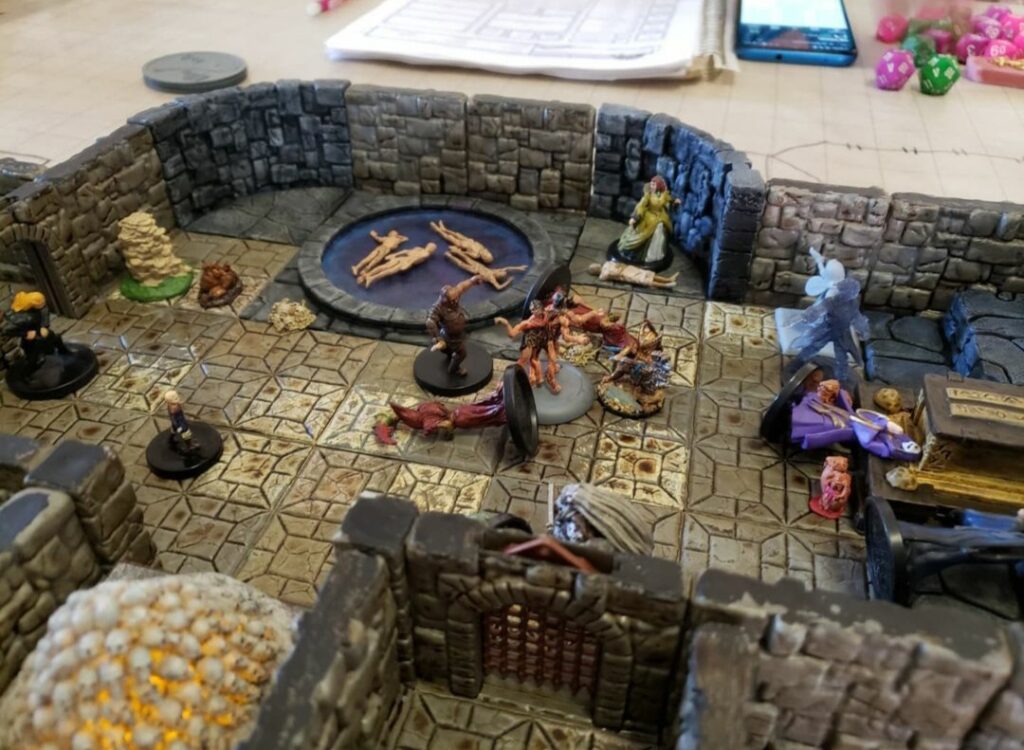
The pictures are something I insert now and then for posterity. I love documenting our adventures with photographs and have been doing it for years. I have pictures going back to the 1980s that I am fondly able to look back on.
~ What have been some of your favorite moments in this iteration of “Adoraith”?
As a DM, I find my favorite moments come when I am able to evoke a visceral reaction from my players. I don’t think there is any greater compliment to a DM’s effort than when the players become that invested in a campaign. I have been fortunate enough to experience many such moments but none more incredible than when Exie was taken from the party.
Mechanically, I truly enjoy creating magic items. In my world, every magic item comes with a beneficial enchantment and a curse. That said, I have removed the Identify spell from the game. Characters have to consult with the wise, research histories, and/or use trial and error to discover an item’s powers. I love watching my players weigh benefits against curses or stress about equipping an item without any idea of what the curse may be. Magic is a dangerous thing and not for the faint of heart!
~ Do you or your players have any other projects on the horizon for which we should keep a weather-eye? Any more plans for new campaigns in the world of “Adoraith” in the foreseeable future?
I have had to step back from game development due to health issues. I have done extensive work on Johnny Fraser-Allen’s, The Gloaming, 5e game setting. I also had a number of other projects in the works but everything is currently on hold. At least in regards to my involvement.
I really liked 5e until Tasha’s came out. I felt the features in that book and subsequent books were unbalanced and poorly written. I used to believe that it didn’t really matter what system you used. The only thing of consequence was the story and interactions of the players. Sadly, 5e became so lopsided in favor of the players that I spent far more time planning battlefield strategies than interesting plot lines.
There were really only two options left to me if I wanted to bring some balance back to my game. Either only use the core 5e books or switch to another edition of DnD. My table really didn’t want to return to an older system like 2e or 3.5e. As a result, for the first time in 45 years of gaming, I am retiring Dungeons and Dragons as my go to system. The plan is to run an Alien RPG Campaign to serve as a Fantasy RPG palate cleanser (I have already set up an Obsidian Portal page for the game here: https://alien-4.obsidianportal.com/wikis/main-page) and then start trying other game systems starting with Castles and Crusades.
~ And as we always do, Obsidian Portal loves to ask for any new tips, tricks, or general advice you’ve gleaned in the last almost-decade that you could share with other Game Masters, World Builders, and writers.
I am a huge proponent of homebrewing just about everything. I love to create new monsters, features, and spells that the players do not have access to or knowledge of. D&D has been around for 50 years and there are very few surprises coming out of the published material. If I want to challenge my players, especially when playing 5e, I have to customize just about everything.
Below are my player’s contributions to the interview:
Joe (Wade the human Ranger/Sorcerer)
Playing Wade, I’ve loved every minute of it, but there have been a few moments that have really stuck with me. It was around the time Wade was given his title of “the immortal” by Lin. We had found a mound that the evil lizard people were using to corrupt eggs and the group was going to go inside and smash them. Wade decided to stay back and be outside with Exie as to avoid the dangers there. Little did Wade know this would be the first of many many times when he stands in the back of the group only to get jumped but this time by a giant lizard man holding a club as he swings it, crits and hits Wade square in the chest caving in his chest and sending him flying 10 feet back. Only for the rest of the group to come out, kill the lizard man and then revive Wade for the umpteenth time in the short amount of time the campaign had been going.
For me the adventure logs are great it’s the first campaign I’ve been in where we’ve done something like this, when I started as the designated writer of them as the captain of the group I tried to give them a twist of not just a recap of the session but more of a POV from Wade, and when life got a little too busy for me to keep up I’m glad when Lin’s player took over for it, that he kept the same thing going. Of course, now we all chip in and I love how we all do it from our POV and add in a little personality to the retelling. As far as we are in this campaign however it can be very difficult to keep some things straight as to what comes next thankfully due to the journals and the notes that Meera takes, they help keep us on the right path.
The other favorite moment for me was the end of the Coraline arc when Meera finally accepted to be her “mommy” and broke the curse on her showing her true form of Sofil the Angel. It was a very emotional moment for Wade because of all the trials he had to go through to keep her safe and care for her in the landscape of Hades while also figuring out his new form of being a zombie. Wade growing up in an orphanage gives him a huge soft spot for children, and a very protective fatherly love for all of them and seeing her reach her potential filled me as a player full of love a pride that we were able to help her. I look forward to seeing her come back at the end of this campaign.
Scott (Reginald the halfling Paladin)
One of my favorite “moments” of the Adoraith campaign has been the planar travel. I read and listen endlessly to planar lore and it’s such an exciting topic for me. In my many years of ttrpg gaming and campaigns I’ve had very minimal time outside the prime material plane. (Except when I first me Pickled Dragon and he was running Temple of Elemental Evil). I joined Adoraith while the party was in Hades and afterwards went to the Abyss as well as the outlands, getting to see Sigil atop the spire and visit the gate town of Tradegate. Matt truly brought these places life making them unique and including game mechanics such as Gloom in Hades to set these places apart.
Another of the most memorable moments was when we were happy to see Demogorgon…. not because he is a swell fella but because the hatred between Orcus and him made it possible for us to escape Orcus’ palace alive.
Courtney (Meera the half-orc Fighter/Barbarian)
The adventure logs and journal entries are especially helpful when one of us has to miss a session. It’s also fun to hear another character’s version of events and how their perception differs from your own. Favorite moments: Some of my (Courtney/Meera) favorite moments include:
>Meera’s first awakening as the Dawn Champion, when all of her physical stats became 30 for the day (I’ve never felt so invincible),
>When Meera and KeeWee set off on a low stakes reconnaissance mission and ended up beating up some guy for being a jerk (not sure why a guest player thought Meera and KeeWee were too reckless),
>Anytime Meera pulls out the severed undead head in a birdcage she’s been carrying since session 2 in order to show (scare) a new PC or NPC
Jeremy (Lin the elf Rogue/Sorcerer/Cleric)
Favorite moments
Matt let me try something I’ve never done in a game before.. actively work against the party. We all came into the game as strangers from the internet, and my character wasn’t trusted at the start due to having a somewhat fancy introduction. Despite the distrust, I presented a character that proved his worth while at the same time set the party back along the way. One of my character’s goals was to get out of the organization he worked for and eventually came clean to the party. We were several months and levels into the campaign, and I felt my character had been through enough ‘party attachment’ events to have courage to reveal his ploys. I even brought cheesy, character specific Christmas presents (IRL) to the group when my character confessed. I got some grumbles, but oh boy the laughs that came out of some of the confessions were priceless.
At one point in the game, my character was cursed by hags and being controlled during long rests. I was only aware of the lack of resting for the longest time as exhaustion (2014) kept stacking up. Once it was revealed to my character that he had been up to nefarious deeds, I tried to take measures to disable my controllers’ abilities by setting nightly traps for myself Moon Knight style. When those weren’t proving to be sufficient, I turned to my most trusted party member and had them babysit my character that was bound, gagged, and blindfolded. Some of the other characters walked in on the scene and a couple of hilarious exchanges were had at my expense.
One mission we had to scale a massive cliff face to reach a fort. Some people’s initial attempts at climbing didn’t go so well, so I had my character begin stretching as I did the same around the table. My character succeeded in scaling the cliff, and other people indulged the goofiness of stretching out of game. The next time we had to climb an even more tumultuous wall, I had my character once again take time to stretch and encouraged the group. We succeeded with a minor, but quite scary hiccup. Matt was even shocked at the success of this climb, and we later found out we skipped weeks of planned content by making the climb. Stretching around the table became a thing after that anytime we had a seemingly monumental task before us. I still get a chuckle when people join in on the goofy suggestion around the table. Remember kids.. Stretch!
Matt does custom magic items complete with lore and potentially even curses. A favorite magic item that we have come across is the Gremlin Bag. It is a Bag of Holding with a Gremlin inside that is one of the vanest characters one will ever meet. My character took on the challenge of appeasing the Gremlin (more or less the curse of this item), of course many times lying to it, and haven’t looked back since. I even aided the Gremlin from an ailment at one point, and the Gremlin has honestly been one of the most valuable NPCs to the group in my opinion. The Gremlin revealed to my character his nefarious deeds while he was being controlled by the hags. We have utilized the bag in a number of instances to temporarily house people in need of saving. We used it to liberate an entire squad of harpies that have now become part of the hilarity of the bag. I even upgraded the bag at a magical forge, and some of the party suspect the Gremlin will wind up being the end game encounter as a result of my brown nosing. Despite all the vanity and requests, the Gremlin actually has standards… Please, please ask Matt about the Gremlin Bag!
Overall
Matt’s campaign and world is unlike any other I’ve ever played in over all my years of the TTRPG hobby. The world is gritty, dark, captivating, and best of all.. organic. All of our choices matter, even seemingly insignificant ones, and have consequences unforeseen for potentially months. Our characters wear their scars and have definitely learned from them. Some of our choices have even resulted in gods being
winked out of existence and going silent. We find out about them later when the general populace has no recollection of the deity. How big of a ‘whoops’ moment is that for a player?!?
I have never been in a game that encouraged complete journaling as a collective either. Took notes here and there sure, but never told the whole story. The journaling of the campaign has been awesome. Matt incentivizes it and we all enjoy it. It keeps the players invested and gives us all reminders of the previous session(s) if needed. I feel it also gets the players more attached to their characters as they are detailing thoughts and emotions they had at the table in those journaled moments that get brought to life for all instead of locked away in memories. I know I especially enjoy the creative liberties in telling moments from my character’s point of view, oftentimes including pokes at others that carries on party banter. The world, players, and characters all become more organic in how everything comes together as a resultl.
I even feel I have become a better player and GM from playing in Matt’s world. I took the journaling aspect to other games as a player and the GMs really appreciate the investment. I have taken the heavy consequences aspect of Matt’s game and applied to my own. Players get that shock factor in the moment, but usually laugh and change their approach to situations the next time while mentioning a previous big consequence. The worlds and games need to have consequences, even sometimes as a result of the party succeeding at a current, dire mission.
Raise up that anchor and make haste, mateys! We’ve strayed too long in these isles and I sense a storm coming up. Many thanks to the treasure-laden team of Adoraith and his crew as they write more grand tales worthy of a sailor’s song. And if you know a campaign just as worthy as this, be sure to nominate it in the community forums for consideration and even a chance to win the coveted Campaign of the Year!
Campaign of the Month June 2025: Shadowrun Returns

In 2050, a Shadowrun team was obliterated in an explosion that lit up the Redmond Barrens.
Official story: gas leak.
Unofficial story: no one’s talking.
Reality: a megacorp cover-up with body bags and black ink.
Every trace of the team was scrubbed. No names. No records. Just scorched ruins, whispered rumors, and a few scattered ashes.
But the dead left behind people.
Each player character is connected to someone who died that night. A sibling. A lover. A partner. A friend. They never worked together – until now.
Brought together by grief, by questions, by fragments the corps missed, the runners are chasing a truth that got six people killed. And if they find it, they’ll have to decide what to do with it.
This is a campaign about mystery, memory, and revenge.
About digging through the ruins of a lie and finding out what was worth killing for.
The Sixth World doesn’t care if they succeed.
But someone does.
And they’re watching.
Come join us in exploring the world within Shadowrun Returns in our interview with Grand_dm below!
Let’s start with the crew. Who are the players behind the runners? Tell us a bit about your group: how did you all come together, and what led you to dive into the world of Shadowrun specifically?
I run with a crew that bleeds story. No rules lawyers, no tourists – just folks who want to make something unforgettable. They’re the kind of players who don’t ask what the bonus is, they ask what it costs. Some of them are friends I have been gaming with for four decades. My wife and adult son are also part of the crew, which is really special to me.
Why Shadowrun? It’s a dirty mirror, and we wanted to see what stared back. We set our campaign in 2050 for a reason – before wireless, before upgrades got sleek. This is a world of tangled cables. We didn’t just choose Shadowrun. We made a deal with it.
What’s your play setup like? How often do you run sessions, and do you play in person, online, or somewhere in between?
Roll20. Custom sheets. Homebrew logic. House rules with claws. We play once or twice a month, adult schedule permitting. The latter is the ultimate final boss of TTRPGs. Every November we get together in person to play a long weekend. Our group is scattered to the four winds so it’s almost like a mini con.
For newcomers to the Sixth World, how would you describe the tone of your campaign? Shadowrun has a wide spectrum of vibes, where does your game land on the scale from neon noir to full-on dystopian chaos?
The tone? Street-level survival with mythic echoes. It’s not just dystopia – it’s personal. It’s rusted chrome, smudged rituals, and memories that bite back. You won’t find shiny futures or sleek solutions here. You’ll find a warehouse full of tagged bodies, a decker staring too long at the static in their feed, a burned-out shaman muttering to something only they can see.
The world doesn’t explain itself. It pressures you until you adapt. This isn’t about saving the world.
It’s about stealing back meaning in a world that already sold it.
The visuals on your campaign site are incredibly cohesive and atmospheric. Can you walk us through your process for sourcing or creating the artwork? Any tips for maintaining such a unified visual style across characters, maps, logs, and wiki entries?
Everything gets filtered through intent. I don’t care if it’s stock art or AI generated – if it looks like it’s right, I will use it. I’m picky when it comes to imagery, since with an RPG you’re deleting the mind’s eye. If you decide that THIS is how the thing looks, it needs to be right.
You’ve clearly spent a lot of time wrangling your campaigns on Obsidian Portal. Which features have become absolutely essential to how you organize and run your game?
The wiki comes first. Not for the players – for me. It’s how I understand the world. I make one for just about every campaign I run. It’s not a vault of facts – it’s scaffolding for story, memory, and consequence. I recommend that approach to new gamemasters. YMMV
Your site design has a unique and gritty feel that’s perfect for Shadowrun. Where did the inspiration for your site’s look and layout come from?
I mine like a pro and reshape it like a hammer to the skull. Blade Runner, The Fifth Element, Neuromancer, Hardwired, Dirty Harry, random junk from old game manuals – I take it, twist it, and make it bleed my tone.
The site isn’t “designed.” It’s assembled like a weapon.
I homebrew everything. I borrow anything. So should every GM.
Steal it all. Make it yours. The game doesn’t care where the pieces came from – only what you build out of the wreckage.
Your adventure logs are rich, detailed, and consistent, clearly crafted with care. How do you approach writing them? Do you use them to recap, expand the world, or even foreshadow future events?
The logs are part mission report, part ghost story.
Sometimes I write them. Sometimes the players do. They’re not just recaps – they’re threads of memory. If someone misses a session, they don’t get a summary – they get a story. Written by someone who was there. Through their lens. With their fear or bias or spin baked in.
But the real power?
Logs aren’t just about what happened – they’re about what gets built from it. Players use them to shape backstory, rewrite assumptions, and plant seeds. Some of the best reveals in the campaign started as a sentence in a log someone thought didn’t matter.
Between sessions, we run a downtime phase – like old-school play-by-mail, but through chat. Conversations. Flashbacks. Deals. Confessions. The logs and downtime play feed each other until they blur. That’s where the world grows teeth.This isn’t bookkeeping. It’s legacy in real time.
Give us a highlight reel moment. What’s one scene or session that still gets talked about to this day?
Whether it was hilarious, heartbreaking, or just plain badass, we’d love to hear about it.
The Garden of SIN. A graveyard for the forgotten of Seattle. A cleansing.
The new group of PCs came to clean up the wreckage – ashes of a team that never got to finish the story. They consecrated ground. Bled for it. Made it matter again. It changed them. A quiet kind of rebirth, soaked in rain and ruined memories. That was the moment the team became a crew. Not because they survived. Because they refused to forget.
And finally, we always ask: What’s your ‘secret sauce’ for running a great campaign? If you had to bottle up your GM philosophy, what are the key ingredients that keep your game compelling and your players coming back for more?
Everything is earned. Everything costs.
And when the big moments come they shine brighter because of the darkness they rose from.That’s my job. That’s the gig.
I build the pressure. I light the fuse. But the story? That’s on them.
The players shape it with their doubts, their decisions, and their scars.
I don’t give them the win. I give them the weight.
Because when they finally pull it off – when something truly lands – it’s not luck. It’s not XP.
It’s the long shadow of a story they helped build with both hands.
That’s the kind of game they remember.
Thank you to the community for making this campaign of the month possible! That’s all for now, join us on our next adventure July 2nd, and don’t forget to nominate your favorite campaigns for our next Campaign of the Month!