Tag Archives: dnd
Campaign of the Month April 2025, Department 7: Crescent City

Greetings Adventurers, come gather ’round for a tale unlike any other we’ve shared before! Set in a modern landscape, our tale follows a series of individuals who serve as agents who walk the line between the known and the supernatural. Join us in talking with GM Dungeon Master Loki as he walks us through this fantastic world of intrigue and action in Department 7: Crescent City.
First off, feel free to tell us about the person behind the GM screen. Where are you from? What do you do aside from gaming? Alter Egos? Life partners? Family? Where can we interact with you on the internet?
I’m an 8th generation New Orleanian of French Creole background, so I was raised in a storytelling culture. I started playing D&D in the White Box era while undergoing leg surgeries at Children’s Hospital, beginning a lifelong love of RPGs. After years of working in music clubs and restaurants I changed gears and began working in online communications (web content, community management and social media) for clients including the Open Society Institute, The National Association of Broadcasters, and The VCU Brand Center.
In 2003 I took on the position of co manager of Planewalker.com, the Official Planescape fan site, where I stayed for over a decade. That and my involvement with Spelljammer.org gave me a taste for sharing my game oriented fevered rantings with others. Since 2014 I have worked as a Table-Top Role Playing Game designer. A two time Silver ENnie award winner, some of my design and writing credits since include the ENnie nominated DarkRoads and Golden Hells, the upcoming Gloomhaven RPG, XCrawl: Louisiana Rising, Bloodlines and Black Magic: The Crescent City, The City of 7 Seraphs, The Pop Culture Catalog series for Starfinder, and many others.
In 2021 Hurricane Ida drove me out of my native New Orleans and I ended up in Cincinnati. Now I teach Introduction to Game Design at the University of Cincinnati and try to freelance enough to keep the bills paid. My family is pretty much all back home in New Orleans so I don’t get to see them very much. Up here in Cincy my family includes my girlfriend, who plays the party cleric / spelljammer pilot, a few close friends, and my two preposterous felines, Puck and Gremlin.
As to where I lurk online, I”ve cut down a lot on that due to spam, AI, and turbulent politics. My website (sorely in need of updating), my Obsidian Portal profile, and my profile on Start Playing Games are really the best ways to contact me these days.
Tell us about “Department 7: Crescent City” in a nutshell. How did you design the world? What was your inspiration?
When I decided to run a modern game using my home city was an obvious way to make it easy on myself. I’ve already written books about using the Crescent City as a site for modern occult and cyberpunk games so I even had a good bit of material already developed for it.
Since several of the players have lived in New Orleans and played at my table ever since, I knew they had familiarity with the city’s culture and terrain. The others would play new transfers to the city from other branches of the Hoffman Institute. Additionally, it’s New Orleans. Our city is full of atmosphere, especially when you consider the folk tales and ghost stories to be true.
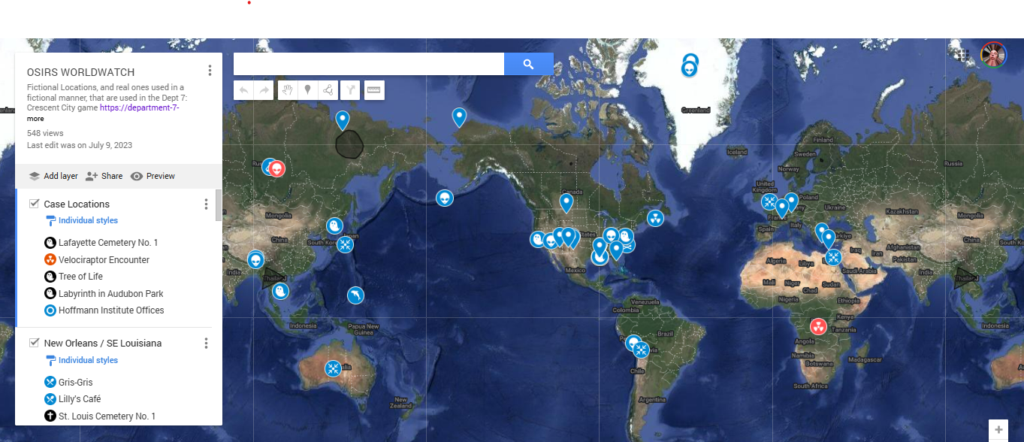
Scouring the internet for fringe stories about dinosaur sightings, alien abductions, and ghost stories made it easy to rapidly build a robust and crazy urban fantasy world with some roots in reality. The ones I thought would add to the world or provide good plot hooks would then get added to the game’s Google map. In addition there was an extensive array of such incidents / locations in the original Dark Matter game that I added.
How regularly do you play, and where do you play? Tell us about your current group of players.
We play on an irregular basis since the same players run different characters in some of the other campaigns in the series. Usually about once every month or two these days. We play online using my private server on Discord for Voice/Video/Text and Owlbear Rodeo for our VTT.
As to the players, they are a delightfully motley krewe.
Gary (Jacquemeaux DuBois) has played through several campaigns with me and is one of my old New Orleans crowd, now here in Cincy. Always good for extremely bad jokes and excellent food bribes for the GM (he’s a former chef).
Drew (Leif Luftson) is another who started at my table in the 90s when we worked in restaurants together. Now in Colorado he has returned to the table via Discord. Survivor of three Planejammer campaigns so far.
Desiree (Eulalie Anastasie “Stazzie” Dugas) another one of the New Orleans gamers at the table, despite now living in California. My former roommate (proving she is tolerant) and favorite Cajun who I got to return to the gaming table for the first time in decades.
Jaime (Michi “Michelle” Aoki) my girlfriend, and one of the team’s combat specialists. She’s been rolling dice with us since 2008 when I lived in Cincy once before. As a matter of fact one of her characters is an easter egg in City of 7 Seraphs.
Zan (Cole Morrin) A fellow pro game writer that I got to know while working with them on the City of 7 Seraphs. After playing Munchausen together at Gen Con 50 I knew they would be a perfect fit for the table. Zan rounds out the West Coast contingent at the virtual table. So far they have survived almost five years at my table without having to roll a new character.
Emily (Victoria Union) our campaign artist and mad journaler. Em is another Cincy gamer that came to the table in 2008 when I lived in Cincy a decade ago. Over those years she has become integral to the look and feel of the game. For example, the upcoming Planejammer Tarot deck coming soon from Evil Robot Games.
What made you choose Pathfinder for your system? How does that system complement your campaign?
The campaign series started back in first edition Dungeons and Dragons days, and has evolved embracing each edition until Pathfinder forked from DND 3.5. Since then Pathfinder 1e has been the baseline. My players like the granularity of control over their character the system gives them. Since it is a system I have written more products for than any other it’s also a matter of rules familiarity and comfort zone I suppose. One more point in its favor is that translating rules from one d20 based system to another is comparatively easy, opening up even more options for my players.
Your campaign integrates the real world with fantasy. Can you tell us a little bit about the immersion of the two? How do you decide which parts of fantasy are too much for the real world, and what is acceptable?
One reason I decided to run a modern sci fi / occult game was an idea I had for leveraging Google Maps as a game tool. Using a custom Google Map (OSIRS Worldwatch Global Anomaly Tracking) I was able to create entries for a lot of the high weirdness from Dark Matter, and other weirdness from Louisiana folklore, to create “known sites” around the world. Being able to fire up the map and see everything from reconstituted dinosaurs to secret alien colonies really helped my players with immersion.
It also allows for a lot of improv based on current events. The news and weather reports of the day set the tone If we are playing during Essence Fest or Jazz Fest, for example, they will have to deal with crowds, traffic and hordes of drunken tourists as well as chance celebrity encounters and the occasional musical interlude..Since it is a present day game I often use Google Street View to show them where their characters are and use screencaps from an aerial view to create any battlemaps I need. I’ve found that from the GM side of the screen it makes it a lot of fun and adds a lot of verisimilitude without a lot of extra effort.
As far as what is off the table? Not much. It’s a low to mid level game at present, but I do like big and flashy games almost as much as I love convoluted conspiracies.
Can you explain the structure and setting of your campaign? Your adventures are “cases” that your characters solve as agents in their agency?
In Dark Matter the players are agents in an X-Files style setting, so they work as paranormal agents for the Hoffman Institute. Much like the Men in Black movies reality is not far from what you see in the craziest tabloids.
This means that most of their adventures are assignments, while a few here and there are during their character’s personal time. This simplifies a few aspects of game play. Equipment other than personal items is requisitioned on a mission by mission basis easing the gear tracking part of the game. It also provides clear direction on what the mission goal is each time. For instance their most recent mission was testing out the Tangent Tunnel, an experimental device for travelling to alternate realities. While trying to rescue a lost exploratory team they ended up stranded in the Land of the Lost for three sessions. The upcoming session takes place after more testing of the Tangent Tunnel with them arriving on an asteroid city in the Tears of Selune in the Forgotten Realms.
That ties us in to the big picture. This campaign is part of a linked series of games that started in 1979. Events in one game can directly influence the others as they are all in a shared Omniverse. Currently one of the NPCs in the game is the cohort of Emily’s PC in The Spelljoined who got bounced into an alternate reality during a massive battle with the illithids (mind flayers).
How much time is usually spent preparing your game sessions? Describe a typical session.
It varies. Some of the episodes require several hours of prep time, but with the amount of info I’ve developed for the series over the decades, session prep is usually a short and sweet two to three hours if I’ve kept up with my notes (always a challenge). Since it is more of an event based sandbox game with an overarching metaplot, the players control a lot of the direction things take.
Sessions are usually about ⅔ investigation / role playing and ⅓ combat. Usually it takes about three sessions to resolve a case so far. Each case starts with a mission briefing and familiarizing the players with the mission and the current gear assigned. From fighting escaped, genetically engineered velociraptors through the streets of the Bywater to communing with nature spirits under Audubon Park’s Tree of Life the missions can encompass many story styles and objectives.
What can you tell us about the art presented in your campaign? Who is the artist? What made you choose this art style?
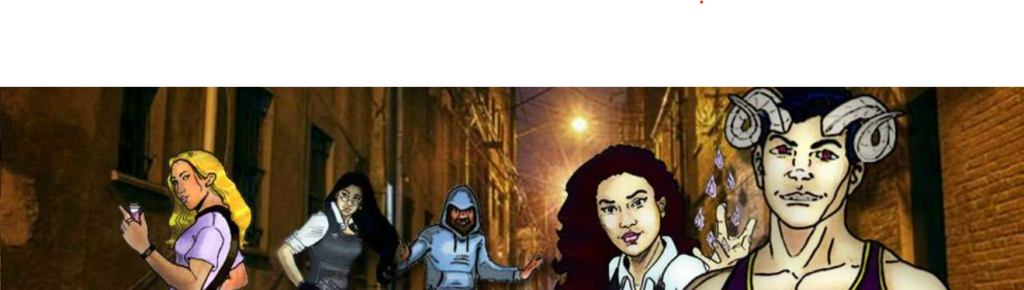
Things like the Hoffman Institute logo are taken directly from the Dark Matter game. The character art and most of the other incidental art is created by a freelance artist in our group: Emily “Syreene” Vittori. She’s been playing at my table since 2008 and has been the primary artist for the campaign series. She is also responsible for hundreds of pages of journal entries and campaign notes.The style is entirely her own choice and there are a variety of styles in her art for our games including classic game art, art nouveau, and even a few chibi images.
In addition there is art created by various players over the decades and a few professional pieces by Jacob Blackmon, done for the Starfinder game in the series, Catch My Drift.
How long have you been using Obsidian Portal? What brought you to the site and what keeps bringing you back?
Roughly 15 years nos. I stumbled across it ages ago and upgraded from the simple wiki I was using prior to that. When it comes to the things that keep me here the wiki is a big one, especially the ability to have sections that are for private notes between the players and myself. I also find that player participation away from the table, i.e. journal writing and such, increased when the adventure log became an option. It has a great set of features and solid organizational structure. All in all, other than some improvements to the backup downloads it is pretty much perfect for my needs.
If you had to pick just one thing, what would you say Obsidian Portal helps you with the most?
Creating an atmospheric portal for my players that organizes the ridiculous amount of house rules into a (hopefully) useful and appealing format. Even without knowing any CSS it is pretty easy to make it sing and it has much greater “out of the box” functionality than setting up a fully customized website. In addition the community is pretty great across the board.
What would you say is the biggest highlight of your game so far (please also provide images and links if possible)?
During one of the adventures that led them to Greyhawk I had the honor of having a special guest. Mike Nystul played with Gary Gygax in the days before D&D was published and the game has included spells named for his wizard, Nystul, ever since. Nystul’s Magic Aura being the most well known. Having him join us and play an updated version of his original character from Gygax’s table was an honor and a pleasure.
Okay, as a last question, we always ask for the GM’s “pearls of wisdom”. What GM insights can you offer the community this month?
It’s all about a combination of organization and improv. In the hopes it will be helpful to someone here is my approach.
If you have trouble making stuff up spur of the moment make a few lists as part of your prep. Each one can be as few as five items.
- A list of names appropriate to your setting
- A list of species/class combos that are common in your setting.
- A list of quirks or behaviors, i.e. constant toe tapping, a lisp, or a tendency toward puns.
With these three lists you have instant NPCs, just roll or choose one item from each list when you need it and the three combine to give you the basics.
For organization I use a triple monitor rig set up as follows:
Left Monitor – Combat Data Browser Tabs:
- Initiative Tracker Opponent Initiatives already pre-rolled and added. I advise adding the Dice Roller plug in.
- One Tab for each creature, trap, or hazard in the encounter
Middle Monitor – Interaction Browser Tab:
- Discord Video and text chat
Right Monitor – Maps and Rules Browser Tabs:
- Owlbear Rodeo Virtual Tabletop
- Obsidian Portal – Planejammer Hub for Core House Rules
- Obsidian Portal – Dept 7 Crescent City or current campaign
- Archives of Nethys Pathfinder 1e rules
- d20pfsrd.com Pathfinder Psionics rules
I keep a pad and pencils on my desk for notes. If I create an NPC on the fly their name / class / and defining mannerisms get noted as does any loot acquired, or major events / accomplishments of the session. (Add these to your wiki on OP immediately after the game because if you’re like me they can easily get misplaced before your group meets up again). It’s also worth noting that if you have trouble taking notes during games you can try recording audio or video of the sessions and go back to them to write your notes and recap. Just make sure to let your players know if you are recording!
That’s about it! May your 20s be both frequent and natural!
Thank you to the community for making this campaign of the month possible! That’s all for now, join us on our next adventure May 1st, and don’t forget to nominate your favorite campaigns for our next Campaign of the Month!
Campaign of The Month March 2025: Age of Conan: The Rise of Yig

Between the years when the oceans drunk Atlantis… and the rise of the sons of Aryas… there was an Age undreamed of. Onto this, CONAN! And also to a lesser extent YOU, the reader! For you have wandered the wastes to find our newest Campaign of the Month winner — “Age of Conan: The Rise of Yig” by award-winning game-maker and author jasonvey of Elf Lair Games. So, put on your best horned helmet and sharpen those two-handed swords before you read the tales of this troupe of talented travelers and hear the wise words of the wizard on the hill…

Obsidian Portal last spoke with you in 2017, when your “Nocturnum: Rebirth” Unisystem game won Campaign of the Month and we had the chance to make your acquaintance. What’s new in your life since then?
Hah! My entire life has changed since then. As with all of us COVID altered our whole world. I am no longer working as a content writer. My day job is now an SEO consultant, while I have also since launched my own gaming company, Elf Lair Games. The game that powers the Age of Conan campaign, Wasted Lands, is one of my games, using the O.G.R.E.S. system (which I’d love to see added to Obsidian Portal, but I have no ability to program character sheets!). I’m still working as a staff writer for Troll Lord Games as well, and we just re-released a new “reforged” printing of Amazing Adventures.
Your current campaign, “Age of Conan: The Rise of Yig” reads like a tale right out of a Robert E. Howard book. In your opinion, what makes games set during the Hyborian Age feel so wonderfully different from other sword-and-sorcery fare to which many of us might be more accustomed (e.g. D&D)? What draws you personally to these kinds of stories?
That’s actually a great question. For me I guess it’s just having been steeped in Howard and Conan since I was a kid – my dad introduced me to the old Ace Paperback series when I was 10 or 12, and it was a formative thing for me. The Hyborian Age is as richly detailed a setting as any other, and more than many, from Howard’s own seminal essay through the many pastiches (of widely varying quality) that have been done throughout the years. So I really think that’s it – what sets ours apart is just that I know this world like the back of my hand. I understand the appeal of the gods and men of that world, of the struggle between barbarism and civilization, and the rich history and cultures that populate the world. Conan and the Hyborian Age, to use a cliche, are much imitated, but never exceeded.
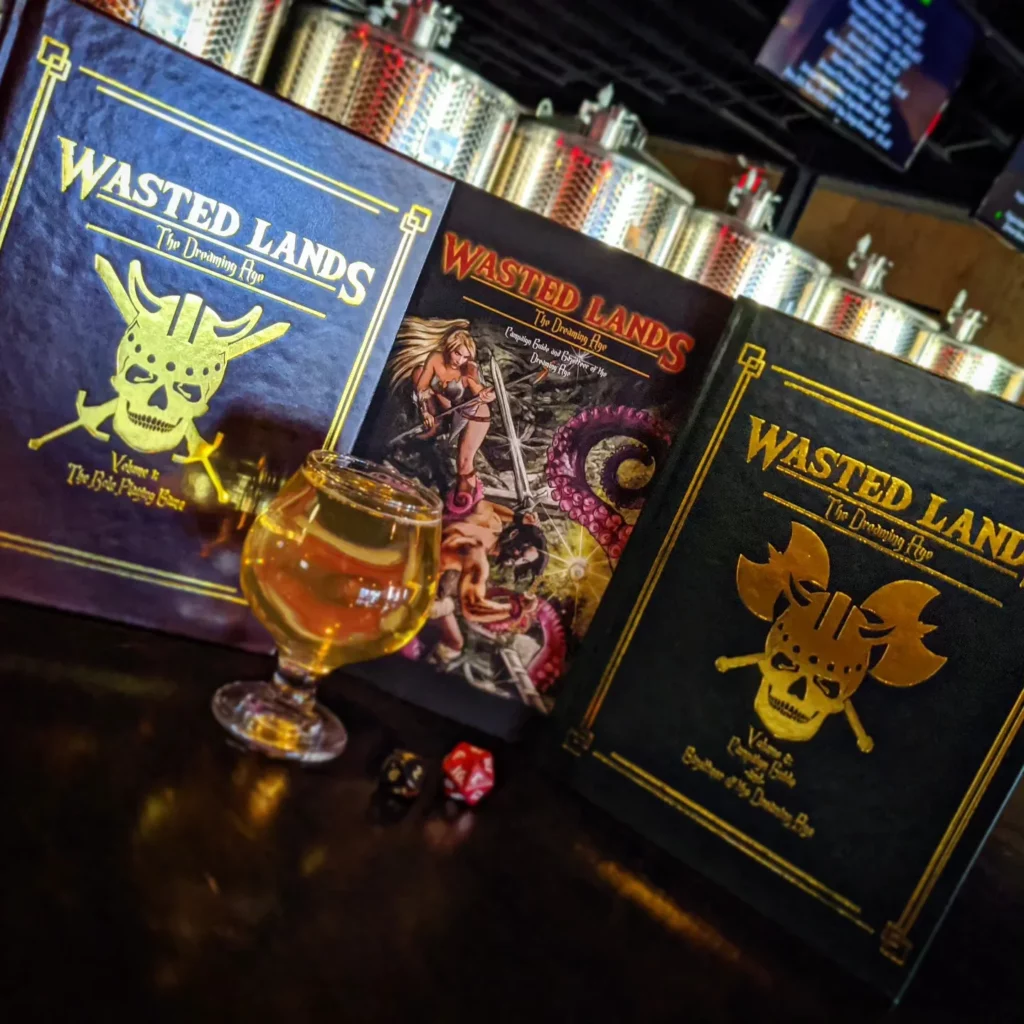
Tell us a little about the rules of “Wasted Lands: The Dreaming Age”, the “Powered by O.G.R.E.S” system, and what you like best about using them for your campaign.
O.G.R.E.S. has three mechanics, inspired by the earliest days of role playing games. The first is a d20 mechanic, wherein you roll a d20, add attribute bonus and other applicable bonuses, and try to get a 20 or better. This powers attribute checks and combat.
The second is a straight percentile check, which powers skills and class abilities (including spellcasting). When you need to do something specific to your character’s skills or class abilities, you roll percentile against your chance of success.
The third is the Rule of 2. This is a GM-only mechanic that serves as a quick way to adjudicate any situation you’re not sure how to otherwise resolve. Just pick a die, roll it, and look for 1 or 2. On a 1 or 2, something happens. This governs things like surprise, trying to listen for noise when you don’t have a perception class ability, whether someone hears you sneaking up if you don’t have a stealth ability, whether you notice a hidden panel in the wall, and the like.
O.G.R.E.S. is drawn from and inspired by the earliest days of gaming, and the three mechanic approach offers an elegance in that it’s intuitive and quickly lets everyone at the table know exactly what’s going on based on who is rolling what dice at what time. It cuts down on “Hey, what is she doing? Can I try that too?” It’s also very fast playing and intuitive. It was specifically built for the kind of gritty high action play that swords and sorcery represents. It is also scaleable for different levels of gritty through cinematic play, so it lets you customize your game for the exact style you like.
We noticed that, as an author of games yourself, you seem quite adept at kit-bashing together exactly what you need for the rules, genres, and adventures that you want to run. We must assume that the advantages outweigh the potential problems with this approach or you wouldn’t do it that way — but what advice would you offer to those of us who want to mix and match our own systems and settings?
Don’t overthink it. Make a call and run with it. Learn to adjudicate things on the fly and do not ever overanalyze what you’re doing. In the end, as we used to say, the play is the thing. If the game is moving forward and everyone’s having fun, you’re getting it right. I’m also not a fan of re-inventing the wheel. If you’ve got a mechanic that works, there is absolutely ZERO reason to create a new subsystem. Just use what you have and 99% of the time you’ll find it works just fine.
You have some extensive experience in writing for the gaming industry and quite a few projects under your belt. Which ones have been your favorites, so far? Any upcoming titles that we should keep an eye out for?
Of course my own Elf Lair Games products under the O.G.R.E.S. system are my children right now – Night Shift is our modern urban fantasy game, Wasted Lands our Swords and Sorcery, and Thirteen Parsecs our sci-fi game. All 100% compatible, all using the same O.G.R.E.S. rules. Other than that? Amazing Adventures from Troll Lord Games sits right alongside my ELG works. That was my first ever core role playing game and it will always be my favorite child as a result.
What have been some of your favorite moments in “Rise of Yig?”
That has to be going back to the earlier days of the campaign. We were running the old Mongoose Betrayer of Asgard campaign, and the characters had sought an old soothsayer named Mimir deep in the Asgardian mountains for the answer to a prophetic riddle. Alas, as happens to all of us, we had a bunch of things come up and gaming was put off for like a month. So when they got back, we picked up. They found the lair, and Mimir, who says, “Why have you come seeking Mimir?”
There was dead silence for a minute. Then, one of my players (Robert, if I remember right) went, “Oh, s–t, why DID we come seeking Mimir??”
Laughter erupted, as the entire group had forgotten what they were doing in the ensuing month.
Your wiki and adventure logs have been a joy to read — lost kings, thwarted assassins, and ancient evils slithering back into the world, it’s just fantastic! Without giving away too much of the ending, what can we expect to see as the rest of the campaign proceeds?
You’ll have to wait and see. I will say that for die hards of Conan, some familiar faces and references will absolutely be turning up! You may already have noticed that I canonized the much-maligned Conan the Destroyer by having Jehnna as the current queen of Zamora and her retinue as of the end of that film still serving her. That was a fun little wink-and-nod. I have also mentioned in passing that one of the Hyrkanian city-states is currently ruled by a fiery-haired she-devil of a woman whose swordplay knows no equal. I’m not sure if she will actually show up (and I’m not sure that bit made it into one of the logs), but again, little references.
And as always, Obsidian Portal loves to ask for any new tips, tricks, or general advice from the last eight years since your previous win that you could share with other Game Masters, World Builders, and writers.
Again, the big thing is to never overthink it. Dive in with gusto and as long as everyone’s having fun, you’re getting it right. It’s okay to make rulings on the fly, and always stop to think, “do I already have a mechanic that will handle this?” You rarely need a whole new character class, or a new subsystem, or something like that. Never try to be innovative just for the sake of being innovative. It’s rarely needed. Stick to the KISS principle, and you can almost never go wrong.
Also, let me just say it’s a real honor to be named Campaign of the Month again – in the same month, I think, as our last one, no less! We’re excited for this, and stay tuned! I’m a little behind on adventure logs right now but am working to get caught up!
The honor is ours, Jason, and we thank you for sharing your creativity with the Obsidian Portal community once again! We look forward to reading more adventures from the Hyborian Age, soon.
We’ve passed along your request to the OP Support team to get your game systems added to our library. And for anyone who would like to add their own games or ask other questions, don’t forget you can always reach out via email to [email protected] for just about anything. Be sure to check out the help articles, Discord server, and community forums too — which is where you can nominate your own favorite campaigns for Campaign of the Month consideration.
Until next month, fellow barbarians!
Campaign of the month February 2025: Stream of Kairos

So, have you ever wondered what it might be like to be the Captain of a Timeship on the Temporal Sea? Well, wonder no more, because when you delve into the depths of imagination on this particular campaign, you can do just that! Join us as we chat to previous Campaign of the Month winner, Abersade, discussing The Kairos Delta, Realspace, and the dreaded Orkehds in his new campaign, Stream of Kairos.
First off, feel free to tell us about the person behind the GM screen. Where are you from? What do you do aside from gaming? Alter Egos? Life partners? Family? Where can we interact with you on the internet?
Hi! My name is John and I’m from Flatlandia, also known as Northwest Ohio. Being born and raised here, there really isn’t much to do except for gaming, gardening, and reading in my opinion. I’ve been with my wife (user Saintdiane) for eighteen years now, and both of my daughters are grown, in their twenties, and have long since fled the proverbial coop.
You had previously won Campaign of the Month in April 2020 for” Core: The Ashes of Alcarna”. Both that game and the new one are using the Dungeons and Dragons 3.5 Systems. What keeps you motivated to designing your Campaigns within this system?
There are four main factors at play for me here:
1. I have almost every official rulebook that was published for 3.0 and 3.5.
2. 4th Ed D&D, 2nd Ed Pathfinder, and 5th Ed D&D all lack the sheer number of crunchy options for characters, rules, feats, and classes.
3. Everyone who’s playing (with one exception) is already very familiar and comfortable with 3.5
4. We use a bunch of tacked on systems like Roleplaying Points (an extra way to advance characters) and House Rules that are specific to 3.5 and which were developed over several years.
How different is your current campaign from the previous one? Are any of the players the same? Are the characters related in any way? Are there any cross connections between the two campaigns?
Have you ever had a concept for a game that was probably too weird or borderline nonsensical, but that you just couldn’t get out of your head? That sort of idea just stays there lodged in the bizarre section of your brain, fermenting like juice that’s gone a bit off.
Most of the time these sorts of ideas slowly wither away, eventually fading completely, leaving only a mild sense of relief. Sometimes though, instead of fading away the idea persists, eventually becoming a monster that must be freed. That monster is Stream of Kairos, which slowly morphed from “an underdeveloped idea involving a stream of water with islands in it, floating in the Astral Sea” into “the Grand Unifying Theory of every TTRPG game that I’ve ever run, while still somehow involving streams of water just sort of floating around with bits of land in them”.
Though it links everything together it is important to know that Stream of Kairos is drastically different from Core, and that Stream of Kairos is also drastically different from Rise of the Durnskald, despite it literally containing multiple elements from both games. Also, some Old World of Darkness content for questionably good measure with just a dash of Warhammer 40k thrown in because who doesn’t like it when things get Orky?
As for the players, the players who returned for Stream of Kairos are some of the same players who were around for Rise of the Durnskald and the last game I played in called The Price of Magic. I have a whole page dedicated to them on our wiki, which can be found here.
Your current landing page outlines future journeys on the “Great Temporal Sea”. These adventures seem like they will incorporate some pretty “deep” concepts. Can you give us all a bit of information about the Temporal Sea and the use of “Timeships” in your campaign.
It all ends with a time loop… all the best nonsense does, really.
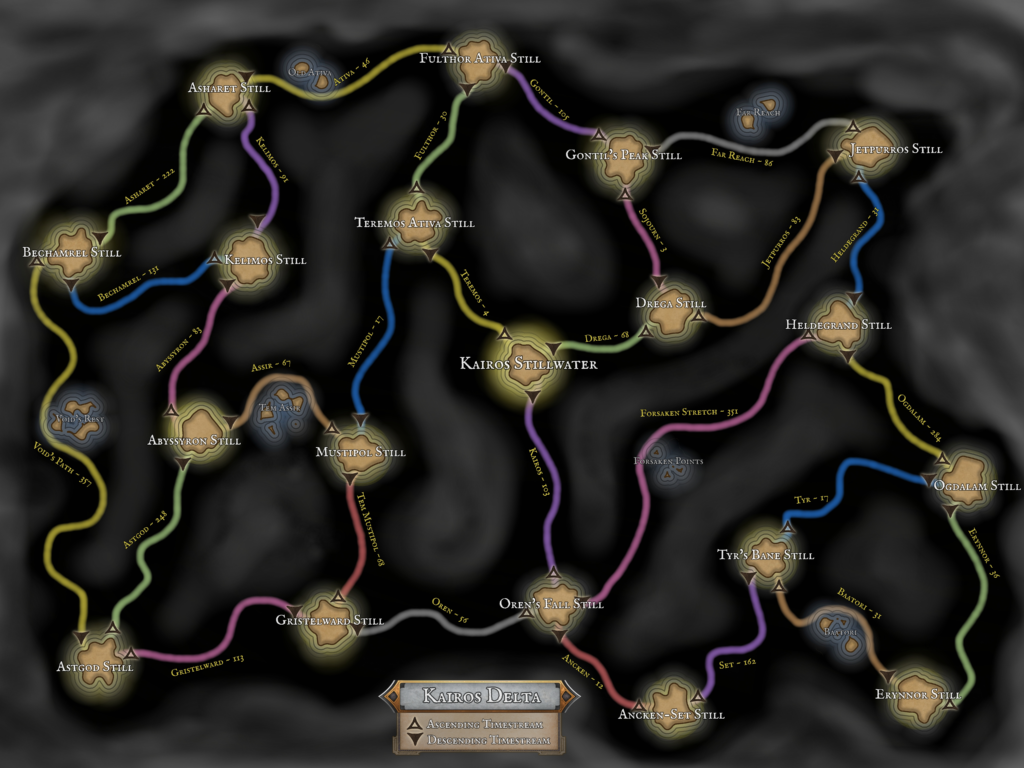
The easiest way to picture the Kairos Delta (and thus the Great Temporal Sea) is thusly: imagine an unbelievably large cloud of dark grey faintly luminescent fog, which takes up the entire known volume of the plane, throw a mess of looped waterways floating through the fog, and plonk down a landmass floating in a small ocean everywhere that the waterways intersect. Now consider that the streams of water are composed of this grey fog, but condensed, and flow in specific directions. These streams of time will either cause something to drastically age upon contact, or will do the opposite, depending on which end of the timestream you entered it from.
In order to traverse the streams folks need protection, which is usually composed of the combined auras of intelligent life. Get enough people together, along with enough Stillwater, and their combined auras will push back the ravages of time. Stillwater isn’t exactly travel friendly though; it takes up literal tons of weight and touching it causes you to become locked in stasis until you are removed from it, so captains aren’t exactly keen on keeping it on board.
That’s where the fuel cells come into play! Maybe don’t ask too many questions about how they are charged though. Slap a couple of fuel cells into a Timebreaker class ship and you have a vessel that can not only traverse the streams, but can forge new ones too, provided you brought a Navigator along.
You remembered to bring a Navigator with you, right?
From where did you draw your main inspirations for the current campaign? Books, gaming modules, films, a vivid imagination? What concepts can explorers in your world expect to encounter?
This one is equal parts easy and difficult to answer. Inspiration comes from all sorts of places, but in this case mainly three sources: a story called “Timeless” from a very popular webcomic (Sluggy Freelance) from back in 2005; the short story “All You Zombies” by Robert Heinlein which I read when I was about ten years old; and the concept of “Arcane Resonance” from a game I’m still fleshing out called Forbidden Empire, which is the second game in the Wrath of the Fallen Goddess planned trilogy.
Arcane Resonance was also featured heavily in Rise of the Durnskald, and also Core, though it wasn’t named. Basically, magic causes ripples in the fabric of reality, bigger magic means bigger ripples, and ripple something hard enough and new stuff happens. Crash a big enough magical meteor into a planet and you can hurl the collective idea of the planet straight out of time itself, left to float around all shattered in a cloud of energy, while the original version slowly heals. Now add a bunch of power hungry Kjerne Runecasters to the mix and, well, though that all happened in the past I’m getting ahead of myself.
As I stated before, Stream of Kairos is my TTRPG Grand Unified Theory, bringing everything and everyone together. I remember reading that D&D cosmology, at least back in the day, theorized that all of the games that everyone ran were tied together by existing in the infinite deep astral, with each game existing within its own prime material plane. In Stream of Kairos, the Kairos Delta exists as the broken shadow of the astral plane, and features scenes and elements from many of the games that I’ve run in the past.
This time around though, the players are seeing the events from different perspectives. Helping to complete the missing portions of the narratives that they played through years ago, and in at least one case drastically changing the course of a doomed world. I mean, it’s probably still doomed, but now it’s different doom.
Sometimes you just have to focus on the small victories.
For more info on all of these concepts and sources, look here: https://streamofkairos.obsidianportal.com/wikis/behind-the-screen
Your campaign has some very innovative design elements. What tools did you use to create it and set it all up? Any recommendations for new GMs starting to design their campaigns?
The campaigns look is done via CSS, paint.net, and flamingtext.com, with a generous splash of google image searching thrown in. W3Schools.com can be a great resource for folks who are interested in learning to use CSS, as can the Obsidian Portal forum and Discord.
What is the importance of the “Orkehd Raiders” in your Campaign. They seem to be integral to the geographic area of “The Kairos Delta”. Please, tell us more…
The Orkehd Raiders are among the most fearsome opponents a ship captain could ever have the misfortune to meet. Piloting vast ships made of iron and steel, armed with cannons and rockets, and frequently protected by powerful energy shields, the Orkehd are a foe you don’t want to meet lying down. Or standing for that matter. Hailing from a different dimension, the Orkehd are powerful and quite technologically advanced, though their skill in magic is extremely lacking.
Oh look, here’s one now: https://streamofkairos.obsidianportal.com/characters/oggie-bigteefs
Without divulging any major plots, what plans do you have for the player characters as they progress through your campaign?
What the characters know: That they are eventually all killed by their sorcerer, ReDyns.
What the players don’t know: One of the players actually knows how this happens, and hasn’t revealed it as of yet.
Having been a member of Obsidian Portal for over ten years, what would you say are the most useful benefits for you as both a Campaign Designer and as a person running a campaign?
I quite like a cohesive theme, and easily accessible info, and eleventy billion rules and systems. Obsidian Portal is, in my humble opinion, still the best platform that allows for easy customization and wiki building without explicitly requiring proprietary software or access fees for everyone involved in the game. Also, I really like the community.
Are there any specific adventures you have yet to have that you are particularly looking forward to that you can give us a glimpse of, without ruining the surprise for your players? You can be as cryptic as you like.
I would suggest that folks read up on what Kairos is, and how it connects to the theme of this game and others I’ve ran. I don’t think that there’s enough clues around to actually ruin the surprise, but maybe someone will figure it out.
Here’s a hint: It all starts with a time loop… all the worst nonsense does, really.
Okay, as a last question, we always ask for the GM’s “pearls of wisdom”. What GM insights can you offer the community this month?
Previously I mentioned learning CSS, and spending extra time getting the world ready to play in so that it sort of becomes self-sustaining.
While those concepts are important, I want to focus on something else this time around. Engage with your players, and your world. Create unique concepts, or monsters, or classes, or races. Create new legends and folktales, maybe songs that tell tales of heroes long gone. Anything really, just make sure to create something, to bring life to your world and vision. You and your players are far more likely to tell tales of the door that made a friend and sacrificed itself to let the heroes continue on their quest than of yet another encounter with a pile of orc guards.
Don’t be afraid to make mistakes, or to be extra goofy with the world (depending on the theme of course). Maybe your world is infested with giant insects that lay eggs that look suspiciously close to oranges, but not quite? Maybe the sewers have Gelatinous Tubes instead of Gelatinous Cubes? Maybe one of your characters is named Lolph Dundgren and you’ve said it so many times over the course of the game that you no longer can remember which way is the actual actor’s name? Maybe try D&D&Space?
And if you’re one of the players?
Maybe, just maybe, play a talking horse who goes out of her way to teach one of her friends how to speak horse. It’s a heck of a story.
Thank you to the community for making this campaign of the month possible! That’s all for now, join us on our next adventure March 1st, and don’t forget to nominate your favorite campaigns for our next Campaign of the Month!
Obsidian Portal Campaign of the Month January 2025: Mass Effect: Spectre’s Angels

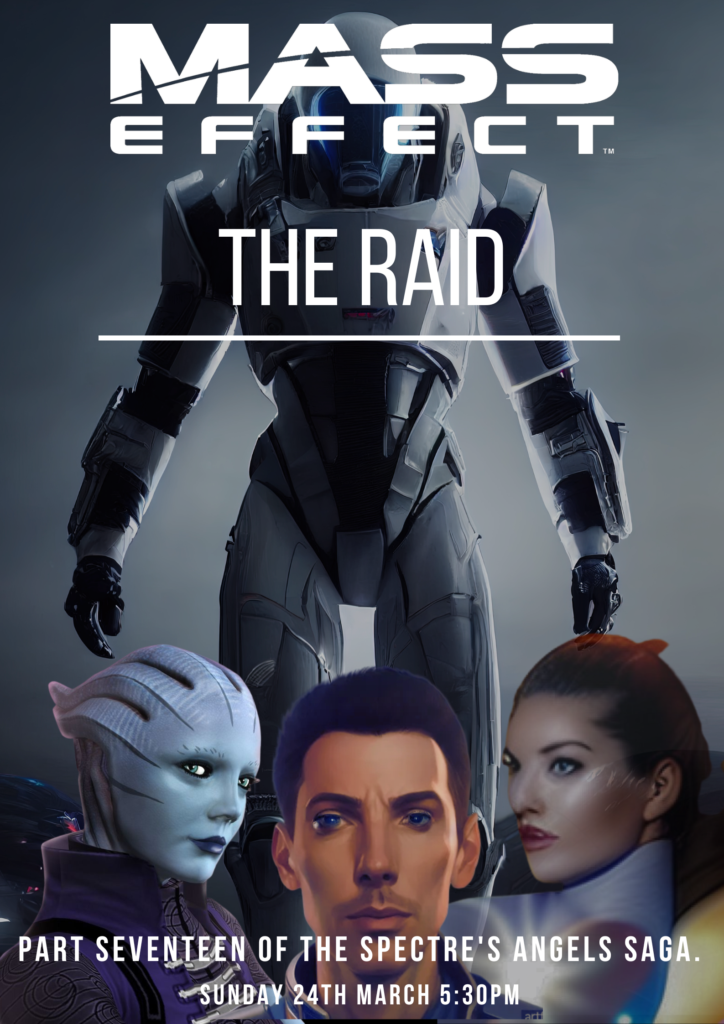
A group of galactic super spies travel the known universe, using a manipulation of ‘dark energy’ to enable faster than light travel. Follow them on their travels as they discover strange races on even stranger worlds in the year 2178 when you step on to the ship of GM Optimusnorm and his team, in their Traveller campaign, “Mass Effect: Spectre’s Angels“.
First off, feel free to tell us about the person behind the GM screen. Where are you from? What do you do aside from gaming? Alter Egos? Life partners? Family? Where can we interact with you on the internet?
I’m a Brit living in Dubai, UAE, where I work as an Investment Advisor, helping clients around the world manage and grow their wealth—whether through stocks, property, fine art, wine, or whisky. Outside of work, I’m a husband, father to two children, and a passionate gamer. I also enjoy camping and socialising, especially connecting with like-minded people. I’m proud to be a co-founder of the Gulf Roleplaying Community, a group we created to bring together roleplayers across the Arabian Gulf and the Middle East, offering a space for enthusiasts to connect and share their love for rolling dice around the table. I have been roleplaying since the late 1980s – I think my first RPG was Warhammer Fantasy RPG second edition.
You are running a Traveller space scenario, but before we get into further details, please explain in a nutshell the “Mass Effect”. What is it? What is its significance to the campaign?
“Mass Effect is a military science fiction franchise, best known for its critically acclaimed video game series. In the game’s universe, the term ‘Mass Effect’ refers to a scientific phenomenon based on the manipulation of a universal force called ‘dark energy.’ This technology underpins the series’ interstellar civilisation, enabling faster-than-light (FTL) travel, advanced weaponry, and biotic powers.
My campaign is a Mongoose Traveller 2nd Ed conversion set in this, universe, combining the franchise’s lore with the unique Traveller system, which is really the granddaddy of sci-fi RPGs
How long has your campaign been running and what made you choose Traveller as your gaming system?
The campaign ran for just over a year and is currently on hiatus while we explore other sci-fi projects (I am definitely more of a sci-fi than fantasy fan). Traveller was always my first choice for this setting because of its excellent character creation system, simple and flexible mechanics, and the inspiration I drew from other gamers who had successfully adapted a previous version of Traveller to the Mass Effect universe.
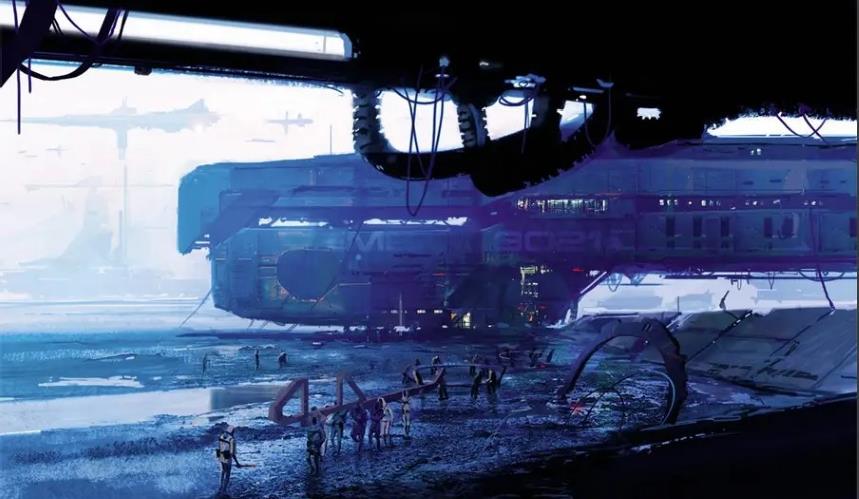
Your WIKI starts out by detailing Mongoose 2nd Edition Rules Conversions. How much work did this involve and what tips would you give to those enterprising GameMasters on Obsidian Portal who might be thinking of converting a Rule System to meet their personal needs.
This project has been a significant undertaking, but much of the groundwork was laid by fellow Obsidian Portal user Jacobkosh, who ran a Mass Effect Traveller conversion about a decade ago and generously shared his notes with me. I adapted those notes to the Mongoose Publishing 2nd Edition rules, and as a group, we’ve been tweaking, adding, and refining elements throughout the campaign. It’s truly been a labour of love. For anyone looking to attempt something similar, I’d recommend starting with the core rules and finding an understanding group of players who are willing to collaborate and help the game evolve through actual play.
You currently seem to have three active players listed. It is presumed they form the basis of the group, “Spectre’s Angels”. Tell us about this group and their place in the universe. And what about the people who play the characters? How often do you meet and how do you all interact?
Living in Dubai means we have a REALLY diverse group of players. Our current roster includes another Brit, his Lebanese wife, and a Russian. We also had a Filipino gent with us but he had to move away and couldn’t make sessions anymore. The transient nature of expat life often means people move on when they change jobs or relocate. As I only game in-person this means we sometimes gain and lose players.
The concept behind ‘Spectre’s Angels’ was inspired by the Spectres in the Mass Effect universe—elite agents with broad authority, akin to super spies. In our campaign, the group operates under a Spectre, much like Charlie’s Angels (hence we called it Spectre’s Angels!). The PCs themselves are a disparate crew with individual agendas but share a common goal: to pay off the debts on their ship and ultimately gain full independence.
We played every two weeks on average but again, the nature of expat life meant people go home for the summer, travel for work, head back for Christmas holidays etc so sometimes a month or more would go by between sessions.
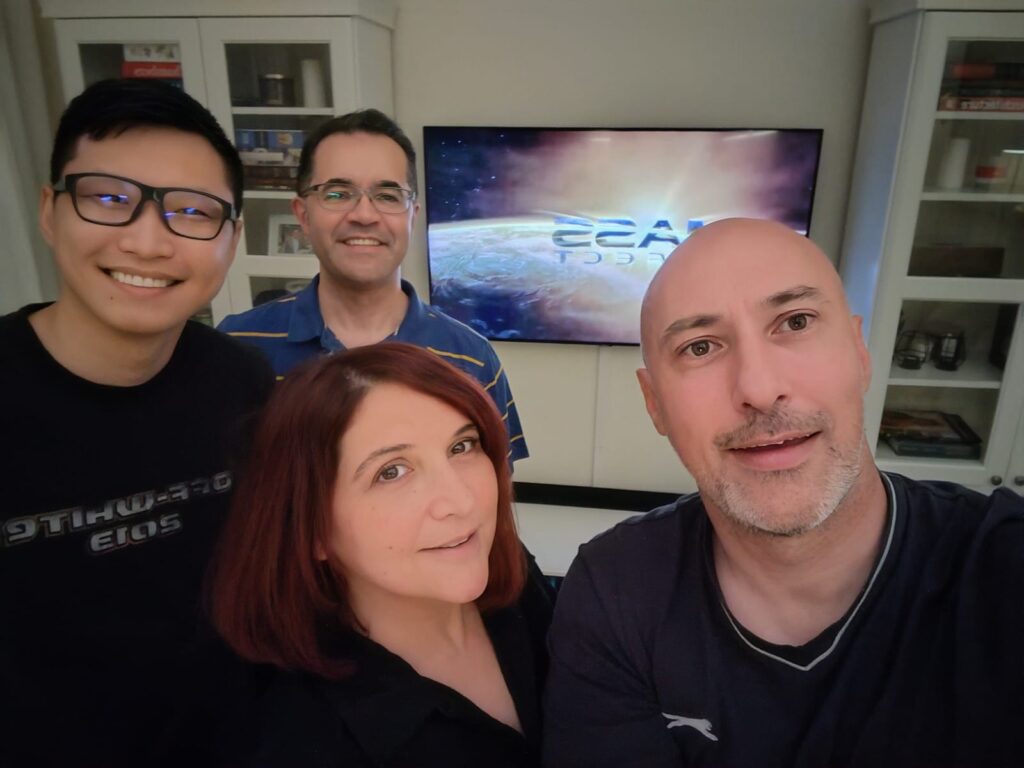
How much of your gaming time is spent on space travel as opposed to action on various worlds? Feel free to give us a brief overview of the type of scenario your characters could normally expect during your campaign.
Space travel is usually quick in our games, unless the adventure itself takes place on a ship en route to somewhere. Most of the time, it’s about getting to a world, space station, or other location and jumping straight into the action. We tend to enjoy a mix of 50-75% investigation and interaction, with 25-50% combat.
One session turned into an epic bar crawl across a massive space station as the group hunted for a missing person, discovering weird cocktails and shady establishments along the way! Some sessions focus more on combat, but overall, the group isn’t too combat-heavy.
Did you build the Campaign yourself? While building your campaign, what tools did you find useful? Do any of your players get involved in the Campaign design?
I always build my campaigns from scratch, starting with a session zero where the players come together to create their characters. This gives them a chance to develop interlinked agendas and backstories, which I then use as inspiration and fuel for shaping the campaign. It’s a great way to make sure the story feels connected to the characters and their goals. I don’t really use any specific tools except Obsidian Portal and my digital notes.

Without divulging any major plots, what is your plan for the future of Spectre’s Angels?
The game ran just before the events of the Mass Effect 1 PC game. The future will likely be in parallel to the events of that first game, bringing in themes and plots that relate to the main story.
Having been a member of Obsidian Portal for over ten years, what would you say are the most useful benefits for you as both a Campaign Designer and as a person running a campaign?
Having one central place for both me and the players to refer to is invaluable. With the expat lifestyle sometimes causing long gaps between sessions, it’s great to have everything in one spot to refresh our memories and keep building on the campaign whenever we’re ready.
For me as a GM, it’s also a great way to gauge player engagement. Those who aren’t really into the game tend not to update their characters and get involved in the Portal, which helps me figure out if we’re a good fit to keep gaming together.
Are there any specific adventures you have had that stand out in your memory as being particularly fun for you and your players? Feel free to add any pictures or links.
We really had fun with a Casino heist scenario where the PCs managed to stumble through every step and succeed in the least subtle way imaginable! There’s been a number of ‘bumbling successes’ around the galaxy – often in clubs and bars!
Okay, as a last question, we always ask for the GM’s “pearls of wisdom”. What GM insights can you offer the community this month?
At its heart, gaming is all about the people. Every gamer is different, and as GMs and players, we all bring our own expectations and standards to the table. One of the most important lessons I’ve learned is that having the right group makes all the difference. A group with committed people who are truly present can thrive even with an unfamiliar system or an improvised adventure, while a mismatched group will struggle—even with the perfect story and a deep understanding of the rules.
Focus on building a group that clicks, and the rest will fall into place.
Thank you to the community for making this campaign of the month possible! That’s all for now, join us on our next adventure February 2nd, and don’t forget to nominate your favorite campaigns for our next Campaign of the Month!
Obsidian Portal Campaign of the Month November 2024: Dark Conflagration

“In a system on the Terra side of the Great Rift this group in service to an Inquisitor must prove their worth through grit and valor to hold back the closing despair. Join them as you pour through this restricted Inquisitorial system and read along with their adventures in their own words.” Please join us in this month’s interview for COTM Dark Conflagration with our GM Medacia and Kenkewl00!

Tell us a little about the people behind the logs. What’s your group like, how did you all start playing together, and what drew you to Warhammer?
We have a group of 3 full time players, one part time player, and the GM. All of the players are lifelong TTRPG players from various professional backgrounds like healthcare, finance, baking, and theater. The GM tailored a short list of concepts for each player and let them choose their favorite. You can see the flavor of the character and the style of the author in each entry into the Inquisitorial Journal System.
The group has been going with varying members for over 8 years, starting with a long-running Vampire the Masquerade game. A few of us got into (or back into) WH40k about a few years ago when they came out with the box sets for pre-built armies, and enjoy the more miniature-focused gameplay.
Warhammer 40K’s atmosphere of hopelessness populated with great acts of heroism is what drew the GM to the system. The grind of ten millennia of slow collapse and bureaucracy combined with the terror of the events surrounding the Great Rift create a need for sacrifice and courage to fight back the encroaching darkness.
How often do you play, and how do you generally do so (online, in-person, hybrid)?
In-Person, once every 2 weeks is the schedule. Occasionally we’ll miss a scheduled session due to real-world obligations or add a session in-between when we can.
For folks that are perhaps less familiar with the world of 40k, where does your game fit into the grim dark?
It’s set after the universe got split by the Great Rift as Cadia fell, in a GM-created star system on the Terra-side of the divide. It’s inspired from various events going on throughout the 40K universe in the early part of M42. The players are part of a small group in the service of an Inquisitor in the Consus System, near the Pariah Nexus.
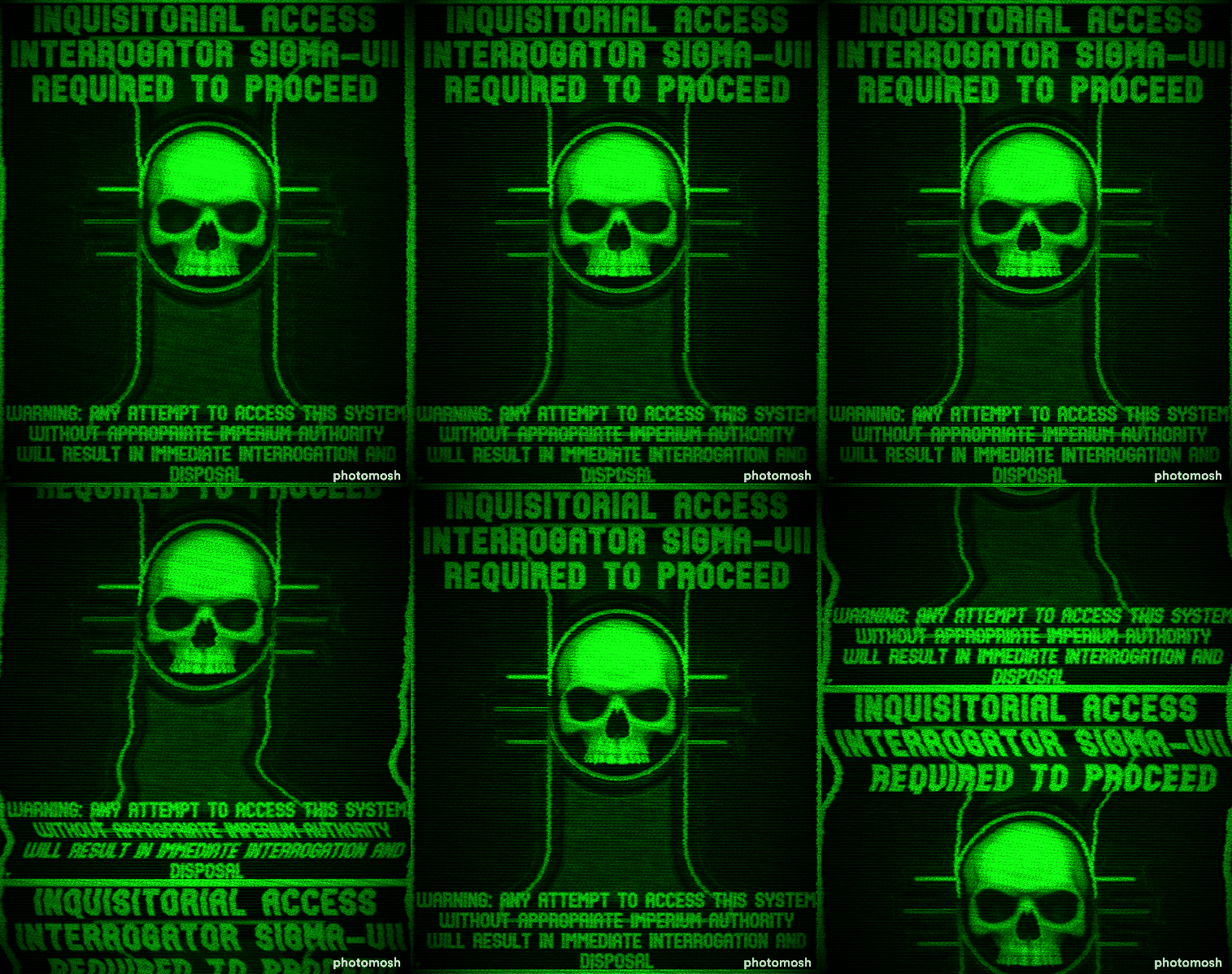
I love the various art on your site, from Characters to Items, Adventure Logs to Wiki Pages. How do you create/source the artwork, and do you have a secret for keeping the feel so consistent across your whole site?
I chose a stylized realism for the overall theme. I sifted through many AI art sites and styles before settling on one that captured my look. I’ve used a lot of iterations of a single concept before settling on any image that makes its way to the site. As I learned more about how the AI responded to particular prompts I’ve been able to achieve my desired outcomes more efficiently. I’ve also tracked down specific pieces (like the propaganda posters) from existing art and included my favorites in entries or slideshows where appropriate. I’ve created or modified images and run it through a program that creates short videos for the cover page to create a more dynamic feel, hoping to give the viewer a more engaging experience like they’re breaking in to the Inquisitorial Journal System.
As you’ve been on Obsidian Portal for quite some time, what is your favorite campaign wrangling feature?
I have mostly used OP as a way to stay consistent as a GM – once its online, it’s easy to reference and I don’t have to deal with lost papers. I should probably use more of the functions truth be told. I like the session reminders, and the forum to post little things in-between sessions to keep players and fans engaged.
Swapping to your intense site for a moment, where did you come up with the style design you have?
I want to give the OP a more exciting feel than the standard campaign designs that I see. I want it to be an experience, and I want the players to sign in and make updates feeling like their characters journaling their horrifying experiences fighting the Chaos cultists. I also want fans to get excited to see the next update, to present a taste of how things would look in the collapsing world of 40K. I want them to feel like they’ve snuck into this secret archive and they’re watching the story evolve from afar. To inspire them to create their own star system, their own Inquisitorial warband and fight off the wickedness of a violent, indifferent universe.
I love your adventure logs, I see that one of your players is involved with them as well. How do you split that load?
Mendacia handles most of the details of the Logs – the game notes, the notable events/locations/people, that sort of thing. kenkewl00 gets involved by occasionally putting a placeholder Log in there for Mendacia to edit later, since one way to encourage player involvement we are utilizing is to give out in-game goodies (extra wrath tokens, given our system) for players to put notes from their characters perspective. kenkewl00, as a normally-GM type, tend to put more detailed notes than others, but the Ogryn puts a lot of time in to write the log in a low-int style since they are “in character journals”.
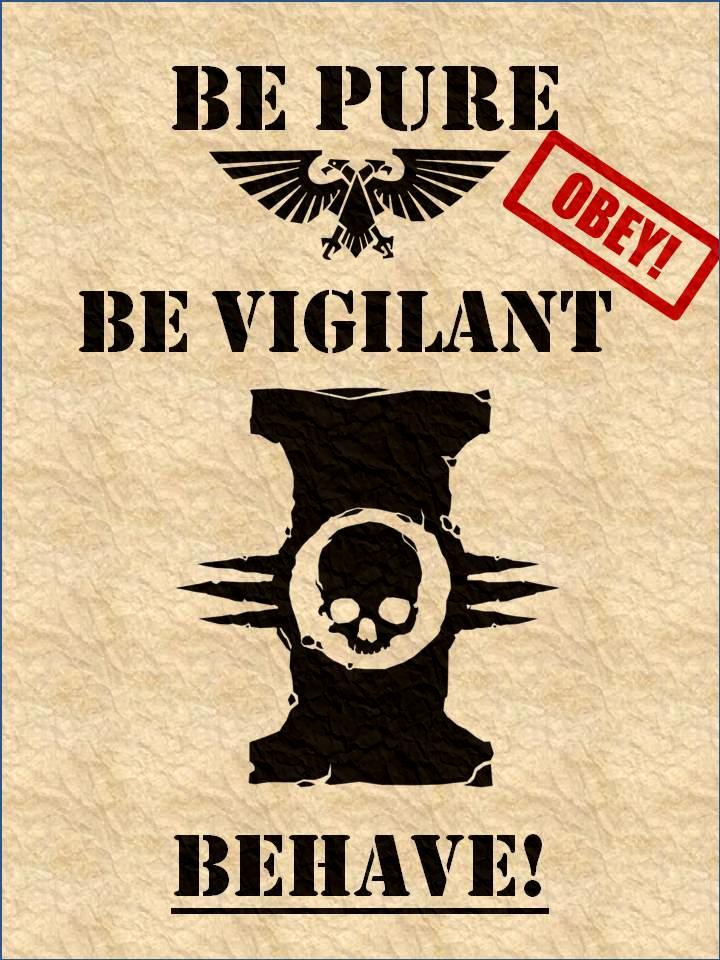
Back to your game, can you share an example of a particularly memorable moment from your campaign?
Lots of epic moments for a campaign that’s only six months old, plenty of acts of heroism and bloody conflict that I could reference here. However, I think the bright spots in this violent, grim saga are the personal exchanges between the Inquisition Pact members. The intro session for Roland (The Navis Imperialis Pilot) and Smasha (Militarum Ogryn) cemented their dynamic and it led to some great roleplaying. In the Calamitous Intent session this plays out with the Ogryn’s massive bulk and clumsiness enraging an entire bar full of patrons, effectively chasing him with torch and pitchfork. A few blocks of pursuit later the noble-born Pilot puts himself between the Ogryn and the crowd and has to use every trick up his sleeve (charm, bribery, his Navis uniform) to calm them. There’s a sense of obligation between Roland and Smasha, just the prior session Smasha had put himself between Roland and the blades and lasers of cultists.
Let’s round this out with one of our favorite questions for our featured GMs! If you had a secret sauce for running a great game, what would be the most important ingredients?
1. Don’t over-prepare. Set up the big detail points, but let the players choose how they get there. They’ll almost always surprise you.
2. When you’re getting started, don’t fall in love with your NPCs. Put out a large amount of them initially, and see which ones that players gravitate towards. I’ve had so many throwaway NPCs that wound up being central to the story because they meshed so well with the troupe.
3. Critical successes can lead to epic moments. So can critical failures. On both sides of the table! Make the most of these opportunities to engage the table and make memories.
Thank you to the community for making this campaign of the month possible! That’s all for now, join us on our next adventure November 1st, and don’t forget to nominate your favorite campaigns for our next Campaign of the Month!
Obsidian Portal Campaign of the Month September 2024: Echo of The Mists

Travel into this dark fantasy world – tune into the dedication of carefully crafted set up designs and story telling, by joining us in talking with shawnrstaub, the GM behind Echo of The Mists, the winner of our Campaign of the Month for September 2024!

First off, feel free to tell us about the person behind the GM screen. Where are you from? What do you do aside from gaming? Alter Egos? Life partners? Family?
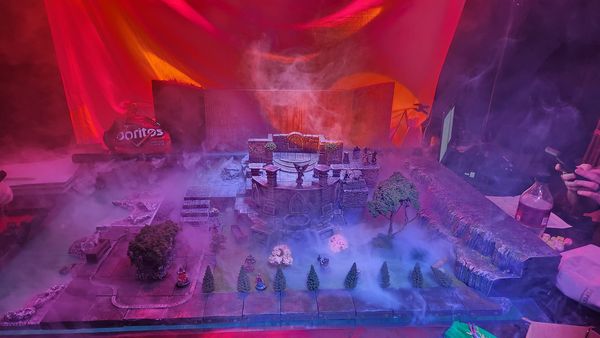
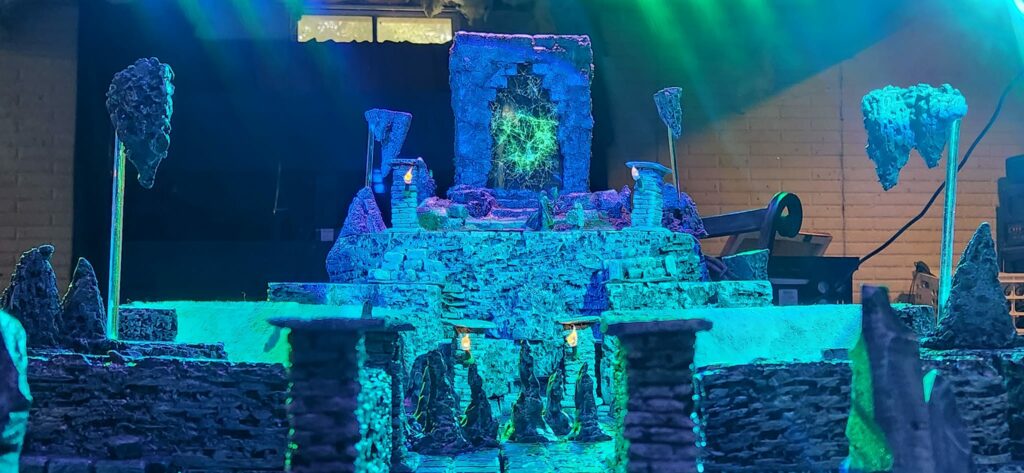
Answer: Where can we interact with you on the internet? I am originally from West Virginia until my wife and I moved to Maryland for work and to start our family. My wife teaches 2nd grade and I work as a branch manager at a bank. Before COVID, I played bass in a heavy metal band themed around the “Legend of Zelda” game series called “Master Sword,” touring around the country playing the nerdy convention circuits. I retired from that life after my oldest daughter was diagnosed with cancer, which I’m happy to report, she has made a full recovery and started 2nd grade today at the school my wife teaches. Now, I spend my free time with my family and building terrain for my D&D games as well as 3D resin printing.
How regularly do you play, and where do you play? Tell us about your current group of players.
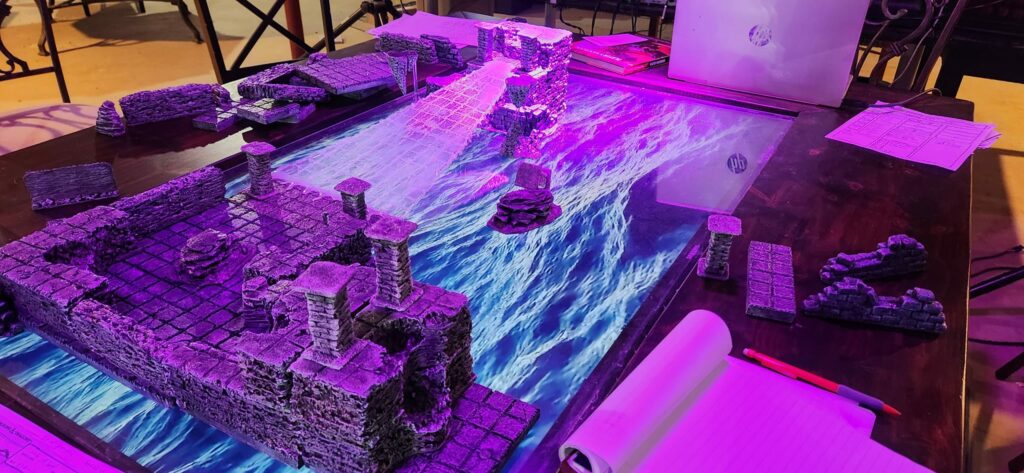
Answer: My D&D group is actually a really great story. I only started playing D&D around 2021/2022 when I was invited as a player to a game hosted by my former band mate and her husband and two other couples (sadly, my wife has no interest in TTRPGs). I’ve always enjoyed building and creating cool nerdy things (in my Zelda band, I learned how do leather working so we could wear custom armor on stage). So for that group, I built a custom gaming table with a 55′ TV screen in the center so we could use digital maps – this was before I started building 3D terrain.
After posting pictures of my gaming table, I was messaged by two separate Fraternity Brothers that I’ve not spoken with in nearly a decade telling me how much they liked my table. They shared with me that they had never played D&D, but never had a group or the confidence to try it out. So I reached out to 2 other Fraternity brothers who I knew played, and the five of us started a game with myself in the position of DM! What started out as a Ravenloft one shot turned into an full-blown campaign that continues to this day. Life is busy, however, so we only get to play once or twice a month, alternating between in person and digital games depending on everyone’s availability.
Tell us about “Echo of the Mists” in a nutshell. How did you design the campaign? What was your inspiration?
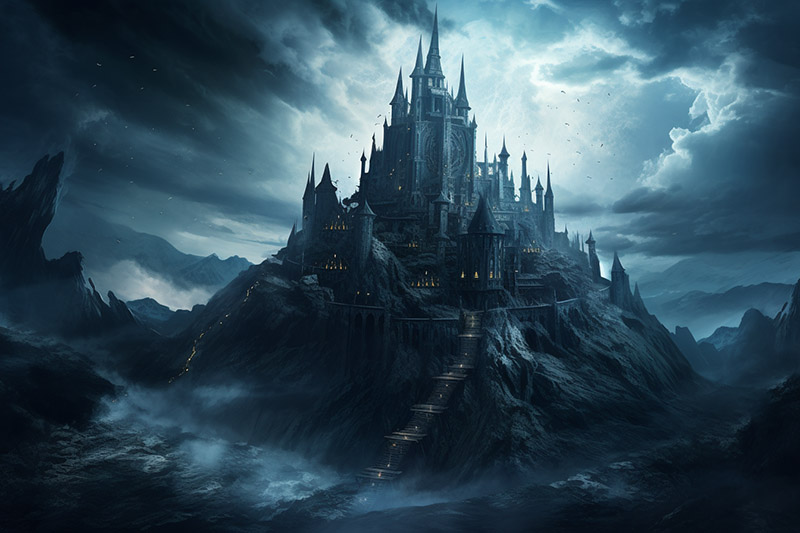
Answer: Echo of the Mists is a homebrew campaign based in the Ravenloft setting combining classic Ravenloft lore, 5e lore, or homebrew content (whatever speaks to me or works in the moment). Although it has yet to be revealed to my players, they will eventually learn that an “echo” refers to the manifestations of specific, powerful entities that exist throughout the multiverse of D&D as “variants” of those entities. One such entity has unwillingly trapped itself within the cage of Ravenloft and is using its power to draw in (and devour) its own echoes in an effort to gain more power and escape.
Why did you choose Ravenloft as the setting for your campaign? How does the setting complement your plot?
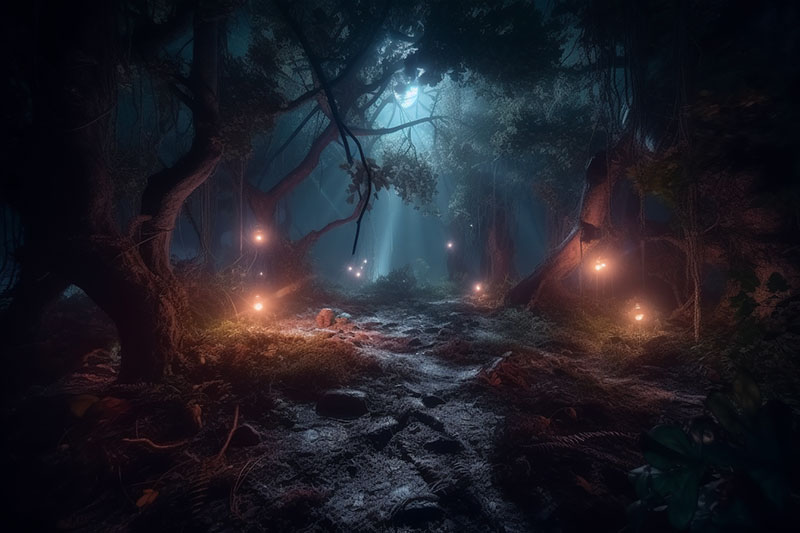
Answer: I love vampires, werewolves, ghosts, and all things spooky, so Ravenloft was a natural choice. Admittedly, our game is more “dark fantasy” than “horror,” but it still allows for me to explore dark themes and spooky stories.
Your wiki section details a lot of domains, but some don’t have a wiki page. Do you add the details of these domains as the players move from one domain to another?
Answer: There are A LOT of Domains in Ravenloft – too many for me to possibly develop between my family life, work, and creating terrain, painting minis, and creating content. So I develop the world as the players move through it and help guide what needs to be developed and what doesn’t. I also love having my players contribute to the world, so whenever I can, I have them make decisions about the world and characters within it. For example, there are times I’ll ask my players to create features in the world like a family estate or a describe the people from their past. I’ll take their ideas and integrate them into the stories, scenes, and settings that they will explore.
Dungeons & Dragons 5th edition has relatively few Ravenloft books. Are you using any materials from previous editions for your domains?
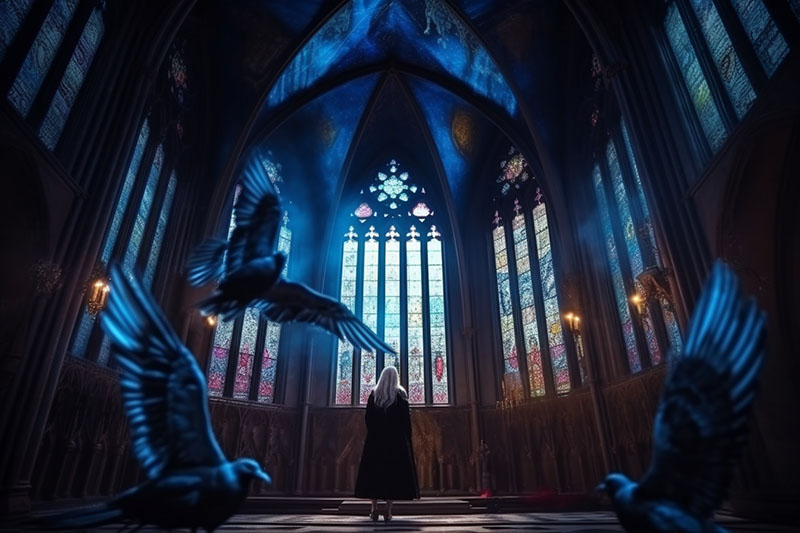
Answer: Oh yes, the older lore has lots of great content. I routinely incorporate “canon” material into my game, but love to fill in the gaps with my own homebrew. I’ll even try and marry the old and new lore on occasion. For example, in 5e they gender bend the ruler of Falkovnia – Vlad Drakov – into Vladeska Drakov. In my game, Valdeska is the daughter of the original Dark Lord who has systematically butchered her many, many siblings to take the reigns of power as the undisputed ruler of the land.
How much time is usually spent preparing your game sessions? Describe a typical session.
Answer: Its hard to say how long I prepare because I do it in bite sized chunks after my kids go to bed while I’m watching Netflix with the wife! I’ll write it little notes and ideas to myself and come back to it later. As any DM knows, some content you make gets completely bypassed by players, but I’ll often “recycle” that content. The old catacombs that the players never explored becomes and underground fortress of a necromancer of laboratory to a mad scientist. I’ve learned that if you “save it for later,” later never comes!
How long have you been using Obsidian Portal? What brought you to the site and what keeps bringing you back?
Answer: I think I started in 2022 as a way to store my ideas and content. I would never be able to remember everything, so having a man repository that is organized the way I like it is super helpful. I’m 99% sure my players don’t even use this wiki, but it sure is helpful for me to keep my world straight and organized.
If you had to pick just one thing, what would you say Obsidian Portal helps you with the most?
Answer: Organization for sure. Visuals help me remember things far better than names and texts, so having things arranged exactly the way that makes sense to me is very helpful.
What would you say is the biggest highlight of your game so far (please also provide images and links if possible)?
Answer: Anytime I can get the reaction of “I REALLY hate that guy” from my players regarding an antagonist feels like an absolute victory to me. Also, when my players geek-out over my table setups, it makes all the work I put into them worth it.
Okay, as a last question, we always ask for the GM’s “pearls of wisdom”. What GM insights can you offer the community this month?
The game and story are better if you don’t stubbornly cling to what you think SHOULD happen, but instead let the story naturally progress. The classic saying is that no story survives the encounter with the players, so let that inspire you. I often will come at a setting with the mentality of “what would happen if the players did NOT intervene?” Then, I use the choices the players make inform what DOES happen, and more often than not, its unexpected and better than what I would have planned. I love not knowing what will happen, so every session is exciting and rewarding for everyone at the table.
Thank you to the community for making this campaign of the month possible! That’s all for now, join us on our next adventure September 1st, and don’t forget to nominate your favorite campaigns for our next Campaign of the Month!